#ArtificialIntelligence #AI #GithHubCopilot #SSMS #SQLServer #TSQL
https://learn.microsoft.com/en-us/ssms/github-copilot/database-instructions?wt.mc_id=DP-MVP-4015656
TSQL Problem:
Let's say you've got one or more scalar values that are VARCHAR 'strings' and you want to determine if they can be typed more appropriately.
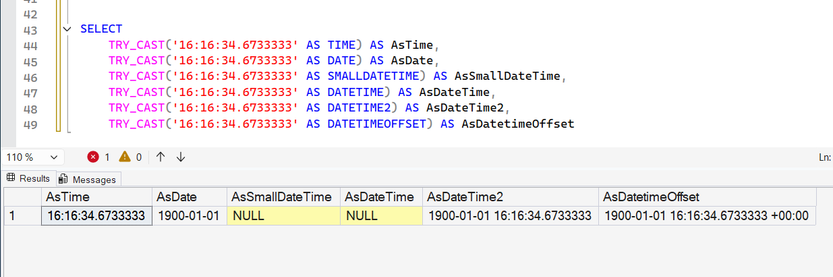
For example '16:16:34.6733333' is data type TIME. It's easy to examine the value manually to make that determination. But how would you do it programatically (via TSQL)?
I've tried casting the VARCHAR as different types. TRY_CAST is successful for some data types. How would I know which one is 'right'?
Строковые константы в MS SQL
Строковые константы в MS SQL кажутся очень простыми в использовании. Но эта простота не всегда очевидна и порой приводит к тяжело выявляемым ошибкам в коде. По этой причине данная статья может оказаться полезной не только новичкам, но и тем, кто уже использует T-SQL в своей работе. Документация явно описывает два типа констант: обычные строковые и юникодные. Но на самом деле ситуация несколько сложнее, что и будет рассмотрено ниже.
OPENROWSET and External Tables for Fabric SQL Databases
#SQL #SQLDatabase #MicrosoftFabric #DataVirtualization #Analytics #TSQL #OneLake

Data Virtualization (Preview) for Fabric SQL Databases, enable you to query, analyze, and ingest OneLake data (CSV, Parquet, JSON) without moving or duplicating it. Data Virtualization brings to Fabric SQL Database the same set of capabilities already available on Azure SQL Database, Azure SQL Managed Instance and SQL Server, customers can now use OPENROWSET and … <p class="link-more"><a href="https://blog.fabric.microsoft.com/en-us/blog/openrowset-and-external-tables-for-fabric-sql-databases/" class="more-link">Continue reading<span class="screen-reader-text"> “OPENROWSET and External Tables for Fabric SQL Databases (Preview)”</span></a>
#TodayILearned about table-valued scalar functions in Microsoft #TSql and why I should care.
These can be used in a view. If you need to run a procedure to calculate parts of the output, but use a middleware that is incapable of calling functions directly, scalar functions are your next best bet.
If they return their value as a table, you can "join" them to the main rowset in the view using the operations "cross apply" (which behaves like inner join) and "outer apply" (like outer join).
Dear Santa,
I wish for a IT remote job, so I can stop ruining my body as a laborer.
Thx a million
Yours Derek
Merry christmas to you all
#merrychristmas #santaclaus #remotejob #itjobs #msaccess #linux #vbnet #tsql #lowcode #noai
Fabric Data Warehouse (DW) supports ACID-compliant transactions using standard T-SQL (BEGIN TRANSACTION, COMMIT, ROLLBACK) and uses Snapshot Isolation (SI) as its exclusive concurrency control model. All operations within a transaction are treated atomically—either all succeed or all fail. This ensures that each transaction operates on a consistent snapshot of the data as it existed at … <p class="link-more"><a href="https://blog.fabric.microsoft.com/en-us/blog/concurrency-control-and-conflict-resolution-in-microsoft-fabric-data-warehouse/" class="more-link">Continue reading<span class="screen-reader-text"> “Resolving Write Conflicts in Microsoft Fabric Data Warehouse”</span></a>