Undefined terrain (2010)

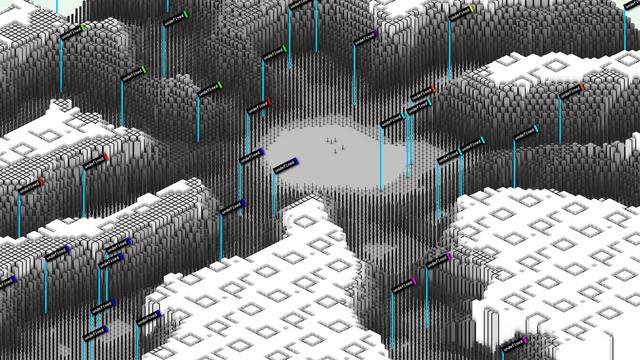
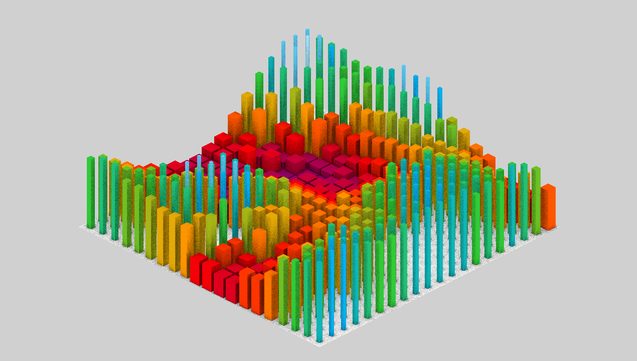
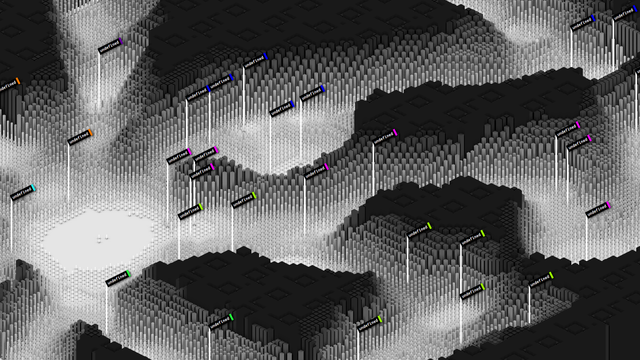
Early research sketches for an experimental, mapping/GIS-inspired UI prototype. The idea was to place different content pieces on an initially empty flat surface and then use traffic/access patterns to erode the space around each item, slowly forming a 2.5D terrain of valleys/canyons visualizing/revealing navigational usage patterns and creating a vast navigable space. My initial prototype (shown here) was for the terrain to be constructed from a pre-rendered set of isometric tiles with pre-baked ambient occlusion shadow maps (for which I wrote a custom AO renderer in Java). The thousands of tiles were loaded as a single PNG sprite sheet for in-browser canvas drawing (this was before WebGL)... Terrain erosion simulation was done dynamically via my toxiclibs simutils library (which I partially ported to JavaScript)...

(Later on I built a cloud-based tool to create better simulations, use #Sunflow with custom extensions to pre-render daily super high-resolution maps, slice results into thousands of map tiles/zoom levels and then use Google Maps API with a custom map layer to create the UI. Sadly the entire project was cancelled just before launch...

#Vintage #UI #Prototype #Mapping #Isometric #AmbientOcclusion #Renderer
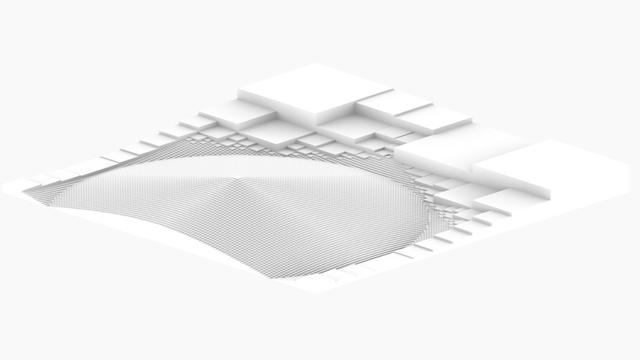
Been getting several DMs about the #GenerativeArt banner image in my profile. It's an old render (from 2010) of a recursive #Voronoi projected into a #Quadtree. This video shows the interplay of 2 conceptual hierarchies:

1) Verlet particles with attractive/repulsive force fields are spawned in a squared 2d space and negotiate their positions over time. These positions are also used as sites for creating a dynamic Voronoi diagram to define cell structures around each particle. Each resulting Voronoi region can then become the physical (and constantly changing) bounds for the next level of recursion, spawning more particles to subdivide it into smaller regions. Each cell at each level is using its own Voronoi instance with sub-regions clipped to their respective parent region. The process becomes more and more local... The setup in the video has a maximum tree depth of 3.

2) A quadtree is used to visualize the hierarchy of cells from phase 1 and its depth structure represented as extruded 3D model (in isometric perspective). For this video the quadtree has a depth of 10 levels with the maximum level of recursion tracing/coinciding with the Voronoi cell edges. The elevation of cell walls depends on the depth of the cell in the original tree, with the cells at deepest level resulting in the tallest structures. Furthermore, the elevation is modulated by the distance of each point to the nearest vertex of its parent cell polygon/region...

#Toxiclibs #Sunflow #GenerativeDesign #Architecture

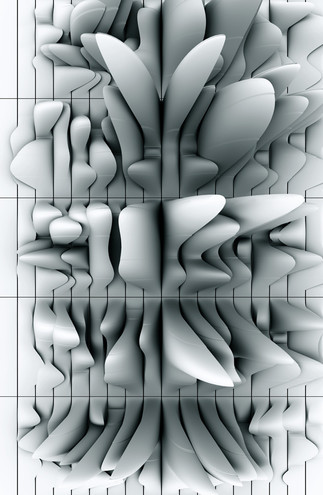
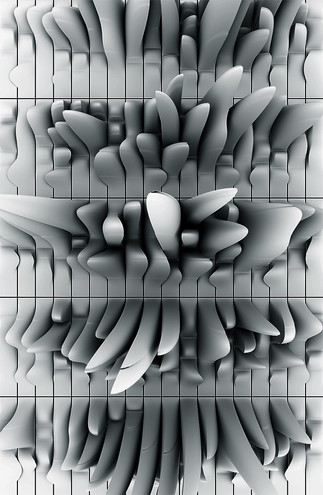
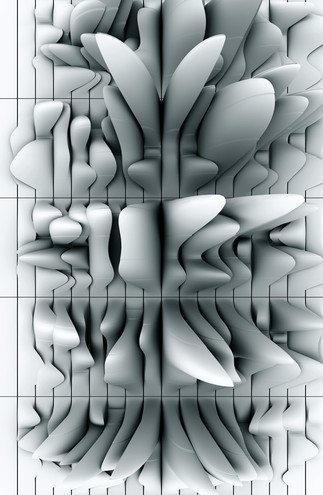
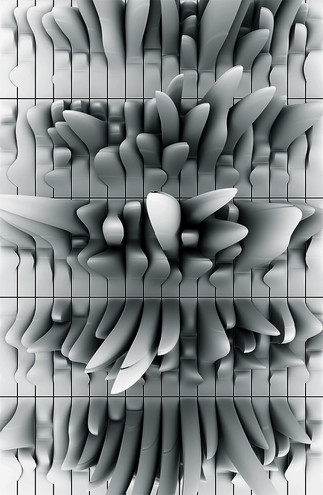
Working on my talk in a Milan hotel, sifting through previous work incl. these hi-res renders of high energy deformations created w/ #toxiclibs & #Sunflow for Today's Art festival, The Hague, 2008