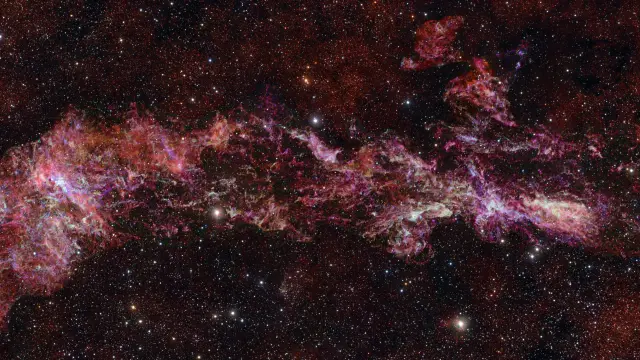
ALMA Maps Cold Gas Filaments in the Milky Way’s Central Region

📰 Original title: ALMA captures the most detailed image ever of the Milky Way’s turbulent core

🤖 IA: It's not clickbait ✅
👥 Usuarios: It's not clickbait ✅

View full AI summary: https://killbait.com/en/alma-maps-cold-gas-filaments-in-the-milky-ways-central-region/?redirpost=da9e1515-6cc9-4779-85aa-f5b086b4501c

#astronomy #milkyway #alma #starformation

ALMA Maps Cold Gas Filaments in the Milky Way’s Central Region

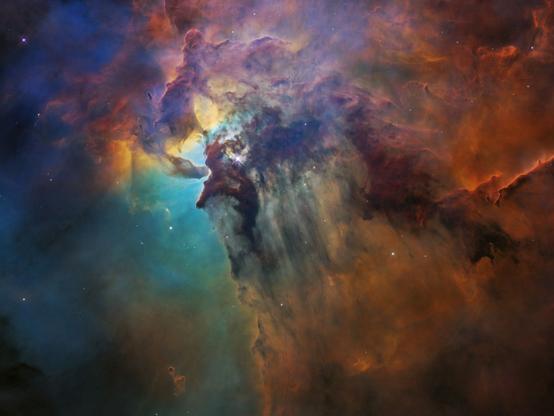
Astronomers using the Atacama Large Millimeter/submillimeter Array (ALMA) have created the most detailed image yet of the Milky Way’s central region, known as the Central Molecular Zone (CMZ).

KillBait Archive

James Webb Telescope Discovers Distant Jellyfish Galaxy with Star Formation

📰 Original title: James Webb spots a galaxy with tentacles in deep space

🤖 IA: It's not clickbait ✅
👥 Usuarios: It's not clickbait ✅

View full AI summary: https://killbait.com/en/james-webb-telescope-discovers-distant-jellyfish-galaxy-with-star-formation/?redirpost=af50d0a1-7360-45ad-bb7d-b25a804f8abb

#astronomy #jellyfishgalaxy #jwst #starformation

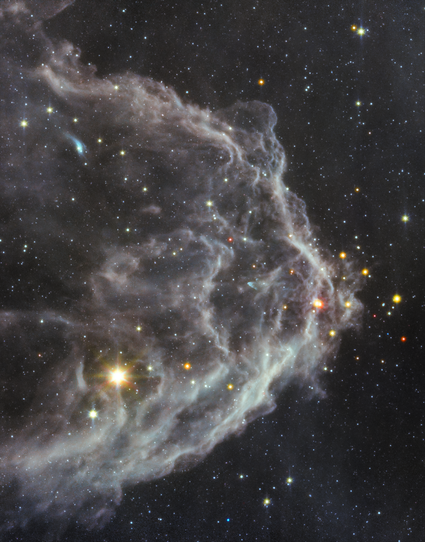
James Webb Telescope Discovers Distant Jellyfish Galaxy with Star Formation

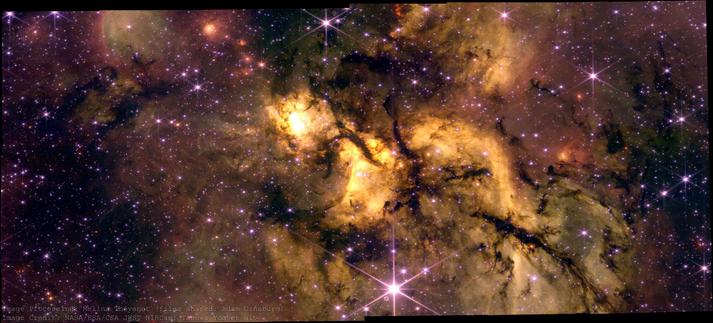
Astronomers using the James Webb Space Telescope (JWST) have identified the most distant jellyfish galaxy ever observed. This galaxy, located 8.5 billion light-years away, exhibits long…

KillBait Archive

Weekly Update from the Open Journal of Astrophysics – 07/02/2026

It’s Saturday once more so time for another update of activity at the Open Journal of Astrophysics. Since the last update we have published a further six papers, bringing the number in Volume 9 (2026) to 24 and the total so far published by OJAp up to 472.

I will continue to include the posts made on our Mastodon account (on Fediscience) to encourage you to visit it. Mastodon is a really excellent service, and a more than adequate replacement for X/Twitter which nobody should be using; these announcement also show the DOI for each paper.

The first paper to report this week is “The Impact of Star Formation and Feedback Recipes on the Stellar Mass and Interstellar Medium of High-Redshift Galaxies” by Harley Katz (U. Chicago, USA), Martin P. Rey (U. Oxford, UK), Corentin Cadiou (Lund U., Sweden) Taysun Kimm (Yonsei U., Korea) and Oscar Agertz (Lund). This paper was published on Monday 2nd February 2026 in the folder Astrophysics of Galaxies. It introduces MEGATRON, a new model for galaxy formation simulations, highlighting that feedback energy controls star formation at high redshift and highlighting the importance of the interstellar medium.

The overlay is here:

You can find the officially accepted version on arXiv here and the announcement on Fediverse here:

https://fediscience.org/@OJ_Astro/116000695648050758

The second paper is “Photometric Redshifts in JWST Deep Fields: A Pixel-Based Alternative with DeepDISC” by Grant Merz (U. Illinois at Urbana-Champaign) and 6 others, all based in the USA. This paper was published on Monday February 2nd 2026 in the folder Instrumentation and Methods for Astrophysics. This paper explores the effectiveness of the DeepDISC machine learning algorithm in estimating photometric redshifts from near-infrared data, demonstrating its potential for larger image volumes and spectroscopic samples

The overlay for this one is here:

The official version of the paper can be found on arXiv here and the Fediverse announcement here:

https://fediscience.org/@OJ_Astro/116000777572439111

Next, published on Wednesday 4th February in the folder Astrophysics of Galaxies, is “Inferring Interstellar Medium Density, Temperature, and Metallicity from Turbulent H II Regions” by Larrance Xing (U. Chicago, USA), Nicholas Choustikov (U. Oxford, UK), Harley Katz (U. Chicago) and Alex J. Cameron (DAWN, Denmark). This paper argues that supersonic turbulenc affects the interpretation of H II region properties, potentially impacting inferred metallicity, ionization, and excitation from in nebular emission lines, motivating more extensive modelling.

The overlay is here:

The official version can be found on arXiv here and the Fediverse announcement is here:

https://fediscience.org/@OJ_Astro/116011384659092223

The fourth paper this week, also published on Wednesday 4th February, but in the folder Solar and Stellar Astrophysics, is “A Systematic Search for Big Dippers in ASAS-SN” by B. JoHantgen, D. M. Rowan, R. Forés-Toribio, C. S. Kochanek, & K. Z. Stanek (Ohio State University, USA), B. J. Shappee (U. Hawaii, USA), Subo Dong (Peking University), J. L. Prieto Universidad Diego Portales, Chile) and Todd A. Thompson (Ohio State). This study identifies 4 new dipper stars and 15 long-period eclipsing binary candidates using ASAS-SN light curves and multi-wavelength data, categorizing them based on their characteristics.

Here is the overlay:

The official version can be found on arXiv here and the Fediverse announcement is here:

https://fediscience.org/@OJ_Astro/116011460612040834

Fifth, and next to last this week we have “Unveiling the drivers of the Baryon Cycles with Interpretable Multi-step Machine Learning and Simulations” by Mst Shamima Khanom, Benjamin W. Keller and Javier Ignacio Saavedra Moreno (U. Memphis, USA). This paper was published on Thursday 5th February 2026 in the folder Astrophysics of Galaxies. This study uses machine learning methods to understand how galaxies lose or retain baryons, highlighting the relationship between baryon fraction and various galactic measurements.

The overlay is here:

The accepted version can be found on arXiv here, and the fediverse announcement is here:

https://fediscience.org/@OJ_Astro/116016883984380622

Finally for this week we have “The Bispectrum of Intrinsic Alignments: II. Precision Comparison Against Dark Matter Simulations” by Thomas Bakx (Utrecht U., Netherlands), Toshiki Kurita (MPA Garching, Germany), Alexander Eggemeier (U. Bonn, Germany), Nora Elisa Chisari (Utrecht) and Zvonimir Vlah (Ruđer Bošković Institute, Croatia). This paper was accepted in December, but publication got delayed by the Christmas effect so was published on February 6th 2026, in the folder Cosmology and Nongalactic Astrophysics. This study uses N-body simulations to accurately measure three-dimensional bispectra of halo intrinsic alignments and dark matter overdensities, providing a method to determine higher order shape bias parameters.

The overlay is here:

You can find the published version of the article here, and the Mastodon announcement is here:

https://fediscience.org/@OJ_Astro/116022562915557971

And that concludes this week’s update. I will do another next Saturday.

#arXiv241107282v2 #arXiv250409744v3 #arXiv250706818v3 #arXiv250719594v2 #arXiv251027032v2 #arXiv260202949v1 #ASASSN #AstridSimulations #AstrophysicsOfGalaxies #bispectrum #CosmologyAndNonGalacticAstrophysics #DEEPDisc #DiamondOpenAccess #DiamondOpenAccessPublishing #dipperStars #galaxyClusters #galaxyFormation #galaxyHaloes #HighEnergyAstrophysicalPhenomena #HIIRegions #InstrumentationAndMethodsForAstrophysics #InterstellarMedium #intrinsicAlignments #JWST #largeScaleStructureOfTheUniverse #MachineLearning #MEGATRON #NebularEmission #OpenAccess #OpenAccessPublishing #OpenJournalOfAstrophysics #PhotometricRedshifts #SolarAndStellarAstrophysics #starFormation #TheOpenJournalOfAstrophysics #Turbulence

Weekly Update from the Open Journal of Astrophysics – 31/01/2026

It’s Saturday once more so time for another update of activity at the Open Journal of Astrophysics. Since the last update we have published a further three papers, bringing the number in Volume 9 (2026) to 18 and the total so far published by OJAp up to 466.

I will continue to include the posts made on our Mastodon account (on Fediscience) to encourage you to visit it. Mastodon is a really excellent service, and a more than adequate replacement for X/Twitter which nobody should be using; these announcement also show the DOI for each paper.

The first paper to report this week is “Probing Stellar Kinematics with the Time-Asymmetric Hanbury Brown and Twiss Effect” by Lucijana Stanic (University of Zurich, Switzerland) and 13 others based in Zurich, Lausanne and Geneva (all in Switzerland). This was published on Monday 26th January 2026 in the folder Instrumentation and Methods for Astrophysics. This research demonstrates that intensity interferometry can reveal internal stellar kinematics, providing a new way to observe stellar dynamics with high time resolution.

The overlay is here:

You can find the officially accepted version on arXiv here and the announcement on Fediverse here:

https://fediscience.org/@OJ_Astro/115961234375736584

The second paper is “DIPLODOCUS I: Framework for the evaluation of relativistic transport equations with continuous forcing and discrete particle interactions” by Christopher N Everett & Garret Cotter (University of Oxford, UK). This was published on Tuesday January 27th 2026 in the folder High-Energy Astrophysical Phenomena. DIPLODOCUS is a new framework for mesoscopic modelling of astrophysical systems, using an integral formulation of relativistic transport equations and a discretisation procedure for particle distributions.

The overlay for this one is here:

The official version of the paper can be found on arXiv here and the Fediverse announcement here:

https://fediscience.org/@OJ_Astro/115966199181415094

Next, also published on Tuesday January 27th but in the folder Cosmology and Nongalactic Astrophysics we have “The Atacama Cosmology Telescope: DR6 Sunyaev-Zel’dovich Selected Galaxy Clusters Catalog” by M. Aguena et al. (101 authors altogether), on behalf of the ACT-DES-HSC Collaboration. This article reports on the discovery of 10,040 galaxy clusters in the Atacama Cosmology Telescope data, including 1,180 clusters at high redshifts, using the Sunyaev-Zel’dovich effect.

The overlay is here:

The official version can be found on arXiv here and the Fediverse announcement is here:

https://fediscience.org/@OJ_Astro/115966458299870033

And finally for this week we have a paper published yesterday, Friday 30th January 2026, in the folder Astrophysics of Galaxies. This is the paper I blogged about yesterday: “A Cosmic Miracle: A Remarkably Luminous Galaxy at zspec = 14.44 Confirmed with JWST” by Rohan Naidu (MIT Kavli Institute) and an international cast of 45 others. This article reports on the discovery by the James Webb Space Telescope (JWST) of a bright galaxy, MoM-z14, located 280 million years post-Big Bang, that challenges models of galaxy formation and the star-formation history of early galaxies.

The overlay is here:

The accepted version can be found on arXiv here, and the fediverse announcement is here:

https://fediscience.org/@OJ_Astro/115982837486159819

And that concludes the update for this week. I will do another next Saturday.

#ACTDESHSCCollaboration #arXiv250511263v2 #arXiv250721459v3 #arXiv250813296v4 #arXiv250913152v2 #AstridSimulations #AstrophysicsOfGalaxies #CosmologyAndNonGalacticAstrophysics #DiamondOpenAccess #DiamondOpenAccessPublishing #DIPLODOCUS #galaxyClusters #galaxyFormation #HanburyBrownAndTwiss #HighEnergyAstrophysicalPhenomena #InstrumentationAndMethodsForAstrophysics #JWST #largeScaleStructureOfTheUniverse #MoMZ14 #OpenAccess #OpenAccessPublishing #OpenJournalOfAstrophysics #PlasmaPhysics #relativisticTransportEquations #starFormation #StellarKinematics #SunyaevZeDovichEffect #TheOpenJournalOfAstrophysics

⭐ Every star that lights the night once faced an impossible challenge: transforming from a cold, dark cloud into nuclear fire. The universe demands precise conditions most clouds never achieve.

✍️ Discover what separates failed attempts from blazing success 🌟: https://TPC8.short.gy/WeAxAQoa

🌌 In cosmic depths, gravity whispers secrets of stellar birth

#Astrophysics #StarFormation #StellarEvolution #Astronomy #SciComm #Physics #Space #TPC8

The Cosmic Recipe: Understanding the Physical Criteria for Star Formation 🌟

Discover the 4 essential criteria for star formation: mass, temperature, pressure & hydrogen. Learn how stars are born from cosmic dust clouds.

The Life Cycle of Stars: From Nebulae to Stellar evolution

Stellar evolution | The Cosmic Engines: Why Stars Define the Universe

Stars are not just twinkling points of light in the night sky; they are the fundamental engines of the cosmos. The study of stellar evolution—the process by which a star changes over its lifetime—is central to astronomy because stars govern the structure, chemistry, and very habitability of the universe. Every star follows a predictable life cycle dictated by a single, simple property: its initial mass. A star’s mass determines its internal temperature, its luminosity, its lifetime, and its ultimate, often violent, fate. The narrative of stellar evolution is a story of constant battle between two opposing forces: gravity, which seeks to crush the star inward, and the pressure from nuclear fusion in its core, which pushes outward. For the vast majority of a star’s life, these forces are in a stable balance, but this equilibrium cannot last forever. As a star exhausts its nuclear fuel, gravity gains the upper hand, leading to a series of dramatic transformations that seed the galaxy with heavy elements, trigger the formation of new stars, and leave behind exotic remnants like black holes and neutron stars. Understanding stellar evolution explains the origin of every atom in our bodies (we are literally “star stuff,” as Carl Sagan famously said), the light that illuminates planets, and the explosive events that shape galaxies. From the majestic pillars of star-forming nebulae to the eerie glow of supernova remnants, the life cycle of stars is the grand narrative that connects the birth of the universe in the Big Bang to the existence of life on Earth.

The story begins in the cold, dark clouds of gas and dust scattered throughout galaxies, known as nebulae or molecular clouds. Regions like the Orion Nebula are stellar nurseries. Within these clouds, local pockets can become gravitationally unstable, often triggered by a shockwave from a nearby supernova or the collision of gas clouds. As such a pocket collapses under its own gravity, it spins faster and flattens into a protostellar disk. The central ball of gas, the protostar, heats up as it contracts. When the core temperature reaches about 10 million Kelvin, a nuclear fusion reaction ignites: hydrogen nuclei (protons) fuse to form helium, releasing enormous amounts of energy. This is the moment a star is truly born, joining the main sequence—the long, stable adult phase of its life where it will spend about 90% of its existence. On the main sequence, a star’s position is fixed by its mass. Massive, hot, blue stars are luminous but short-lived, burning out in just a few million years. Low-mass, cooler, red stars are frugal with their fuel and can shine for trillions of years. Our Sun, a medium-mass, yellow dwarf star, has a main sequence lifetime of about 10 billion years; it is currently middle-aged, about 4.6 billion years old. During this stable phase, the star is in hydrostatic equilibrium, with outward pressure from fusion perfectly balancing inward gravitational pressure. But the hydrogen fuel in the core is finite. When it is nearly exhausted, the balance is broken, and the star embarks on the final, often tumultuous, chapters of its life. The specific path it takes—whether it ends as a gentle ember or a catastrophic explosion—depends entirely on the mass it was born with, making stellar evolution one of the most elegant and predictive theories in all of astrophysics.

The Main Sequence and Beyond: Paths Diverge by Mass

A star’s fate is a function of its birth mass:

  • Low-Mass Stars (like our Sun): After hydrogen fusion ends in the core, the core contracts and heats up, causing the outer layers to expand and cool, turning the star into a red giant. The hot, compressed core eventually becomes hot enough (100 million K) to fuse helium into carbon and oxygen. In stars like the Sun, this helium fusion is unstable and occurs in a sudden flash. Eventually, the star cannot fuse carbon, and its outer layers are gently ejected into space, forming a beautiful planetary nebula. The exposed, hot core—now a white dwarf—is left behind. A white dwarf is an Earth-sized, incredibly dense remnant made of carbon and oxygen, supported against gravity by quantum mechanical pressure (electron degeneracy pressure). It will slowly cool over billions of years to become a black dwarf.
  • High-Mass Stars (More than ~8 Solar Masses): These stars live fast and die young. They progress through successive stages of nuclear fusion in their layered cores: hydrogen to helium, helium to carbon, carbon to neon, oxygen, and silicon, and finally silicon to iron. Iron fusion does not release energy; it consumes it, so an iron core builds up. When the iron core becomes too massive (about 1.4 solar masses, the Chandrasekhar limit), electron degeneracy pressure can no longer support it. The core catastrophically collapses in less than a second. The implosion rebounds in a titanic supernova explosion (Type II or core-collapse supernova), outshining an entire galaxy for a brief period. This explosion forges elements heavier than iron and blasts them into space, enriching the interstellar medium for future generations of stars and planets.

The Exotic Endpoints: Neutron Stars and Black Holes

The collapsed core left behind after a supernova is itself a star of extreme physics.

  • Neutron Stars: If the collapsing core is between about 1.4 and 3 solar masses, it crushes protons and electrons together to form neutrons, creating a city-sized object so dense that a teaspoon of its material would weigh billions of tons. It is supported by neutron degeneracy pressure. Neutron stars often have incredibly strong magnetic fields and spin rapidly, emitting beams of radiation; those detected as pulsed radio signals are called pulsars.
  • Black Holes: If the collapsing core exceeds about 3 solar masses, no known force can stop the collapse. Gravity wins completely, crushing the matter into an infinitely dense point—a singularity—surrounded by an event horizon from which not even light can escape. This is the formation path for many stellar-mass black holes.

The Cycle of Cosmic Rebirth

The death of stars is not an end, but a vital part of a grand cycle. The material expelled by red giantsplanetary nebulae, and supernovae—now enriched with heavy elements like carbon, oxygen, silicon, and iron—mixes back into the interstellar medium. This enriched gas collapses to form new stars, but now of a later generation that contain the elements necessary to form rocky planets and the chemistry of life. Our Sun, Earth, and everything on it are products of this recycling process that occurred over multiple stellar lifetimes. The study of stellar evolution thus connects us directly to the cosmos, revealing that we are not merely observers of the universe, but active participants in an ongoing cosmic story of birth, death, and rebirth that plays out on a galactic scale.

👉 Share your thoughts in the comments, and explore more insights on our Journal and Magazine. Please consider becoming a subscriber, thank you: https://borealtimes.org/subscriptions – Follow The Dunasteia News on social media. Join the Oslo Meet by connecting experiences and uniting solutions: https://oslomeet.org

References

  • Carroll, B.W., & Ostlie, D.A. (2017). An Introduction to Modern Astrophysics (2nd ed.). Cambridge University Press. (Comprehensive chapter on stellar evolution).
  • NASA. (n.d.). Starshttps://science.nasa.gov/astrophysics/focus-areas/how-do-stars-form-and-evolve/
  • Chandra X-ray Observatory. (n.d.). Supernovas and Remnantshttps://chandra.harvard.edu/xray_sources/supernovas.html
  • LIGO Scientific Collaboration. (n.d.). Neutron Starshttps://www.ligo.org/science/GW-NeutronStars.php
  • Hubble Space Telescope. (n.d.). Planetary Nebulae Galleryhttps://hubblesite.org/contents/media/images/2005/27/1778-Image.html
  • #mainSequence #neutronStar #starFormation #stellarEvolution #supernova
    Extreme burst of star formation lights up the Milky Way - Earth.com
    Today’s Image of the Day from the European Space Agency features a busy scene inside NGC 3603, a star-forming region packed with energy....
    #photography #SpacePhotography #galaxies #stars #starformation #milkyway #EuropeanSpaceAgency #space #universe
    https://www.earth.com/image/million-year-old-starburst-shines-with-extreme-stellar-activity/
    Extreme burst of star formation lights up the Milky Way

    Today's Image of the Day from the European Space Agency features a bright, bustling scene inside the young star cluster NGC 3603.

    Earth.com
    Hubble révèle N159 comme un chaos de gaz et étoiles en pleine danse cosmique, façonnant la naissance de nouvelles étoiles. https://www.vietnam.vn/fr/buc-anh-tuan-cua-esa-hubble-can-canh-su-tuong-tac-phuc-tap-ben-trong-tinh-van-n159 #Space #Science #Innovation #Astrophysics #StarFormation #Hubble #CosmicWonders

    Weekly Update from the Open Journal of Astrophysics – 20/12/2025

    Christmas is coming, but it’s still time for the usual update of the week’s new papers at the Open Journal of Astrophysics. Since the last update we have published two more regular papers, described below, which brings the number in Volume 8 (2025) up to 197, as well as the 12 papers in yesterday’s Supplement, and the total published for the year up to 209, and the total so far published by OJAp up to 444.

    Please note that we will be pausing publishing activity from 24th December 2025 until Monday 5th January 2026. Submissions will remain open, but no more papers will be published in Volume 8 (2025) after Christmas Eve. We will resume in the New Year with Volume 9.

    Now for this week’s update. Since I blogged about the contents of the Supplement yesterday I won’t repeat them here and will instead just include the two regular papers.

    The first regular paper this week is “Optimal intrinsic alignment estimators in the presence of redshift-space distortions” by Claire Lamman (Harvard-Smithsonian CfA, USA), Jonathan Blazek (Ohio State U., USA) and Daniel J. Eisenstein (Northeastern U., USA). This was published on Monday December 15th 2025 in the folder  Cosmology and Nongalactic Astrophysics. The authors present estimators for quantifying intrinsic alignments in large spectroscopic surveys intended to inprove the constraints they provide for weak gravitational lensing and other cosmological applications.

    The overlay is here:

    You can find the officially accepted version on arXiv here and this is the announcement on Mastodon (Fediscience):

    Open Journal of Astrophysics

    @[email protected]

    New Publication at the Open Journal of Astrophysics: "Optimal intrinsic alignment estimators in the presence of redshift-space distortions" by Claire Lamman (Harvard-Smithsonian CfA), Jonathan Blazek (Ohio State U.) and Daniel J. Eisenstein (Northeastern U.); all based in the USA

    https://doi.org/10.33232/001c.154373

    December 15, 2025, 8:57 am 1 boosts 0 favorites

    The second regular paper of the week is “What is the contribution of gravitational infall on the mass assembly of star-forming clouds? A case study in a numerical simulation of the interstellar medium” by Noé Brucy (Universite Claude Bernard Lyon 1, France), Enrique Vázquez-Semadeni (Universidad Nacional Autónoma de México, Mexico), Tine Colman (Universite Claude Bernard Lyon 1, France), Jérémy Fensch (Universite Claude Bernard Lyon 1, France) and Ralf S. Klessen (Universität Heidelberg, Germany). This was published in the folder Astrophysics of Galaxies on Friday 19th December 2025. This paper describes research using numerical simulations to quantify how much of the mass inflow into a star-forming cloud is driven by the self-gravity of the gas and the gravity from the stellar disk.

    The overlay is here:

    You can find the official version of this one on arXiv here. The federated announcement on Mastodon is here:

    Open Journal of Astrophysics

    @[email protected]

    New Publication at the Open Journal of Astrophysics: "What is the contribution of gravitational infall on the mass assembly of star-forming clouds? A case study in a numerical simulation of the interstellar medium" by Noé Brucy (Universite Claude Bernard Lyon 1, France), Enrique Vázquez-Semadeni (Universidad Nacional Autónoma de México, Mexico), Tine Colman (Lyon), Jérémy Fensch (Lyon) and Ralf S. Klessen (Universität Heidelberg, Germany)

    https://doi.org/10.33232/001c.154637

    December 19, 2025, 8:30 am 0 boosts 0 favorites

    And that concludes the update for this week, which will be the last Saturday update for 2025.

    #arXiv250416076v3 #arXiv251009480v2 #AstrophysicsOfGalaxies #CosmologyAndNonGalacticAstrophysics #DiamondOpenAccess #DiamondOpenAccessPublishing #gravitationalInfall #InterstellarMedium #intrinsicAlignments #OpenAccess #OpenJournalOfAstrophysics #RedshiftSpaceDistortions #starFormation #starFormingClouds #TheOpenJournalOfAstrophysics #weakGravitationalLensing