 Bernd von Mallinckrodt 🦋
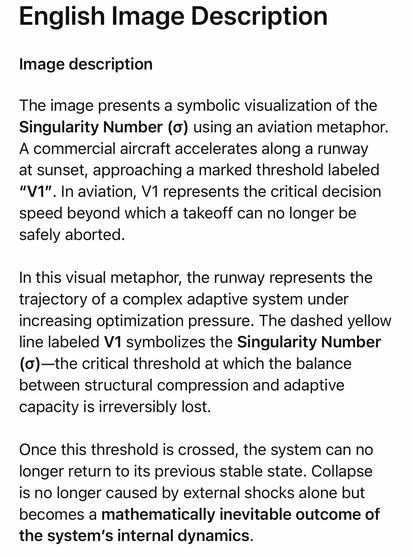
The #SingularityNumber (σ) …
marks the #V1 moment of complex systems …
beyond it, collapse becomes mathematically inevitable.
#CRTI 🖖



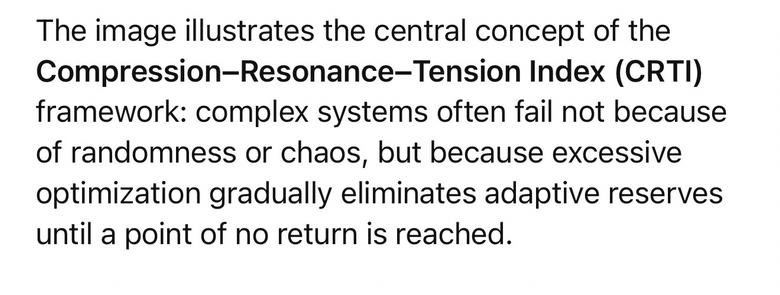
This manuscript introduces the Singularity Number (σ) as a critical stability threshold in complex adaptive systems. The concept is derived from the Compression–Resonance–Tension Index (CRTI), a dimensionless diagnostic metric designed to quantify the balance between structural optimization pressure and adaptive capacity in complex systems. The CRTI is defined as: χ = (Φ · Δ) / (R_eff · Ω) where Φ represents structural compression or optimization pressure, Δ denotes accumulated systemic tension, R_eff describes the system’s effective resonance with its environment (information exchange capacity), and Ω denotes the system’s adaptive reserve, including redundancy and degrees of freedom. Within this framework, the Singularity Number σ is defined as the critical value of χ beyond which a system loses adaptive resilience and undergoes structural singularization—a regime characterized by excessive optimization, reduced feedback permeability, and collapse of functional stability. To formalize this transition, a minimal dynamical model is introduced using coupled differential equations describing system integrity, adaptive reserve, and environmental resonance. Analytical results demonstrate that system stability is governed by the intrinsic regenerative rate of the system, and that the collapse threshold corresponds to a transcritical bifurcation where the functional equilibrium becomes unstable. The model further reproduces well-known early warning signals of critical transitions, including critical slowing down, rising variance, and increased autocorrelation prior to collapse. Conceptually, the Singularity Number functions analogously to dimensionless critical parameters such as the Reynolds number in fluid dynamics, though its numerical value is expected to vary across system classes. The structural logic of the transition, however, is scale-invariant and applies to biological, economic, technological, and organizational systems. The framework therefore provides a quantitative basis for understanding a central paradox of complex systems: systems do not collapse primarily due to chaos, but due to excessive structural order and over-optimization. The Singularity Number offers a potential diagnostic tool for identifying systemic fragility before collapse occurs and highlights the critical importance of maintaining adaptive reserves and environmental resonance in resilient system design. Keywords (für Zenodo) CRTI Singularity Number Complex Adaptive Systems Resilience Nonlinear Dynamics System Collapse Bifurcation Theory Complexity Science