 DoomsdaysCW
Thank you for all this good info, @NatureMC ! I am fascinated by #SimonaKossak! She's a person after my own heart!
As a few folks have pointed out, this post is filled with inaccuracies. Please read the replies in the thread!
From "This Day in History" on FB:
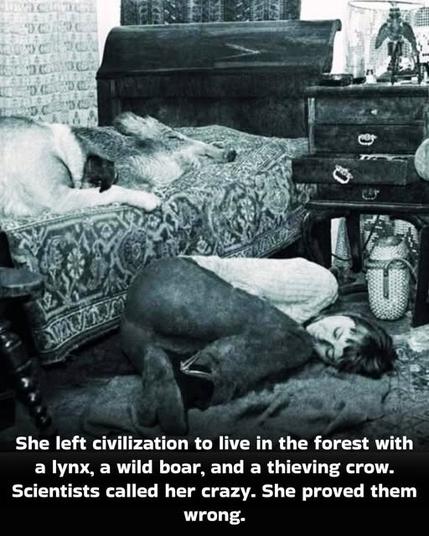
"She left civilization to live in the forest with a lynx, a wild boar, and a thieving crow. Scientists called her crazy. She proved them wrong.
In 1975, a young Polish scientist named #SimonaKossak made a decision that baffled everyone who knew her.
She had a doctorate. She had credentials. She came from one of Poland's most prestigious artistic families—her grandfather was Wojciech Kossak, the legendary painter whose work hung in museums.
She could have had a comfortable university position. A modern apartment in Warsaw. A conventional career studying nature from a safe distance.
Instead, Simona packed a single bag and walked into the #bialowiezaforest . And she stayed there for thirty years.
Białowieża is no ordinary forest. It's the last remaining fragment of the primeval wilderness that once covered all of Europe—ancient, untouched, older than recorded history. Trees there grow so tall they seem to hold up the sky. Wolves still howl at night. European bison, extinct almost everywhere else, roam freely. It's the kind of place where you can still hear what the world sounded like before humans started building cities.
Simona found a small wooden cabin deep in the forest's heart. No electricity. No running water. No neighbors for miles.
Just trees. Silence. And the wild things.
Most people would have lasted a week.
Simona lasted decades.
But she wasn't alone.
She shared her bed with a lynx named Żabka. Not a pet—lynxes can't be pets. But Żabka had been orphaned as a cub, and Simona raised her. The massive cat would curl up beside her at night, purring like distant thunder.
She rescued a wild boar named Żabka who followed her through the forest like a devoted dog, grunting softly when she spoke.
And then there was Korasek. Korasek was a crow—but not just any crow. He was brilliant, mischievous, and absolutely devoted to chaos. He'd dive-bomb cyclists riding through the forest, steal shiny objects from tourists' pockets, and bring Simona "gifts": coins, buttons, pieces of foil.
He'd sit on her shoulder while she worked, cawing commentary on everything she did.
The locals whispered that Simona was a witch. How else could you explain it? Animals followed her. Birds landed on her outstretched hand. Deer approached without fear.
She spoke to them, and somehow, impossibly, they seemed to understand.
But Simona wasn't casting spells.
She was listening.
Most people walk through nature talking, making noise, asserting their presence. Simona did the opposite. She learned to move quietly, to observe patiently, to let the forest teach her its rhythms.
She studied animal behavior not from textbooks, but by living among them. She documented species that had never been properly observed. She proved that wild animals weren't just instinct-driven automatons—they had personalities, emotions, complex social structures.
Her research changed how scientists understood wildlife.
But her most important work wasn't in journals.
It was in the forest itself.
Because while Simona was studying nature, others were trying to destroy it.
#LoggingCompanies wanted to cut down the #AncientTrees. Developers wanted to build roads through the #wilderness.
Bureaucrats argued that the forest was "too wild," that it needed to be "managed," controlled, made productive.
Simona fought them all.
She wrote letters. She filed lawsuits. She gave interviews where she spoke bluntly about what would be lost if the forest fell.
She stood in front of bulldozers.
She made powerful enemies.
She didn't care.
"This forest has survived for ten thousand years," she'd say. "Who are we to decide it should end on our watch?"
Her cabin became a symbol. Journalists came from across Europe to photograph the woman who lived with wild animals. Documentaries were made. Her story spread.
And slowly, the tide began to turn.
Public opinion shifted. International pressure mounted. UNESCO got involved. The ancient forest, in large part because of Simona's tireless advocacy, gained greater protections.
The trees she loved were saved.
Simona Kossak lived in that cabin until 2007, when illness finally forced her back to the city. She died in 2007, at the age of 71.
But her legacy didn't die with her.
Today, Białowieża Forest stands as one of Europe's last true wildernesses—a living monument to what the continent once was. Tourists walk trails where Simona once walked with Żabka the lynx. Bison graze in meadows she fought to protect.
Scientists still study the forest using methods she pioneered.
And somewhere in those ancient trees, maybe, a descendant of Korasek steals something shiny from an unsuspecting hiker.
Simona Kossak proved something the modern world desperately needs to remember:
That you don't have to choose between science and intuition. Between civilization and wilderness. Between being human and being part of nature.
She proved that sometimes the most rigorous science comes from simply paying attention. That the deepest understanding comes from respect, not dominance.
She proved that one person, living authentically and fighting fiercely for what they love, can change the fate of an entire ecosystem.
They called her a witch because she spoke to animals.
She called herself a scientist because she listened.
And she spent thirty years in a cabin without electricity, surrounded by wild things, protecting an ancient forest from a modern world that had forgotten how to be still.
Simona Kossak wasn't running away from civilization.
She was protecting something far more valuable than anything civilization could offer.
And because of her, that forest still stands."
#Rewilding #NatureLover #CitizenScientist #Nature #SaveTheForest
 BasoBiziakPlataforma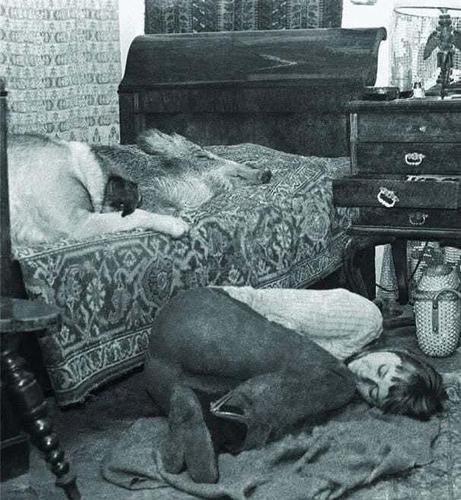
 isaak
isaak
 Ingrid Hoeben Ⓥ 🇧🇪
 audrina
 Mural Hunters - Łowcy Murali
 anna_lillith 🇺🇦🌱🐖
 paket (soupie)