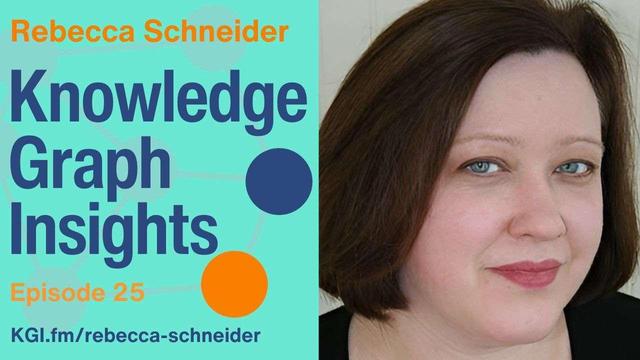
Skills that Rebecca Schneider learned in library science school - #taxonomy, #ontology, #semanticModeling, and #metadata - have only become more valuable with the arrival of AI technologies like LLMs and the growing interest in #knowledgeGraphs.

Two things have stayed constant across her library and enterprise content strategy work: organizational rigor and the need to always focus on people and their needs.
https://knowledgegraphinsights.com/rebecca-schneider/

Rebecca Schneider: knowledge graphs and enterprise content strategy

Rebecca Schneider is an expert on taxonomy, ontology, semantic modeling, knowledge graphs and enterprise content strategy.

KGI

📅 Die erste “konstituierende Sitzung” wird am 18. März 2025, 14.00h - 15.30h per Zoom abgehalten. Der Link wird über die Mailingliste verschickt.

Wir freuen uns auf eine “verlinkte” Zusammenarbeit 🙂 3/3

#SemanticWeb #LinkedOpenData #LOD #KG #Fuzziness #Wobbliness #Forschungsdatenmanagement #FDM #ResearchDataManagement #RDM #Wissensgraphen #RDF #SemanticModeling

👉 Wenn Sie aktiv in der TWG mitarbeiten wollen (erweiterte Kenntnisse in semantischer Modellierung in RDF sind nötig), abonnieren Sie bitte die Mailingliste unter https://www.listserv.dfn.de/sympa/info/n4o_twg_fuzzy-wobbly-sw.

⏩ Chairs der TWG sind Florian Thiery (LEIZA) und Karsten Tolle (Goethe-Universität Frankfurt am Main).

2/3

#SemanticWeb #LinkedOpenData #LOD #KG #Fuzziness #Wobbliness #Forschungsdatenmanagement #FDM #ResearchDataManagement #RDM #Wissensgraphen #RDF #SemanticModeling

n4o_twg_fuzzy-wobbly-sw - NFDI4Objects Temporary Working Group (TWG) "FuzzyWobblySW" - info

📣 Aufruf zur Mitarbeit in der TWG "Community-Standards for modelling fuzziness & wobbliness in research data using Semantic Web technologies and formalisms"

🌐 Am 14. Februar 2025 wurde die Temporary Working Grop (TWG) im Steering Committee beschlossen, weitere Informationen finden Sie unter https://www.nfdi4objects.net/portal/twgs/community-standards-for-modelling-fuzziness-wobbliness-in-research-data-using-semantic-web-technologies-and-formalisms-fuzzywobblysw/.

#SemanticWeb #LinkedOpenData #LOD #KG #Fuzziness #Wobbliness #Forschungsdatenmanagement #FDM #ResearchDataManagement #RDM #Wissensgraphen #RDF #SemanticModeling 1/3

Community-Standards for modelling fuzziness & wobbliness in research data using Semantic Web technologies and formalisms (FuzzyWobblySW)

NFDI4Objects

With her 15-year history in the #knowledgeGraph industry and her popular YouTube channel, Ashleigh Faith has informed and inspired a generation of graph practitioners and enthusiasts.

She's an expert on #semanticModeling, knowledge graph construction, and #AIarchitecture and talks about those concepts in ways that resonate both with her colleagues and with newcomers to the field.

https://knowledgegraphinsights.com/ashleigh-faith/

Ashleigh Faith: knowledge graph modeling and AI architectures

Ashleigh Faith is an expert on semantic modeling, knowledge graph construction, and AI architectures and hosts a popular YouTube channel.

KGI

Find more about #EKAW24 𝙏𝙪𝙩𝙤𝙧𝙞𝙖𝙡 on
Semantic Knowledge Modeling -
Ontologies & Vocabularies
at https://metaphacts.com/ekaw24-semantic-modeling-tutorial

#SemanticModeling #Ontologies #Vocabularies #KnowledgeEngineering #Tutorial

EKAW-24 Tutorial: Semantic Knowledge Modeling

This tutorial covers a new approach to knowledge graph modeling based on metaphactory's visual and user-friendly interface for creating, exploring, visualizing,

TIL about #ReconTraj4Drones: A Framework for the Reconstruction and #SemanticModeling of #UAV #Trajectories based on #MovingPandas https://www.mdpi.com/2076-3417/13/1/670

Still have to read the paper but it's great to know that @movingpandas is useful for others

#GIScience #GISChat #OpenSource #ScientificSoftware

ReconTraj4Drones: A Framework for the Reconstruction and Semantic Modeling of UAVs’ Trajectories on MovingPandas

Unmanned aerial vehicles (UAVs), also known as drones, are important for several application domains, such as the military, agriculture, cultural heritage documentation, surveillance, and the delivery of goods/products/services. A drone’s trajectory can be enriched with external and heterogeneous data beyond latitude, longitude, and timestamp to create its semantic trajectory, providing meaningful and contextual information on its movement data, enabling decision makers to acquire meaningful and enriched contextual information about the current situation in the field of its operation and eventually supporting simulations and predictions of high-level critical events. In this paper, we present an ontology-based, tool-supported framework for the reconstruction, modeling, and enrichment of drones’ semantic trajectories. This framework extends MovingPandas, a widely used and open-source trajectory analytics and visualization tool. The presented research extends our preliminary work on drones’ semantic trajectories by contributing (a) an updated methodology for the reconstruction of drones’ trajectories from geo-tagged photos taken by drones during their flights in cases in which flight plans and/or real-time movement data have been lost or corrupted; (b) an enrichment of the reconstructed trajectories with external data; (c) the semantic annotation of the enriched trajectories based on a related ontology; and (d) the use of SPARQL queries to analyze and retrieve knowledge related to the flight of a drone and the field of operations (context). An evaluation of the presented framework, namely, ReconTraj4Drones, was conducted against several criteria, using real and open datasets.

MDPI