 Friedrich Wilhelm Grafe
announcement found at bsky, & suggest worth a read
https://www.cambridge.org/core/elements/scientific-realism/233B5F72916177C09804EB8402DEE9B2
[ "...This Element is free online from 20th February 2025 - 6th March 2025 ..." ]
announcement found at bsky, & suggest worth a read
https://www.cambridge.org/core/elements/scientific-realism/233B5F72916177C09804EB8402DEE9B2
[ "...This Element is free online from 20th February 2025 - 6th March 2025 ..." ]
Why I’m an ontic structural realist
Scientific realism vs instrumentalism
A long standing debate in the philosophy of science is about what our best scientific theories tell us. Some argue that they reveal true reality, that is, they are real. Others that scientific theories are only useful prediction frameworks, instruments useful in the creation of technology, but that taking any further implications from them is misguided.
In practice, most people are a mix, taking a realist attitude toward theories whose implications they like, and an antireal or instrumentalist one toward those they dislike. For example, it’s pretty common for people to take an antireal stance toward the quantum wave function, while being realist toward much of the rest of science.
The most common argument for instrumentalism is the pessimistic meta-induction, the observation that a theory can be predictive of current observations yet later still turn out to be very wrong, with the Ptolemaic earth centered model of the cosmos being the most famous example. For centuries it predicted naked eye astronomical observations, yet its view of reality was completely overturned by the post-Copernican models.
The most common realist response is the no miracles argument, that if our best successive theories aren’t give us at least an increasingly closer approximation of reality, it amounts to a miracle.
Theory scope
As someone whose take on reality is that the real is what leads to more accurate predictions, I’ve long thought the above description misses the core difference between these stances, which is the scope of current theories. Instrumentalists tend to regard the scope as only pertaining to current observables. Scientific realists tend view it as broader.
Maybe the biggest practical difference is a realist expects our best theories to eventually converge and reconcile. Albert Einstein, perhaps the most famous realist, made a lot of progress just figuring out ways to reconcile different successful theories. Although he was the first person to struggle to do that with quantum mechanics and general relativity.
Structural realism
Structural realism somewhat straddles the fence between instrumentalism and traditional scientific realism, with the observation that what does get preserved across theory change, at least approximately, is the core structure and relations of the old theory. Ptolemy’s mathematical structure still works, just in a much narrower scope than he might have imagined. And Isaac Newton’s model of motion and gravity remain very useful for many purposes (including most NASA missions), even though general relativity has to be used for more exotic scenarios.
Structural realism seems to get the instrumentalist benefit of minimizing assumptions while accepting that scientific theories are telling us something about reality. It’s worth noting that the difference between structural realism and traditional scientific realism is most prominent in fundamental physics. It’s easier to be a straight realist for much of the rest of science. Although structural realism seems useful in evaluating psychophysical theories. Maybe another way of putting this, structuralism seems most useful at the current boundaries of knowledge.
Epistemic vs ontic structural realism
Epistemic structural realism (ESR) is the stance that while science can tell us about the structure and relations of entities in the world, as well as what they do (relations across time), it doesn’t tell us what they are. In other words, science can’t tell us about their intrinsic nature. Ontic structural realism (OSR) rejects this distinction, arguing that all of the structure and relations of an entity amount to its full nature.
Some variations of ESR resonate with Immanuel Kant’s transcendental idealism philosophy, that while we can know phenomena, there remains a reality beyond our observations, the noumena. Noumena may or may not be related to the notion of “things in themselves”, considered unknowable by Kantians. It’s commonly noted that with this move, Kant seems to make room for concepts that seemed threatened by the enlightenment of his day: God, the soul, free will, moral realism, etc.
Why ontic structural realism?
When I first discovered the structural realist view, the epistemic option seemed plausible. It seemed like a responsible acknowledgement on the limits of what we can know. But I now realize I was making a very common mistake. It’s completely rational to assume that the structures and relations we know about aren’t the final story, that there remain underlying structures we haven’t discovered yet.
For example, when scientists discovered atoms, they gave them the ancient Greek name for the ultimate building blocks of matter. However, they didn’t know about subatomic particles like electrons, protons, and neutrons. And of course it was later discovered that protons and neutrons are themselves composed of quarks and gluons. It seems entirely appropriate to be cautious about accepting that these entities, which we currently call “elemental particles”, are the final story.
However, these possible hidden underlying components are not the intrinsic nature that ESR is arguing for. They are just more structure, relations, and functions. What then does ESR mean? The only example of an intrinsic nature I’ve seen presented are the quiddities of Russellian monism, which are often taken in panpsychism as the proto-phenomenal properties that make up the phenomenal properties of conscious experience.
But it’s not clear to me what an intrinsic nature might amount to. Whenever I attempt to imagine it, I always end up with something having some kind of structure and relations. Even conscious experience to me seems structural. People often argue that phenomenal properties, like the redness of red or the painfulness of pain, aren’t structural, even if they serve as elements in the overall structures of experience.
But to me this just bring us back to the point above, that it makes sense to be cautious in assuming there aren’t underlying structures and relations. The idea that there aren’t is an assumption of fundamental consciousness, which I argued against a few posts back. Interestingly, the notion that phenomenal properties are composed of proto-phenomenal properties seems to imply an underlying structure, albeit one separate from the normal structure accessible to science.
So my issue with ESR is I don’t know what it could mean by an intrinsic non-relational non-structural nature. Of course, my inability to conceive it doesn’t mean it isn’t reality (see quantum spin, for instance). But then without some kind of evidence for that reality, it leaves me with no reason to assume they exist. Leaving OSR as the only option. At least for now.
What do you think?
#antirealism #instrumentalism #Philosophy #PhilosophyOfScience #Science #scientificRealism #structuralRealism

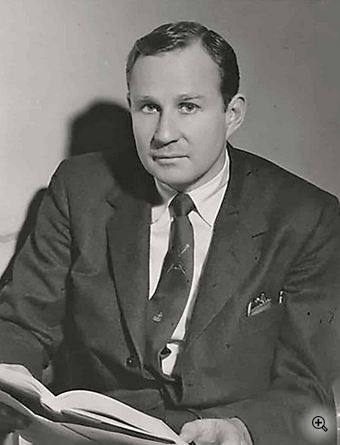
Wilfrid Sellars (1912 - 1989) is not well known outside university departments of philosophy.
His writings have nevertheless exercised an important influence on better known figures such as Richard Rorty and Daniel Dennett. In addition, he is regarded as a key figure in the development of that school of thought known as scientific realism.
I'll be honest and admit that he isn't always the easiest of writers to understand. This overview of his own approach to philosophy is one of his more accessible pieces:
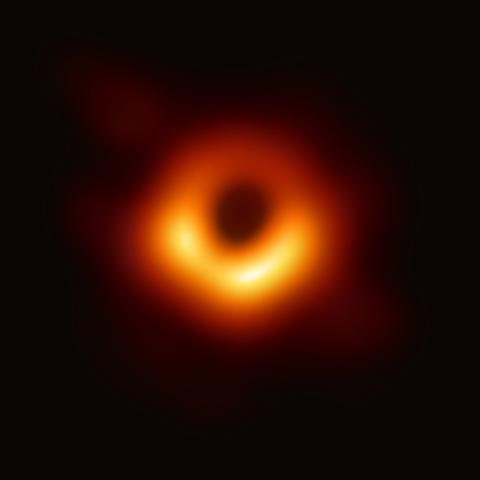
Scientific breakthroughs often begin with someone saying, “Don’t panic. This crazy sounding assumption is just to make the math work.”
Nicholaus Copernicus, when he developed his theory of heliocentrism (the earth orbits the sun), was operating from a scientific realist view. In other words, he thought his system reflected actual reality, or at least reflected it better than Ptolemy’s geocentric system (everything orbits the earth), which had been the accepted model of the universe since ancient times.
However, the new reality he presented was controversial, particularly in protestant circles at the time. Which led Andreas Osiander, a Lutheran theologian involved in printing his book, to add an unauthorized and unsigned preface. Osiander argued that Copernicus’ framework shouldn’t be evaluated on whether it’s literally true, but as a useful mathematical framework to make predicting astronomical phenomena easier. In other words, don’t worry; it’s just convenient math.
For decades many astronomers followed Osiander’s advice, accepting just Copernicus’ mathematics. The number who actually accepted heliocentric realism was vanishingly small. One astronomer, Tycho Brahe, advocated for a compromise cosmology with most planets orbiting the sun, but the sun still orbiting the earth. Straight Copernicans like Johannes Kepler and Galileo Galilei were very rare. It wouldn’t be until the early 1600s and Galileo’s telescopic observations, that heliocentrism started to be taken seriously (and resisted).
Moving forward to 1900, Max Planck was trying to mathematically model black body radiation. But he couldn’t make it work. In desperation, he made a change he was loathe to do, one that would make his math compatible with Ludwig Boltzmann’s statistical interpretation of entropy, a view he opposed. He added discrete quantities into the equations, essentially doing the math as if there was a minimum unit of radiation. The change worked.
Planck was beginning the science of quantum physics, but he didn’t see it at the time. He saw the quantization as purely a pragmatic move, a mathematical contrivance, and was skeptical of any deeper philosophical implications. However, a few years later, Albert Einstein used quanta to explain the photoelectric effect, essentially reifying the quanta into what we now know as photons.
That same year, Einstein introduced his theory of special relativity. He was a realist about the theory from the beginning. However, his equations had implications for spacetime that he was initially skeptical of. We call it “Minkowski spacetime” today because his old math teacher, Hermann Minkowski, recognized the implications. Einstein eventually came around.
But after working out general relativity, Einstein was again resistant to some of the implications of his math. General relativity predicted that the universe either had to be contracting or expanding. To save appearances, he introduced a fudge factor called the cosmological constant, a move he later regretted after observations showed that the universe was indeed expanding. (Although the cosmological constant later found new life with the discovery of dark energy.)
Einstein was also resistant to certain solutions to his equations, solutions which seemed to indicate there could be regions of spacetime which were so curved that nothing could escape. In the early 1900s, these seemed like perverse entities that couldn’t be physical. Of course, today we know black holes exist and play a pivotal role in the universe. We’re able to detect and image them.
In 1935, Einstein, together with Boris Podolsky and Nathan Rosen, published the famous “EPR paradox” paper, pointing out issues in the mathematics of quantum theory that violated locality, at least under conventional interpretations of quantum mechanics. Erwin Schrödinger followed up with additional papers naming the phenomenon “entanglement”, as well as coming up with the famous “Schrödinger’s cat” thought experiment, which questioned the implications of the mathematical framework he himself had been instrumental in developing.
The thrust of their argument at the time was that these mathematical implications couldn’t be reality. However, twenty years later, John Stuart Bell came up with a way to test those implications. Alain Aspect, John F. Clauser, and Aton Zeilinger won the 2022 Nobel Prize for their experiments carrying out out those tests, progressively closing the loopholes to such an extent that it would be at least as absurd for the predictions to be wrong as right.
(Einstein is picked on a lot on this post, but it’s worth noting that these are cases of him blanching at the implications of his own brilliant theories, or theories he helped develop. The fact is many famous scientists struggled with the full implications of their discoveries.)
Of course, the mathematics aren’t always right. Newton’s laws of gravity were used to predict the existence of Neptune based on anomalies in Uranus’ orbit. However, those same laws were also used to predict the existence of the planet Vulcan, supposedly closer to the sun than Mercury. But Mercury’s orbital anomalies turned out to be stranger, heralding the limitations of Newtonian theory, limitations which would require Einstein’s general relativity to resolve.
And the Large Hadron Collider hasn’t been kind to many speculative theories and their mathematics. So just because someone can manipulate equations, doesn’t mean it reflects reality.
On the other hand, when the mathematics of a heavily tested theory, with no further assumptions, make predictions that can’t currently be tested, history seems to suggest taking them seriously. And mathematical convenience often heralds new realities. Even when the limits of a theory are reached, the new explanation typically ends up being far stranger than the initial prediction.
Granted, it’s always possible to ignore the implied ontology by going instrumentalist. I do think it’s important to be able to put on the instrumentalist hat from time to time. It helps to sidestep ontological biases. Planck did it to make his breakthrough, as did Werner Heisenberg when he was working out the initial mathematical framework for quantum mechanics. But these were theorists using instrumentalism to make progress in spite of the strangeness.
Other times making progress seems to mean finding ways to reconcile theories, to find where they converge, an inherently realist approach. Einstein reportedly worked out special relativity from reconciling classical electromagnetism and Newtonian motion, and then general relativity from reconciling special relativity and Newtonian gravity. And most of us got interested in science and philosophy to get closer to truth, not to unrelated prediction instruments.
This is why my own preferred outlook these days is structural realism, a sort of minimal realism that accepts the mathematical structures described by well tested theories as real, but remains agnostic on any underlying ontology. However even structural realism means accepting strange implications.
Which is why many people reach for instrumentalism. Although few are able to stick with it consistently. And selectively adopting it to dismiss predictions we don’t like seems firmly in the tradition of Osiander.
Unless of course I’m missing something.
https://selfawarepatterns.com/2023/12/30/is-it-just-the-math/
#instrumentalism #Philosophy #PhilosophyOfScience #Physics #Science #scientificRealism #structuralRealism
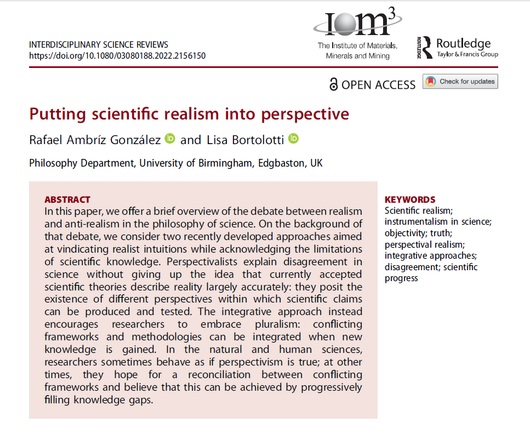
In their new article, Rafael González and Lisa Bortolotti (@lisabortolotti) compare and contrast scientific realism and anti-realism and discuss recent approaches: perspectival realism and the integrative.
Open access: https://doi.org/10.1080/03080188.2022.2156150
Few quotes follow 🧵👉
#Science
#PhilosophyOfScience
#PhilSci
#Realism
#AntiRealism
#ScientificRealism
#PerspectivalRealism
@philosophy
1/6
https://iai.tv/iai-academy/courses/take/lectures?course=every-thing-must-go
This is a great video lecture from James Ladyman about scientific realism, structural realism and ontology. He wrote, together with Don Ross, "Every Thing Must Go", one of the most inspiring books in philosophy of science of the last years.
#philosophy #philosophyofscience #realism #structuralrealism #scientificrealism #ontology

 SelfAwarePatterns
 Jonathan Emmesedi
 Mark Rubin
 Danny Krämer