 Hacker News
 Front Page [Unofficial]
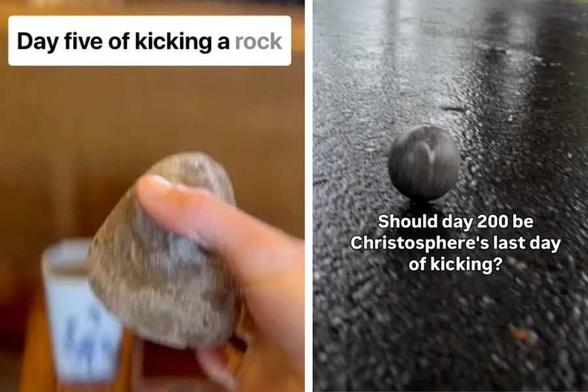
Guy kicks a single rock for 200 days to see if it'll become a perfect sphere. Here's how it went.
https://fed.brid.gy/r/https://www.upworthy.com/rock-kicked-for-200-days
Guy kicks a single rock for 200 days to see if it'll become a perfect sphere. Here's how it went.
https://fed.brid.gy/r/https://www.upworthy.com/rock-kicked-for-200-days
8th grader's award-winning experiment finally reveals if a dog's mouth is cleaner than a human's
https://fed.brid.gy/r/https://www.upworthy.com/dog-tongue-versus-human-tongue-experiment-ex1

Are wolves using tools?
Listen to episode 53 to hear Joe and Finlay discuss, and let us know what you think!
https://www.science.org/content/article/have-wild-wolves-learned-use-tools
#hwatweekly #science #sciencenews #scienceexperiments #wolvesusingtools
6th grader's science fair project answers age-old question: 'Do cat buttholes touch everything?'
https://fed.brid.gy/r/https://www.upworthy.com/cat-buttholes-experiment-ex1

Amusing Experiments (after Martin Gardner) by Martin Gardner; M. Stoliar ; L. Fomin
SCIENCE READER FOR THE EIGHTH FORM OF SECONDARY SCHOOL
In this book you will find descriptions of amusing experiments which are based upon well-known scientific facts. You can easily carry out these experiments yourselves, and you will not need any special equipment. But if you wish to show the experiments to your friends, we advise you to practise them a few times before you demonstrate.
The experiments are not only amusing: after you have carried out each experiment and read the explanation, you will learn something interesting and important in such fields of science as mathematics, physics, chemistry, biology, astronomy and psychology.
The book will help you to learn a number of new English words which are connected with science. When you have learned them, it will be much easier for you to read scientific literature in English in the senior forms. At the end of the book you will find the vocabulary of the words which you may not know. Some of the terms are given in the footnotes. We hope that you will find the book interesting and easy to read, and that it will help you to become science-minded people.
You can get the book here and here.
Twitter: @MirTitles
Mastodon: @[email protected]
Mastodon: @[email protected]
Bluesky: mirtitles.bsky.social
CONTENTS
ASTRONOMY
Prove That the Sum of All the Angles of a Triangle Is 180°
You Can Push a Coin Through a Smaller Hole
How Long Is the Diagonal of a Square?
Short Bridges
The Pythagorean Theorem
How Many Matches Are There in Your Hand?
A Trick with Dice
The Wonderful Window
Quick Addition
An Interesting Way to Multiply Numbers
Strange Mathematics
Magic in Mathematics
PSYCHOLOGY
Hot or Cold?
“Moscow in the Spring”
It Is Easy to Remember Some Facts
PHYSICS
Watermarks
Spectrum on the Ceiling
A Device to Copy Pictures
An Experiment with a Box of Matches
The Forks Will Not Fall Down
How to Break a Strong Rope
A Lemonade-straw Can Go Through a Potato
Egg in the Bottle
A Three-kopek Coin Can Dance
The Magdeburg Glasses
Bernoulli’s Principle
Two Interesting Ways to Blow Out a Candle
An Experiment with a Table-tennis Ball
Cold Water Can Boil
The Button Which Does What You Tell It
An Automatic Siphon
You Can Get the Water out of the Glass
The Water Is in the Lower Glass
Pascal’s Law
Put the Cork in the Centre
An Experiment with a Cardboard Arrow
How You Can Demonstrate Inertia
The Egg and Friction
There Is No Magic
OPTICAL ILLUSIONS
A Funny Finger
Circles on the Card
A Missing Piece of Cake
An Optical Illusion with a Match
Moon Illusion
An Illusion with a Three-kopek Coin
You Can See Through Your Hand
The Third Coin
A Strange Spiral
Paper Films
A Turning Device
An Illusion with a Pencil
A Pendulum Which Moves in a Circle
The Stamp Which Disappears
The Two Sides of Your Face Are Different
You Haven’t Seen the Real Image of Your Face in the Mirror
Colour That Isn’t There
You Can Read a Secret Letter from Your Friend
You Can Make a Stroboscope
EXPERIMENTS WITH SOUND
A Musical Fork
Music from a Coat-hanger
A Musical Glass of Water
VOCABULARY
#childrenSScience #handsOnScience #popularScience #scienceExperiments #sovietLiterature
Stand Back. I’m Going to Try Science.
Risk level: HIGH.
Coolness level: HIGHER.
Chance of explosions? Classified.
🔗 https://techgeeksapparel.com/stand-back-im-going-to-try-science/
#MadScientistMode #ScienceExperiments #WhatCouldGoWrong #STEMHumor


Stand Back I'm Going to Try Science T-Shirt - Chemistry Student T-Shirt Idea - Science Nerd Shirt - Science Teacher Gift - Scientist Experiment Tees - Classic
Most people (I guess?): Finds a recipe, then follows the recipe.
Me: Finds a recipe, finds a couple more similar recipes, mentally compares the recipes, breaks down all the common elements (basically deconstructing the recipe), looks around to see what ingredients I have on hand, then re-constructs the recipe based on ingredients on hand (unless I happen to be going to the store), jots down rough notes, creates a new recipe (tweaking as needed).
Does anyone else do this? I know some folks who can just throw together ingredients (and I can do that too) -- but I prefer having a "formula" and notes so I can replicate it in the future (if it comes out well), or tweak as needed.
#Recipes #Cooking #FoodPreparation #ScienceExperiments #CookingWhileAutistic?
Have you ever seen a “snake” emerge from a sugar and baking soda? Welcome to the wild world of the giant carbon snake experiment! This jaw-dropping demonstration has been wowing students and science lovers for decades. A 2023 survey found that 87% of science teachers consider it one of the most engaging classroom experiments. But what’s going on beneath the surface of this chemical reaction?
What is the Giant Carbon Snake Experiment?
The giant carbon snake experiment, also known as the “black snake” or “sugar snake” experiment, is a captivating chemical demonstration showcasing sugar’s dehydration. This reaction, catalyzed by baking soda, produces a growing, snake-like carbon foam structure.
The experiment has its roots in 19th-century chemistry demonstrations, originally using more dangerous compounds like mercury thiocyanate. Today’s version is much safer and perfect for classrooms and home science projects!
The Chemistry Behind the Magic
At its core, the giant carbon snake experiment is all about the dehydration of sugar (sucrose). Here’s what’s happening:
It’s like watching chemistry come alive right before your eyes!
Step-by-Step Guide to Conducting the Experiment
Ready to try it yourself? Here’s what you’ll need:
Safety first! Always conduct this experiment in a well-ventilated area and under adult supervision.
Pro tip: Try powdered sugar instead of granulated for an even more impressive show. The finer particles react more quickly, creating a faster-growing snake!
The Science of Carbon Snakes: From Micro to Macro
Let’s zoom in on what’s happening at the microscopic level:
Under a microscope, the carbon snake looks a bit like a sponge made of charcoal. It’s similar in structure to activated carbon, used in water filters and air purifiers. Cool, right?
Educational Value and Applications
The giant carbon snake experiment is more than just a fun show – it’s a powerhouse of scientific concepts:
Teachers love this experiment because it brings these abstract concepts to life. It’s a great way to spark interest in chemistry, especially for visual learners.
But the applications go beyond the classroom. Similar processes are used in the production of activated carbon and some types of insulation materials.
Safety Considerations and Best Practices
While this experiment is generally safe, it’s important to take some precautions:
After the experiment, let everything cool completely before cleaning up. The carbon snake can be safely disposed of in the regular trash.
Beyond the Basic Experiment: Advanced Variations
For the budding scientists out there, here are some ways to take your carbon snake to the next level:
You could even use this experiment as a jumping-off point for exploring topics like carbon capture or materials engineering. The possibilities are endless!
Conclusion
The giant carbon snake experiment is more than just a cool party trick – it’s a window into the fascinating world of chemical reactions! From the sizzling dehydration of sugar to the formation of intricate carbon structures, this demonstration never fails to captivate. Whether you’re a seasoned chemist or a curious beginner, there’s always something new to discover in the twists and turns of these carbonaceous serpents.
So why not give it a try? Who knows – you might just ignite a lifelong passion for science! Remember, in chemistry, sometimes the most eye-catching experiments reveal the deepest truths about our world. Happy experimenting!
#activitiesForKids #kids #science #ScienceExperiments #scineceActivities


Did you know that the average potato sitting in your pantry has the potential to light up your world? It’s true! In fact, a single potato can generate about 0.5 volts of electricity. Imagine harnessing that power for your next science fair project or as an emergency light source. Sounds a-peeling, doesn’t it? (Sorry, couldn’t resist!)
The Science Behind Potato Batteries
Before we start building, let’s understand why potatoes can generate electricity. It’s all thanks to a branch of science called electrochemistry.
What Can a Potato Battery Actually Power?
Now, let’s get practical. What can you realistically power with a potato battery?
Remember, potato batteries aren’t meant to replace your household batteries or power grid. They’re great for educational purposes and understanding basic electrical concepts.
Materials Needed for Your Potato Battery
Ready to build? Here’s what you’ll need:
Most of these items can be found at your local hardware store. For the best results, choose firm potatoes without any soft spots.
Step-by-Step Guide to Building Your Potato Battery
Let’s get our hands dirty (or starchy)!
Boosting Your Potato Battery’s Power
Want more juice? Try these tips:
Cool Projects Powered by Potato Batteries
Now that you’ve got your potato power plant running, here are some fun projects to try:
Real-World Applications of Bio-Batteries
While potato batteries are primarily used for educational purposes, the concept of bio-batteries has some exciting real-world potential:
Environmental Impact and Sustainability
Potato batteries are generally eco-friendly:
However, it’s important to use potatoes responsibly. Don’t waste edible food for long-term power needs!
Conclusion
Well, folks, we’ve just peeled back the layers on the amazing world of potato batteries! From lighting up LEDs to powering clocks, these starchy powerhouses are proving that science can be both fun and functional.
As we’ve discovered, the humble potato is not just a side dish anymore – it’s a glimpse into a more sustainable future of energy production. While a potato battery won’t power your house, it can illuminate young minds and spark interest in renewable energy.
More fun science experiments on geekysteth.com
https://geekysteth.com/how-to-make-a-potato-battery-powering-science-projects-in-2024/

 Hwat?! Weekly!
 Mir Books
 TechGeeksApparel
 DoomsdaysCW
 Sriharsha Koduru