 WPS News
The Philippine Power Grid: Reactive Power Management and Voltage Stability
By Cliff Potts, CSO, and Editor-in-Chief of WPS News
Baybay City, Leyte, Philippines — May 5, 2026
Introduction: Voltage Collapse Is a Grid Problem, Not a Generation Problem
Public discussion of electricity reliability often focuses on megawatts of generation capacity. In operational practice, however, many stability events occur without generation shortages. Instead, they arise from reactive power imbalances and voltage instability.
In the Philippine grid, long transmission corridors, islanded load pockets, and uneven reactive compensation make voltage control one of the system’s most persistent technical constraints.
Real Power vs. Reactive Power
Electric power systems operate with two forms of power:
- Real power (P) measured in megawatts (MW), which performs useful work.
- Reactive power (Q) measured in megavolt-amperes reactive (MVAr), which sustains electromagnetic fields required for voltage control.
Transmission networks require reactive power support to maintain voltage profiles along lines. Without sufficient local reactive supply, voltage drops and instability propagate through the system.
In simplified terms:
- Real power moves energy.
- Reactive power holds the grid together.
Why Archipelagic Systems Struggle With Reactive Balance
The Philippine grid contains several characteristics that complicate reactive power management:
- Long transmission lines across islands, increasing reactive demand.
- Load centers distant from generation plants, amplifying voltage drop.
- Weak interconnections between grid regions, limiting reactive support transfer.
Reactive power does not travel efficiently over long distances. Unlike real power, it must be supplied close to the load to maintain voltage stability.
When reactive support is insufficient, voltage begins to decline, forcing generators and transmission equipment into stressed operating conditions.
Voltage Profiles and Line Impedance
Transmission lines exhibit inductive reactance. As real power transfer increases, reactive demand increases simultaneously.
Consequences include:
- Voltage depression at receiving ends of long lines
- Increased reactive losses
- Reduced stability margins during peak demand
When voltage falls below acceptable thresholds, operators must either reduce load or shed circuits to prevent cascading instability.
Voltage collapse events typically occur rapidly and nonlinearly, making preventive planning essential.
Compensation Equipment: The Hidden Backbone of Stability
Utilities manage reactive power through compensation equipment located across the grid. These devices regulate voltage and supply reactive support locally.
Key technologies include:
- Shunt capacitor banks
- Shunt reactors
- Static VAR compensators (SVCs)
- STATCOM systems
- Synchronous condensers
In many developing systems, capacitor banks remain the primary tool due to cost and simplicity. However, modern grids increasingly rely on dynamic compensation devices capable of rapid voltage control during disturbances.
Renewable Integration and Reactive Control
The transition toward inverter-based renewable generation introduces new voltage control challenges.
Traditional synchronous generators inherently supply reactive power through excitation control. Inverter-based systems require explicit reactive control algorithms.
Without proper configuration:
- Renewable plants may provide limited reactive support.
- Voltage regulation becomes dependent on external devices.
- Stability margins narrow under fluctuating generation conditions.
Advanced inverter control strategies—such as grid-forming and grid-following modes—can mitigate these issues if implemented correctly.
Distribution-Level Voltage Regulation
Voltage stability challenges are not limited to transmission systems. Distribution networks also contribute to voltage fluctuations through:
- High feeder impedance
- Uneven load distribution
- Rapid demand changes from motor loads and air conditioning
Voltage regulators, capacitor banks, and on-load tap-changing transformers play a critical role in maintaining acceptable service voltage at the customer level.
Failure to coordinate distribution voltage control with transmission planning can lead to systemic inefficiencies.
Engineering Priorities for Voltage Stability
Improving reactive power management within the Philippine grid requires:
Voltage stability is not a secondary concern; it is one of the core engineering disciplines that determines system reliability.
Conclusion: Voltage Stability Is Invisible Until It Fails
Most grid users never think about reactive power. Yet voltage control governs whether electricity flows smoothly or collapses abruptly.
In systems with long lines, fragmented geography, and rapidly evolving generation portfolios, reactive power management becomes central to grid stability. Addressing it requires careful planning, equipment investment, and operational discipline.
Voltage stability is not a theoretical issue. It is a daily engineering challenge within the Philippine power system.
References (APA)
Kundur, P. (1994). Power system stability and control. McGraw-Hill.
Glover, J. D., Sarma, M. S., & Overbye, T. J. (2016). Power system analysis and design (6th ed.). Cengage Learning.
International Energy Agency. (2021). Power system flexibility and stability in renewable grids. IEA.
National Grid Corporation of the Philippines. (2023). Transmission development plan. NGCP.
#electricalInfrastructure #PhilippineGrid #powerSystemEngineering #reactiveCompensation #reactivePower #STATCOM #voltageStability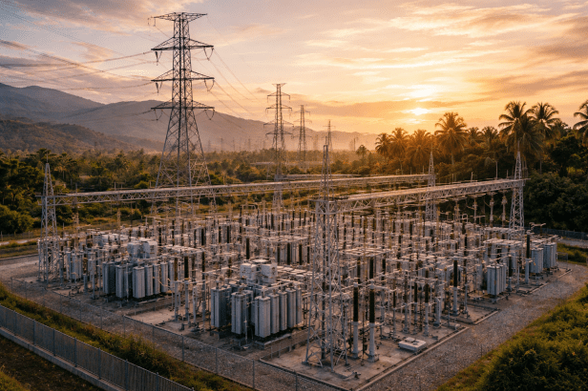
 Tino Eberl
 Lucomo
 Dani (
 Antifascista)


 Cymaphore