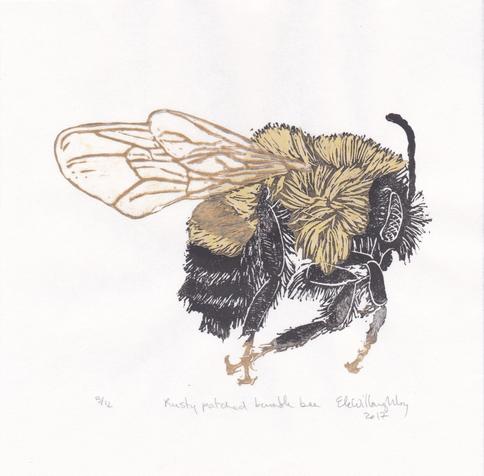
#WildlifeWednesday

🐝 A new effort by the U.S. Fish and Wildlife Service aims to help the endangered rusty patched bumble bee recover.

🐝Since 2000, only 13 states have had confirmed sightings of the rusty patched bumble bee which used to be found from Maine to Georgia West to the Dakotas. (NC is one.)

🐝Roughly 1.5 million acres of land across five states – Illinois, Iowa, Minnesota, Virginia, and Wisconsin, plus West Virginia – has just been designated as critical habitat for the bee.

https://www.fws.gov/species/rusty-patched-bumble-bee-bombus-affinis

@NCConnect

#BumbleBee #RustyPatchedBumbleBee #Biodiversity #NativeBees

Rusty Patched Bumble Bee (Bombus affinis) | U.S. Fish & Wildlife Service

Historically, the rusty patched bumble bee was broadly distributed across the eastern United States, Upper Midwest, and southern Quebec and Ontario in Canada. Since 2000, this bumble bee has been reported from only 13 states and 1 Canadian province: Illinois, Indiana, Iowa, Maine, Maryland, Massachusetts, Minnesota, North Carolina, Ohio, Pennsylvania, Tennessee, Virginia, Wisconsin and Ontario, Canada. Rusty patched bumble bees live in colonies that include a single queen and female workers. The colony produces males and new queens in late summer. Queens are the largest bees in the colony, and workers are the smallest. All rusty patched bumble bees have entirely black heads, but only workers and males have a rusty reddish patch centrally located on the back. Resources for Rusty Patched Bumble Bee Researchers and Surveyors Are you looking for resources on survey protocols, recovery permits, the habitat connectivity model, and maps of the high and low potential zones? Visit our Rusty Patch Bumble Bee Researcher and Surveyor Guidance Library.
FWS.gov

Like other bumble bees it is yellow and black. It is a medium to large bee and males and workers have a distinctive rusty-coloured patch on the second segment of the abdomen. It lives on the nectar of many flowers and can be found in open habitat such as mixed farmland, urban settings, savannah, open woods and sand dunes.

#printmaking #bumblebee #BombusAffinis #rustyPatchedBumblebee #mastoArt 🧵3/3

Day 9 #SciArtSeptember prompt is vanishing. This #linocut print rusty-patched bumble bee (Bombus affinis) is handprinted on Japanese white and yellow papers, 8" x 8". The rusty-patched bumble is a pollinator native to North America and was common here in Ontario as recently as the 1980s. It is now sadly on the brink of extinction, designated federal Species at Risk in Canada.

🧵1/n
#printmaking #bumblebee #sciart #BombusAffinus #RustyPatchedBumblebee #insect #bee #pollinator #conservation

The 3rd Friday in May is Endangered Species Day, so I am sharing the Rusty-patched bumblebee which was common here during my childhood but is likely now extirpated in Canada and endangered in the US.

When we think about endangered species we mustn’t only remember the charismatic megafauna.

#linocut #printmaking #sciart #entomology #bumblebee #rustyPatchedBumblebee #endangeredSpeciesDay #endangeredSpecies

Bumblebees will nest in any suitable sized cavity, so I’m going use #InsertAnInvert2024 prompt “around logs” as my cue to talk about the rusty-patched bumble bee (Bombus affinis). The rusty-patched bumble is a pollinator native to North America and was common here in Ontario as recently as the 1980s. It is now sadly on the brink of extinction, 🧵1/n

#linocut #printmaking #bumblebee #RustyPatchedBumblebee #sciart #ecology #entomology #conservation #MastoArt