I am reviewing processes and recommendations for #SecondaryData analysis projects for our #ResearchEthics Committee, especially ones where data access is centrally managed (e.g., via @UKDataService ). Here, they require standard review.

How is this at your place?

Any views on this?

### ###

NB: Yes, there are many ethical considerations in advance (e.g.,
https://mastodon.social/deck/@jrboehnke/109823124976479472
and for #RoutineData
https://mastodon.social/deck/@jrboehnke/113940722709618338).
My question is about applying for ethics review for such a project.

Preparing an internal workshop on #SecondaryDataAnalysis for tomorrow, brings me back to my thread on the very minimal #ResearchEthics and #ResearchIntegrity checks to perform when one has found a data set:
https://mastodon.social/deck/@jrboehnke/109823124976479472

What I think I have not moved to here, were some brief comments regarding minimum standards for the use of routinely collected data in health services. ๐Ÿงต๐Ÿ‘‡

#RoutineData #RoutinelyCollected

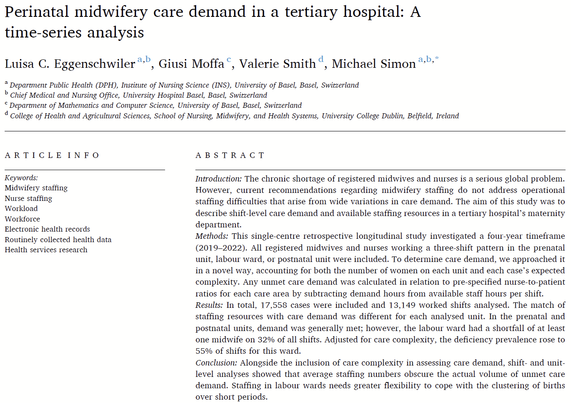
๐Ÿคฐ๐Ÿคฑ๐Ÿ‘ฉโ€๐ŸผPerinatal midwifery care demand in a tertiary hospital: A time-series analysis

New open-access paper: https://doi.org/10.1016/j.ijnsa.2025.100299
Main findings:
๐Ÿงต1/4
 
#Midwifery #staffing #healthservicesresearch #routinedata
@[email protected] @nursingresearch @[email protected] @a_randomwalker @unibasel

๐Ÿ’ธ funded by @snsf_ch

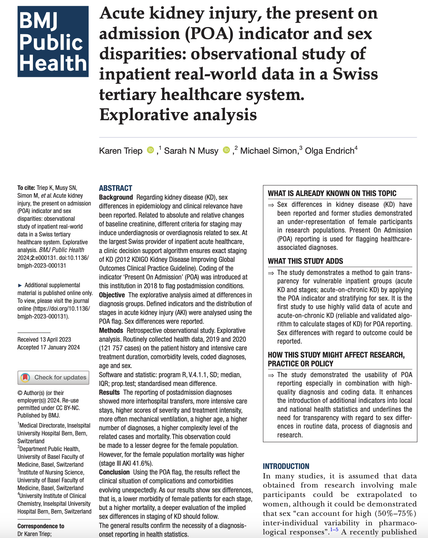
๐Ÿ“ฃ New paper: Using the present on admission (POA) indicator we explored acute #kidney injuries and sex #disparities It's an explorative analysis showing how the POA flag can help to analyse #routinedata more deeply. #realworlddata #openaccess

@nursingresearch

https://bmjpublichealth.bmj.com/content/2/1/e000131

Acute kidney injury, the present on admission (POA) indicator and sex disparities: observational study of inpatient real-world data in a Swiss tertiary healthcare system. Explorative analysis

Background Regarding kidney disease (KD), sex differences in epidemiology and clinical relevance have been reported. Related to absolute and relative changes of baseline creatinine, different criteria for staging may induce underdiagnosis or overdiagnosis related to sex. At the largest Swiss provider of inpatient acute healthcare, a clinic decision support algorithm ensures exact staging of KD (2012 KDIGO Kidney Disease Improving Global Outcomes Clinical Practice Guideline). Coding of the indicator โ€˜Present On Admissionโ€™ (POA) was introduced at this institution in 2018 to flag postadmission conditions.ObjectiveThe explorative analysis aimed at differences in diagnosis groups. Defined indicators and the distribution of stages in acute kidney injury (AKI) were analysed using the POA flag. Sex differences were reported.MethodsRetrospective observational study. Explorative analysis. Routinely collected health data, 2019 and 2020 (121 757 cases) on the patient history and intensive care treatment duration, comorbidity levels, coded diagnoses, age and sex.Software and statistic: program R, V.4.1.1, SD; median, IQR; prop.test; standardised mean difference.ResultsThe reporting of postadmission diagnoses showed more interhospital transfers, more intensive care stays, higher scores of severity and treatment intensity, more often mechanical ventilation, a higher age, a higher number of diagnoses, a higher complexity level of the related cases and mortality. This observation could be made to a lesser degree for the female population. However, for the female population mortality was higher (stage III AKI 41.6%).ConclusionUsing the POA flag, the results reflect the clinical situation of complications and comorbidities evolving unexpectedly. As our results show sex differences, that is, a lower morbidity of female patients for each stage, but a higher mortality, a deeper evaluation of the implied sex differences in staging of KD should follow.The general results confirm the necessity of a diagnosis-onset reporting in health statistics.

BMJ Public Health

On Day 2 #RedemptionWeek, I share our review of healthcare systems data (HSD; sometimes called routinely-collected healthcare data โ€“ RCHD), for clinical trials in the UK, led by @SarahLensen
#routinedata #healthdata

#clinicaltrials #methodology

1/5