Okay, I've figured out how to actually measure the bead seat diameter of a bicycle wheel rim and I've done it and I'm not going to mess around with this anymore, even though I'm sure there's still some systematic error somewhere in my measurements.
I measured the well circumference of each rim with a narrow tape measure hooked over the valve stem hole on each rim. (This one only measures in inches, but I work with what I've got.)
Well diameter in millimeters is 25.4 times the circumference in inches divided by pi.
I measured the flange heights above the well and bead seat using two rulers: one stood up on its edge across the top of the flange, and the other extending down into the rim and resting in the well or on the bead seat, measuring at the bottom of the other ruler.
Bead seat height above the well is the difference in flange heights above the well and above the bead seat.
Finally, the bead seat diameter is the well diameter plus 2 times the bead seat height above the well.
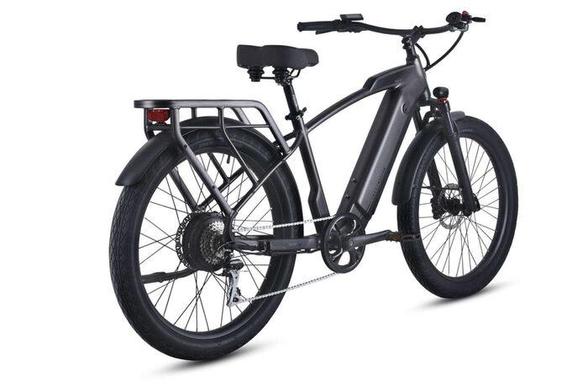
My Ride1Up Roadster V3 wheels are similar in dimensions, but they're both too small. They're 617mm, which is 5mm less than the nominal 622mm.
The Matrix 550 was previously installed on my 2008 Trek 7000 hybrid. It's nominally the same size so I thought it would make for a good comparison as a "normal" wheel which has never given me tire trouble. It's 628mm, which is 6mm more than the nominal 622mm.
I don't think layering on rim tape will be the solution in my case because that would eat into the flange height above the bead seat. The bead won't have the support that it needs. These wheels are just too small.
#Cycling #BikeRepair #EBike #Ride1UP
 Maxwell (it/its)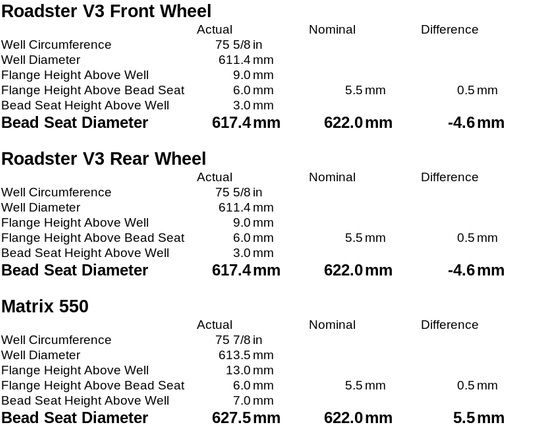
 Cycle Review News
 krissyg