
#OpenScience, #OpenAccess, #Preregistration, #ReplicationResearch – weite Felder. Unser MüCOS, das Münster Centre for Open Science, hat jetzt einige Flyer und CheatSheets dazu entwickelt: https://lukasroeseler.github.io/MueCOS-Infomodule/flyerlanding.html

Flyer & Cheatsheets – Open Science Infomodule

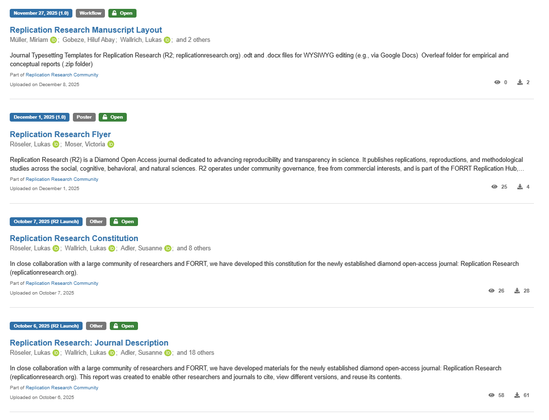
Setting up an entirely new journal involves a lot of work such as website materials, a constitution, submission guideilens, reviewer guidelines, and manuscript stylesheets. This is why, for #replicationresearch you can find all of them versionized and citable in our R2 Community on Zenodo: https://zenodo.org/communities/r2/records

https://openbiblio.social/@replicationresearch

#OpenScience, #OpenAccess, #Preregistration, #ReplicationResearch – weite Felder. Unser MüCOS, das Münster Centre for Open Science unter der Leitung von @aufdroeseler, hat jetzt einige Flyer und CheatSheets dazu entwickelt: https://lukasroeseler.github.io/MueCOS-Infomodule/flyerlanding.html
Flyer & Cheatsheets – Open Science Infomodule

#FOERRT: The need for public opinion and survey methodology research to embrace preregistration and replicati[...]

This Resource has been tagged with 'Preregistration', 'Replication' and 'Public Opinion' and is available in English.

It's aimed at the Undergraduate, Graduate/Professional, Career/Technical and Adult-Education levels in Social Science.

You can find it here: https://forrt.org/curated_resources/976_the-need-for-public-opinion-and-survey-m

#Preregistration #ReplicationResearch #OpenScience #OER

#FOERRT: SPSP experts - open science

This Teaching/Learning Strategy / Video has been tagged with 'Video' and 'Reproducibility Knowledge' and is available in English.

It's aimed at the Undergraduate level in Applied Science, Math & Statistics and Social Science.

You can find it here: https://forrt.org/curated_resources/365_spsp-experts-open-science

#ConceptualandStatisticalKnowledge #ReproducibleAnalyses #Preregistration #OpenData #ReplicationResearch #OpenScience #OER

#FOERRT: Statistical Modeling, Causal Inference, and Social Science

This Resource has been tagged with 'Blog' and 'Reproducibility Knowledge' and is available in English.

It's aimed at the Undergraduate and Graduate/Professional levels in Math & Statistics.

You can find it here: https://forrt.org/curated_resources/335_statistical-modeling-causal-inference-an

#ConceptualandStatisticalKnowledge #ReproducibleAnalyses #Preregistration #OpenData #ReplicationResearch #OpenScience #OER

#FOERRT: Registered replication report: Schooler and engstler-schooler (1990).

This Paper has been tagged with 'Transparency' and 'Registered Reports' and is available in English.

It's aimed at the Undergraduate level in Applied Science and Social Science.

You can find it here: https://forrt.org/curated_resources/648_registered-replication-report-schooler-a

#Preregistration #ReplicationResearch #OpenScience #OER

Registered replication report: Schooler and engstler-schooler (1990).

Trying to remember something now typically improves your ability to remember it later. However, after watching a video of a simulated bank robbery, participants who verbally described the robber were 25% worse at identifying the robber in a lineup than w

FORRT - Framework for Open and Reproducible Research Training

#FOERRT: Repligate: Reliability and Reproducibility in Psychology Syllabus

This Syllabus has been tagged with 'Reproducibility Crisis and Credibility Revolution' and is available in English.

It's aimed at the Undergraduate and Graduate / Professional level in Social Science.

You can find it here: https://osf.io/ms7ix/

#Reproducibility #ConceptualandStatisticalKnowledge #ReproducibleAnalyses #Preregistration #OpenData #ReplicationResearch #Replicability #OpenScience #OER

OSF

#FOERRT: ‘‘Positive’’ Results Increase Down the Hierarchy of the Sciences
This Paper has been tagged with 'Reproducibility Crisis and Credibility Revolution' and is available in English.
It's aimed at the Undergraduate level in Applied Science and Social Science.
You can find it here: https://doi.org/10.1371/journal.pone.0010068
#Reproducibility #ReplicationResearch #Replicability #OpenScience #OER
“Positive” Results Increase Down the Hierarchy of the Sciences

The hypothesis of a Hierarchy of the Sciences with physical sciences at the top, social sciences at the bottom, and biological sciences in-between is nearly 200 years old. This order is intuitive and reflected in many features of academic life, but whether it reflects the “hardness” of scientific research—i.e., the extent to which research questions and results are determined by data and theories as opposed to non-cognitive factors—is controversial. This study analysed 2434 papers published in all disciplines and that declared to have tested a hypothesis. It was determined how many papers reported a “positive” (full or partial) or “negative” support for the tested hypothesis. If the hierarchy hypothesis is correct, then researchers in “softer” sciences should have fewer constraints to their conscious and unconscious biases, and therefore report more positive outcomes. Results confirmed the predictions at all levels considered: discipline, domain and methodology broadly defined. Controlling for observed differences between pure and applied disciplines, and between papers testing one or several hypotheses, the odds of reporting a positive result were around 5 times higher among papers in the disciplines of Psychology and Psychiatry and Economics and Business compared to Space Science, 2.3 times higher in the domain of social sciences compared to the physical sciences, and 3.4 times higher in studies applying behavioural and social methodologies on people compared to physical and chemical studies on non-biological material. In all comparisons, biological studies had intermediate values. These results suggest that the nature of hypotheses tested and the logical and methodological rigour employed to test them vary systematically across disciplines and fields, depending on the complexity of the subject matter and possibly other factors (e.g., a field's level of historical and/or intellectual development). On the other hand, these results support the scientific status of the social sciences against claims that they are completely subjective, by showing that, when they adopt a scientific approach to discovery, they differ from the natural sciences only by a matter of degree.