 Thoughtful Disclaimer
The Bug That Painted Europe Red (and Made Spain Very Rich)
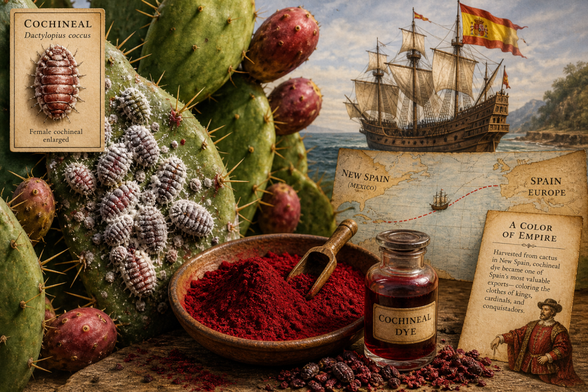
Close-up of cochineal insects on cactus producing bright red dye pigmentDear Cherubs,
Europe once had a red problem. Not the political kind—the fashion kind. Their dyes were dull, faded fast, and frankly a bit embarrassing.
Then Spain showed up with something that made everything else look like a washed-out sock.
THE SECRET IN THE CACTUS
The star of this story is the cochineal insect, a tiny creature that lives on prickly pear cacti. Indigenous peoples in what is now Mexico had been farming it for centuries, extracting a vivid red pigment called carminic acid. It’s giving luxury, but make it microscopic.
When the Spanish arrived during the conquest of the Aztec Empire in the early 16th century, they quickly realized this wasn’t just a local craft—it was liquid gold. According to the British Museum, cochineal produced a far more intense and long-lasting red than anything available in Europe at the time.
So Spain did what empires tend to do: they took the product, scaled it, and kept the source a closely guarded secret.
RED, BUT MAKE IT EXCLUSIVE
Back in Europe, the demand exploded. This wasn’t just any red—it was rich, deep, and didn’t fade into sadness after a few washes. Royalty, the Catholic Church, and anyone with a decent budget wanted in.
According to the Victoria and Albert Museum, cochineal became one of Spain’s most valuable exports, second only to silver. Let that sink in. Tiny bugs beat most commodities.
It took around 70,000 insects to produce a single pound of dye, according to Smithsonian Magazine. So yes, that luxurious crimson robe? It’s basically a mass insect effort. Hope you like commitment.
Artists were equally obsessed. Painters like Rembrandt and Titian used the pigment to achieve those dramatic reds that still pop centuries later. It wasn’t just fashion—it was cultural influence in full color.
Spain controlled the trade for nearly 300 years, exporting the dried insects across Europe while keeping everyone else guessing. It wasn’t until the 18th century that other countries managed to smuggle the cactus and insects out and start their own production.
Of course, nothing stays on top forever. The invention of synthetic dyes in the 19th century, as noted by the Science History Institute, eventually pushed cochineal out of the spotlight. Cheaper, easier, less… insect-heavy.
Still, cochineal never fully disappeared. Today it’s used in food, cosmetics, and textiles—often listed as “E120” if you’re reading labels and suddenly feeling curious about your yogurt.
Hot take: Europe didn’t just import a dye. It imported a whole new standard of luxury, powered by insects and a very clever bit of agricultural know-how.
For more deep dives into strange global trade stories and overlooked innovations, you can explore insights on thisclaimer.com and their YouTube channel, where topics like this get unpacked with equal parts curiosity and context.
Sources list — plain text
British Museum — https://www.britishmuseum.org/collection/term/BIOG124866
Victoria and Albert Museum — https://www.vam.ac.uk/articles/cochineal
Smithsonian Magazine — https://www.smithsonianmag.com/arts-culture/bug-that-changed-history-180962611/
Science History Institute — https://www.sciencehistory.org/stories/magazine/cochineal-the-red-dye-of-the-americas/
thisclaimer.com — https://thisclaimer.com

 Norbert_R 🦣
 🐘
🐘
 Steve Dustcircle 🌹
 Jason Stiff
 AL
AL