 Richard Rathe
Thanks!
His "Claim #3" seems to agree with me... "A diamond tarp is a good compromise between good coverage and easy set-up verses an asym tarp."
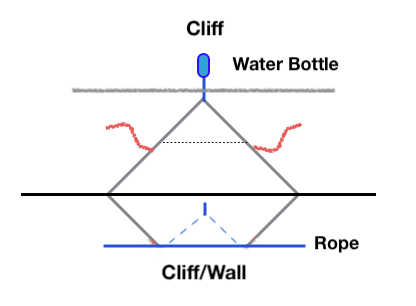
I will probably add "half-way" tie-outs (orange lines in graphic) to the diamond tarp I've used for years. I've been in situations (cliffs) where I've strung a line between two-trees, and folded the point of the tarp around that line and back under the hammock. (blue line in graphic) This also works when up against a rock wall or similar.
I've actually had a lot of experience pitching on "cliff edges" (usually no more than 20-30ft drop). For one I just tied to a full 1L water bottle (could use a bag of rocks, etc.) and let it hang over the edge. (top of graphic)
Of course if you are sleeping under the stars and have a spreader pole you don't need ANY extra lines (other than two trees and the hammock straps). 🙂
https://mdpaths.com/rrr/camping/hammocks/hammock_guide/index.html