
Полезные утилиты RTT Viewer и System Viewer

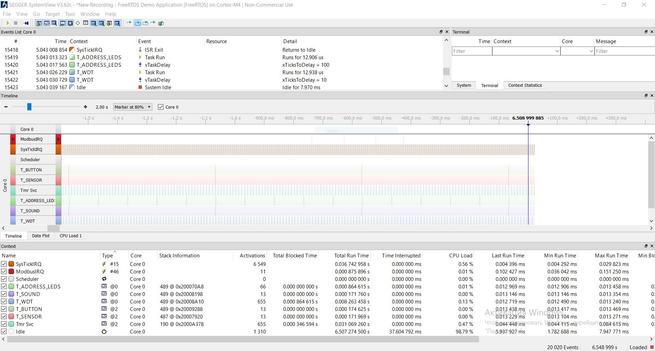
Хорошие инструменты для отладки встраиваемого ПО микроконтроллеров давно стали делом привычным. Возможности таких инструментов определяются как архитектурой ядра, так и выбором отладчика. Рассмотрим три понятия: DAP (Debug access port), ITM (Instrumentation Trace Macrocell) и RTT (Real-Time Transfer). Всё это «механизмы» позволяющие выводить отладочную информацию в том или ином виде. DAP – это аппаратный блок, который дает доступ к шинам и ядру микроконтроллера. ITM – это специальный блок внутри Cortex-M (начиная с M3 и выше), предназначенный для сообщений с минимальными потерями времени. RTT – технология компании SEGGER, построенная на использовании кольцевого буфера внутри RAM. Именно о ней и пойдет речь в публикации.

https://habr.com/ru/articles/1011650/

#RTT_Viewer #System_Viewer #rtos #программирование_микроконтроллеров #printf
Полезные утилиты RTT Viewer и System Viewer

Хорошие инструменты для отладки встраиваемого ПО микроконтроллеров давно стали делом привычным. Возможности таких инструментов определяются как архитектурой ядра, так и выбором отладчика. Рассмотрим...

Хабр
Da ich mich gerade ein wenig mit Digitaler Signalverarbeitung beschäftige, suche ich ein #RTOS, mit dem ich harte Realtime Tasks laufen lassen kann. Dabei bin ich über #RTIC gestolpert und habe es gerade mal auf einem STM32H7A3 zum Laufen gebracht. Die Tage werde ich es mal weiter testen und schauen, ob ich darauf aufsetzen werde. #rust #rustlang

The article Design of Prototyping Control Unit for BLDC/PMSM Drives and Piezoelectric Actuators documenting our work on #NuttX #RTOS and #pysimCoder has been published. It documents SaMoCon Open HW and SW motion control platform as well.

We have submitted another related presentation to the Apache Community Over Code 2026 in Glasgow, from October 10 to 15. The NuttX call for presentations is still open for this event.

We hope to be available on Open Source Summit Europe in Prague in October, if the price bar/access rules allow that to our students and us, and we will be available (for sure) at #LinuxDays in Prague, which is (in a contrast) a really freely accessible community organized event in Prague with long history, and this year exactly before @linuxplumbersconf and Open Source Summit Europe

Zephyr Turns 10.
A decade of open governance and real-world deployment.
New Linux Foundation research confirms strong global adoption and long-lifecycle production use.

Most organizations plan to grow their Zephyr footprint. Many already rely on it in commercial products designed to operate for years.
The next phase focuses on maintenance, certifications, and ecosystem resilience.
Read the report and get involved.
https://www.linuxfoundation.org/research/zephyr-turns-10

#Zephyr #OpenSource #RTOS #LinuxFoundation #IoT

Zephyr® Turns 10: A Decade of Adoption, Maturity, and Ecosystem Evolution

Zephyr® Turns 10: A Decade of Adoption, Maturity, and Ecosystem Evolution

Grinn ReneSOM-V2H is a tiny LGA SoM based on Renesas RZ/V2H processor for vision AI applications

Polish embedded systems company Grinn has recently introduced ReneSOM-V2H, a tiny vision AI SoM built around the Renesas RZ/V2H vision AI processor. Measuring just 42.6 x 37 mm, Grinn claims it is the world’s smallest module based on this specific Renesas MPU, and targets space-constrained Edge AI applications such as smart cameras, robotics, and industrial automation. The RZ/V2H SoC features a heterogeneous architecture with 4x Cortex-A55 cores, 2x Cortex-R8 cores, and 1x Cortex-M33 core, along with a DRP-AI3 accelerator with up to 8 TOPS. It supports LPDDR4 memory and eMMC storage, along with various connectivity options, including PCIe Gen3 (4-lane), USB 3.2, USB 2.0, and Gigabit Ethernet. It also provides four MIPI-CSI camera inputs and a MIPI-DSI display output for vision applications. Grinn ReneSOM-V2H specifications: SoC – Renesas RZ/V2H CPU/MCU cores 4x Arm Cortex-A55 cores up to 1.8 GHz 2x Cortex-R8 real-time cores up to 800 MHz Arm Cortex-M33 microcontroller core up

CNX Software - Embedded Systems News
The Hidden Costs of Using Zephyr (and How to Mitigate Them) - Shawn Hymel

Over the past few years, I've been excited to watch Zephyr grow and evolve. It’s modern, actively maintained, vendor-neutral, and backed by a large community.

Shawn Hymel

@cstross @alex_p_roe @timo21

Amusing aside on that score:

I looked at Lynx's vaunted 1991-patented interrupt handling for #LynxOS.

There's prior art for it in the forms of KMOS, an operating system used for teaching purposes by Milan Milenković (who published a book on operating systems in 1987 describing kernel-task-based interrupt handling), and indeed in #Minix too.

#OperatingSystems #KMOS #MessagePassing #SystemsProgramming #RTOS

LR2021 LoRa Plus board combines Semtech LR2021 and Nordic nRF54L15 for high-speed FLRC and LoRa connectivity

Last year, Semtech released the Semtech LR2021 LoRa Plus transceiver chip, designed to address the low data-rate issue associated with LoRa, but surprisingly, they didn't release a development board for the chip. Now, almost a year later, Seeed Studio and Semtech have partnered to introduce the LR2021 LoRa Plus development Kit targeting long-range high-speed LoRa and FLRC applications up to 2.6 Mbps. Not only does the board support LoRa Gen 4 technology, providing Sub-GHz, 2.4 GHz ISM, and S/L-band operation, but a XIAO nRF54L15 board also adds dual-core processing (Arm Cortex-M33 + RISC-V) and supports other short-range protocols, including NFC, Bluetooth LE 6.0, Matter, Thread, and 2.4 GHz proprietary protocols. The development board also features a 0.96-inch 128×64 OLED, three Grove connectors for expansion, a USB Type-C for power, SWD debugging, and two Sub-GHz and 2.4 GHz SMA connectors. It is compatible with Arduino Uno, STM32 Nucleo, and Nordic DK

CNX Software - Embedded Systems News
Open Stack standalone 4G LTE IoT board runs RTOS on Quectel EC200 LTE module (Crowdfunding)

Open Stack is a standalone 4G LTE IoT connectivity board designed to run RTOS-based C applications directly on the Quectel EC200 series LTE module, meaning you don't need an external MCU like Arduino, ESP32, or Raspberry Pi. By removing the MCU, the board reduces power consumption, bill-of-materials (BOM) cost, and physical footprint. The board supports multi-band LTE with GSM fallback, GNSS, and Bluetooth 4.2, as well as IPv4/IPv6 client and server modes. It also includes a USB Type-C port, a Nano SIM card slot, LTE/GNSS/BLE antenna connectors, an OLED information display, status LEDs, control buttons, and a 40-pin Raspberry Pi HAT-compatible GPIO header. Networking support includes TCP/UDP, SSL/TLS, HTTP/HTTPS, MQTT, LwM2M, CoAP, FTP/FTPS, and PPP, making it suitable for asset tracking, industrial monitoring, BLE-to-LTE gateways, remote infrastructure, and always-connected IoT deployments without additional controller hardware. Open Stack specifications: Cellular Module - Quectel EC200U-CN series (EC200UCNAA-N05-SGNSA) module Cellular Connectivity: LTE FDD

CNX Software - Embedded Systems News
Ariel OS – A Rust RTOS for IoT microcontrollers

Ariel OS is a new RTOS for microcontrollers written in Rust with support for popular hardware architectures (Arm Cortex-M, ESP32, RISC-V) and boards from Espressif, Nordic Semi, Raspberry Pi, and STMicroelectronics. Ariel OS is built on top of Embassy Rust framework and embedded-hal Hardware Abstraction Layer (HAL) for embedded systems, and adds several OS functionalities and a multi-core capable scheduler. It is mainly designed for secure, memory-safe, networked applications on microcontrollers. The developers further describe Ariel OS as follows on the project's website: Ariel OS follows an approach whereby it simultaneously integrates a curated ecosystem of libraries (available via crates.io), and adds missing operating system functionalities as depicted below. Such functionalities include a preemptive multicore scheduler, portable peripheral APIs, additional network security facilities, as well as a meta-build system to bind it all together. As a result, a low-power IoT developer can focus on business logic sitting on top of

CNX Software - Embedded Systems News