
Originally from Hristo H. here: https://www.linkedin.com/posts/hristo-sv-hristov_quantitativefinance-tradingstrategies-backtesting-activity-7449676947430965250-sFQ4

The 9 Deadly Sins of Backtesting (and How to Fix Them) - Part I

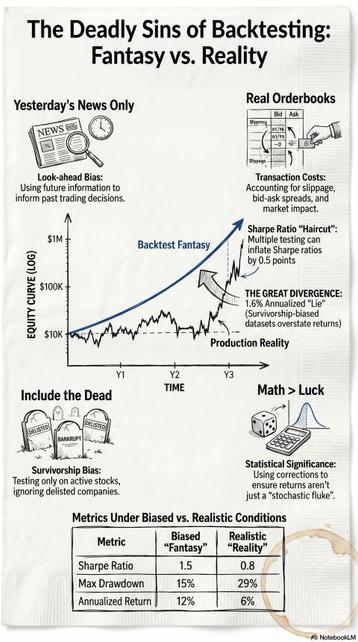
Many trading strategies do not fail because of unforeseen market events; they fail at their inception—specifically, the moment the researcher ceases to maintain absolute rigor in the backtesting environment. The fundamental premise of successful quantitative research is not the discovery of clever signals, but the systematic and ruthless elimination of bad ideas through the identification of false positives. On paper, you see a clean equity curve; in production, the profits disappear.

1. Survivorship Bias:
This error occurs when a researcher focuses exclusively on assets that have survived a selection process while overlooking those that did not, leading to a sample that is fundamentally unrepresentative of the historical population. For example, a momentum strategy applied to the S&P 100 can yield a 26% CAGR, but once failed and delisted companies are reintegrated, the edge plummet to 12.2%. In the Nasdaq 100, the discrepancy is even more extreme, with drawdowns exploding from 41% to 83% when "forgotten" losses are included. Fix: Point-in-time (PIT) data. This means using a database that reproduces the exact information available at the historical moment, ensuring you only trade assets that were actually listed and tradable on that specific day.

2. Forward-Looking Bias:
Often called "trading with tomorrow's newspaper," this involves incorporating information into a signal that would not have been available at the moment of execution. A primary culprit is backward price adjustment: if a stock trades at $100 on Jan 1 and splits 2:1 on Feb 1, a backward-adjusted dataset will rewrite the Jan 1 price to $50. Any signal using a price filter on Jan 1 effectively "knows" the split is coming. Fix: Use raw prices for signals and forward price adjustment (anchoring to the first available date) for performance measurement to maintain temporal integrity.

3. Transaction Costs:
Many strategies show a small edge that evaporates once realistic costs are applied. Standard OHLCV data often suffers from "outlying" values due to small orders at regional exchanges and cannot capture the reality of market depth or slippage. Fix: Use Transaction Cost Analysis (TCA) benchmarks like Arrival Price—the mid-quote price at the moment the order is submitted—and model non-linear market impact that grows with your order size.

4. Statistical Significance:
In finance, we routinely accept discoveries where the t-statistic exceeds 2.0, yet a 10-trade "hot streak" is often just a stochastic realization of noise. Relying on small sample sizes provides a distorted picture of a strategy's true predictive power. Fix: Look for hundreds or thousands of independent "bets" across the timeline. Use a t-stat > 2.0 as a bare minimum requirement to ensure results are unlikely to have occurred by chance.

To be continued ...
#QuantitativeFinance #TradingStrategies #Backtesting #DataScience #FinTech #AlgorithmicTrading
The frontier of Alpha is moving. 🚀

Breakthroughs in 2026: LLMs meet Quant Finance.

Trends:
1️⃣ Symmetry-aware Transformers
2️⃣ Specialized "Quant-LLMs"
3️⃣ LLMs as Financial OS

The intersection of AI & Finance is the new standard.

#QuantitativeFinance #AI #LLM #MayaInsight 🐱

ojAlgo integrates Clarabel via our clarabel4j https://github.com/atraplet/clarabel4j:

"CPLEX handles 94% of the cases (...). JOptimizer, (...), has been replaced with Clarabel4j – and it performs really well. Apart from good execution times it handles all the cases (100% success rate)."

https://www.ojalgo.org/2026/01/qp-news/ #optimization #java #ai #machinelearning #datascience #quantitativefinance #programming

GitHub - atraplet/clarabel4j: Clarabel Solver for Java

Clarabel Solver for Java. Contribute to atraplet/clarabel4j development by creating an account on GitHub.

GitHub

Cơ hội hợp tác dự án Tài chính số: Tìm người tham gia phát triển hệ thống tự động 24/7 với Python, phân tích dữ liệu, API và giải pháp tối ưu hiệu năng. Dự án tập trung vào thị trường tiền mã hóa, mở rộng trong tương lai. Cộng sự quốc tế, sử dụng Discord & Obsidian. Ưu tiên người có cam kết, kỹ năng kỹ thuật mạnh. Có cơ hội hợp tác dài hạn và lợi nhuận. DM để tham gia! #QuantitativeFinance #TàiChínhSố #Python #DataAnalysis #Crypto #TiềnMãHóa #RemoteWork #LàmViệcTừAf

https://www.reddit.com/r/Sid

🌟 KIẾN TẢO SỞ CỦA STARTUP QUANT TỰ ĐỘNG CHỈ 5USD/THÁNG! 🌟
Strategy Grade xây dựng nền tảng backtest dựa trên độ bền vững thống kê - không phải lợi nhuận đơn thuần. Sử dụng Next.js + Supabase + Python chạy trên Railway giá siêu rẻ ($5/tháng). 12,000 mô phỏng/ngày kiểm tra chiến lược bằng 50 permutation Monte Carlo, tự động hóa 100%. Gói cao cấp 29USD/tháng mở khóa mã & log giao dịch. #QuantitativeFinance #SaaS #StartupVietNam #Python #Nextjs

https://www.reddit.com/r/SideProject/comments/1pk9

Portfolio optimization with Java 25 LTS, Kotlin notebooks, and clarabel4j https://github.com/atraplet/portfolio-optimization #optimization #java #quantitativefinance
GitHub - atraplet/portfolio-optimization: Solve a Markowitz portfolio optimization problem with clarabel4j

Solve a Markowitz portfolio optimization problem with clarabel4j - atraplet/portfolio-optimization

GitHub
Clarabel4j is now ready to be used with the latest Java 25 LTS. In the latest release, it also supports the linear solvers from Faer and Intel MKL Pardiso. https://github.com/atraplet/clarabel4j #optimization #java #ai #machinelearning #datascience #quantitativefinance #programming
GitHub - atraplet/clarabel4j: Clarabel Solver for Java

Clarabel Solver for Java. Contribute to atraplet/clarabel4j development by creating an account on GitHub.

GitHub

Damir Filipović, named best teacher in the financial engineering section for 2024, could very well have pursued a career in pure mathematics but instead chose the tumultuous field of quantitative finance.

And he loves his chalkboard! https://go.epfl.ch/8482a1

#EPFL #BestTeacher #quantitativefinance

“My chalkboard isn't going away anytime soon!”

Damir Filipović, named best teacher in the financial engineering section for 2024, could very well have pursued a career in pure mathematics but instead chose the tumultuous field of quantitative finance.

I am excited to announce that clarabel4j (Clarabel Solver for #java) is now released and open-source https://www.ustermetrics.com/post/clarabel-solver-for-java/ #optimization #java #ai #machinelearning #datascience #quantitativefinance #programming
Clarabel Solver for Java | Uster Metrics

We are excited to announce that clarabel4j (Clarabel Solver for Java) is now released and open-source! After ecos4j it is our second library that provides an interface from the Java programming language to a native open source mathematical programming solver.

Uster Metrics
#DolphinDB, a leading provider of real-time platform for analytics and streaming, and #TimeStored, a pioneering company in data #visualization and analytics, are proud to announce a partnership for advancing data visualization in #quantitativefinance! ➡️https://dolphindb.com/news/detail/221
- DolphinDB