🧵 (5/5) In trading, end-to-end latency from sensing the market to executing the action (new order single, amend, cancellation) determines whether the agent's reward signal is meaningful or just random noise.

Cross disciplinary research rocks. More later.

#ReinforcementLearning #AlgorithmicTrading #Latency #JohnCarmack #HighFrequencyTrading #Trading

Prop Firm Risk Management I Tested 7 Accounts and Kept 2

Most prop firm risk management advice is backwards. On March 14, 2025, at 9:31 a.m., I watched a $1,140 NQ loss print on NinjaTrader through Rithmic while a Topstep eval sat one click away from done.

https://runvigil.app/blog/prop-firm-risk-management-i-tested-7-accounts-and-kept-2

#proptrading #algorithmictrading #investing #finance #stocks

Prop Firm Risk Management I Tested 7 Accounts and Kept 2 | Vigil

A 4-month review of FTMO, Topstep, and Apex after one $1,140 mistake and a cleaner process.

Vigil

#python #algorithmictrading #technology #fintech #finance
#risk #btc #gold
#stockmarket
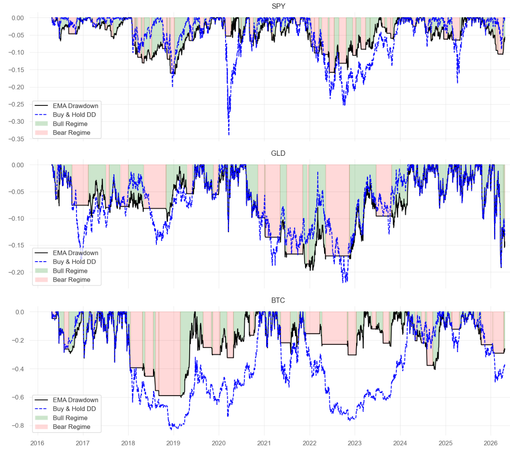
Backtesting Moving Averages Across Multiple Asset Classes — Part 3: EMA

Python-Based EMA Backtesting Across Asset Classes: Out-of-Sample Performance, Volatility, and Drawdowns

#exploremore 👇

https://medium.com/@alexzap922/backtesting-moving-averages-across-multiple-asset-classes-part-3-ema-d73cdaf52d9b?sk=a42a43edcbcda4aea7019bc5056ee697

#python #technology #algorithmictrading #code #programming
#datascience #simulation #statistics #stochastic
#volatility #trading #realtime
#stockmarket
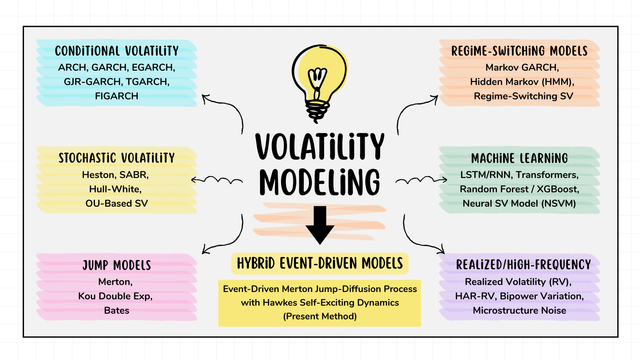
Volatility Clustering in an Intraday Multi-Asset Universe Using Merton–Hawkes Jump-Diffusion Simulations in Python

Combining return bootstrapping with self-exciting jump dynamics across stocks, ETFs, indices, and BTC for market microstructure analysis and Monte Carlo scenario testing

#exploremore 👇

https://medium.com/@alexzap922/volatility-clustering-in-an-intraday-multi-asset-universe-using-merton-hawkes-jump-diffusion-475926069191?sk=076aec351e9c1f950ff950f36d52ff6c

Originally from Hristo H. here: https://www.linkedin.com/posts/hristo-sv-hristov_quantitativefinance-tradingstrategies-backtesting-activity-7449676947430965250-sFQ4

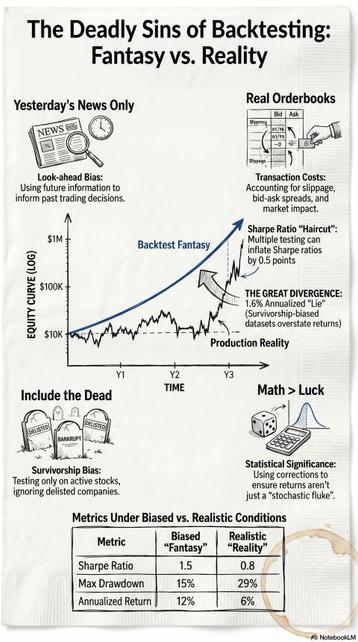
The 9 Deadly Sins of Backtesting (and How to Fix Them) - Part I

Many trading strategies do not fail because of unforeseen market events; they fail at their inception—specifically, the moment the researcher ceases to maintain absolute rigor in the backtesting environment. The fundamental premise of successful quantitative research is not the discovery of clever signals, but the systematic and ruthless elimination of bad ideas through the identification of false positives. On paper, you see a clean equity curve; in production, the profits disappear.

1. Survivorship Bias:
This error occurs when a researcher focuses exclusively on assets that have survived a selection process while overlooking those that did not, leading to a sample that is fundamentally unrepresentative of the historical population. For example, a momentum strategy applied to the S&P 100 can yield a 26% CAGR, but once failed and delisted companies are reintegrated, the edge plummet to 12.2%. In the Nasdaq 100, the discrepancy is even more extreme, with drawdowns exploding from 41% to 83% when "forgotten" losses are included. Fix: Point-in-time (PIT) data. This means using a database that reproduces the exact information available at the historical moment, ensuring you only trade assets that were actually listed and tradable on that specific day.

2. Forward-Looking Bias:
Often called "trading with tomorrow's newspaper," this involves incorporating information into a signal that would not have been available at the moment of execution. A primary culprit is backward price adjustment: if a stock trades at $100 on Jan 1 and splits 2:1 on Feb 1, a backward-adjusted dataset will rewrite the Jan 1 price to $50. Any signal using a price filter on Jan 1 effectively "knows" the split is coming. Fix: Use raw prices for signals and forward price adjustment (anchoring to the first available date) for performance measurement to maintain temporal integrity.

3. Transaction Costs:
Many strategies show a small edge that evaporates once realistic costs are applied. Standard OHLCV data often suffers from "outlying" values due to small orders at regional exchanges and cannot capture the reality of market depth or slippage. Fix: Use Transaction Cost Analysis (TCA) benchmarks like Arrival Price—the mid-quote price at the moment the order is submitted—and model non-linear market impact that grows with your order size.

4. Statistical Significance:
In finance, we routinely accept discoveries where the t-statistic exceeds 2.0, yet a 10-trade "hot streak" is often just a stochastic realization of noise. Relying on small sample sizes provides a distorted picture of a strategy's true predictive power. Fix: Look for hundreds or thousands of independent "bets" across the timeline. Use a t-stat > 2.0 as a bare minimum requirement to ensure results are unlikely to have occurred by chance.

To be continued ...
#QuantitativeFinance #TradingStrategies #Backtesting #DataScience #FinTech #AlgorithmicTrading

🚫 Stop Guessing: Take Control of Your Indian Portfolio with Foliolytics! 🇮🇳

YouTube
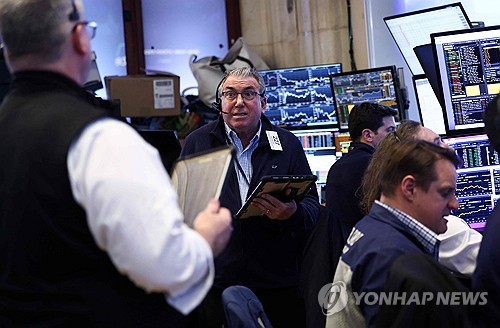
Goldman Sachs forecasts CTAs will purchase $34 billion in S&P 500 stocks next week, potentially liquidating $30 billion in short positions and shifting to long positions as momentum-based algorithmic trading continues to drive market flows following recent $3.8 billion net buying session
#YonhapInfomax #CommodityTradingAdvisors #SP500 #GoldmanSachs #ShortPositions #AlgorithmicTrading #Economics #FinancialMarkets #Banking #Securities #Bonds #StockMarket
https://en.infomaxai.com/news/articleView.html?idxno=114832
Goldman Sachs Expects CTAs to Buy $34 Billion in S&P 500 Stocks Next Week

Goldman Sachs forecasts CTAs will purchase $34 billion in S&P 500 stocks next week, potentially liquidating $30 billion in short positions and shifting to long positions as momentum-based algorithmic trading continues to drive market flows following recent $3.8 billion net buying session

Yonhap Infomax
📑 Ein #Handelsalgorithmus ist ein mathematischer Algorithmus, der den Kauf oder Verkauf von Wertpapieren automatisch auf Grundlage vordefinierter Regeln und Bedingungen durchführt. #AlgorithmicTrading #Börse
Foreign investors show net selling on KOSPI despite $4.5 billion inflows into US-listed Korea ETFs, as active fund outflows exceed passive inflows amid rising algorithmic trading activity that has pushed turnover rates to 3-year highs at 28%.
#YonhapInfomax #KoreanETFs #ForeignInvestors #AlgorithmicTrading #KOSPI #TurnoverRate #Economics #FinancialMarkets #Banking #Securities #Bonds #StockMarket
https://en.infomaxai.com/news/articleView.html?idxno=107629
[Foreign Selling] Korean ETFs Listed in US See Inflows, But Active Outflows Larger

Foreign investors show net selling on KOSPI despite $4.5 billion inflows into US-listed Korea ETFs, as active fund outflows exceed passive inflows amid rising algorithmic trading activity that has pushed turnover rates to 3-year highs at 28%.

Yonhap Infomax