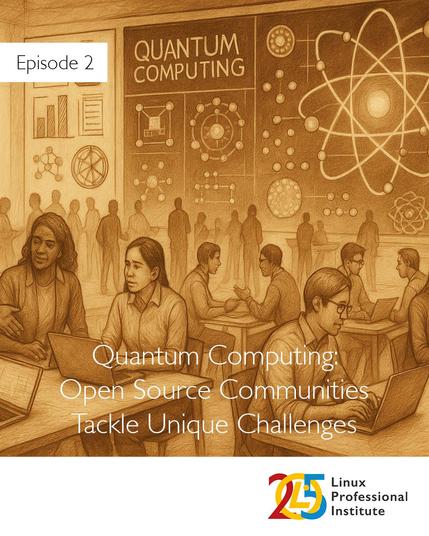
From Japan’s labs to Canada’s research hubs, #FOSS is driving the leap from #quantum research to real-world impact 💪 ⚛️🖥️

Explore Part 2 of this series as Linux Professional Institute (LPI) Editor Andrew Oram dives into #QuTiP, an #opensource toolkit advancing science and careers despite funding and governance hurdles: https://lpi.org/2to2

@LPI #LPI #QuantumComputing #opensource #FOSS #python #QuTiP #QuantumResearch #DevOps #IT #Tech #toolkit #OQTOPUS @ClassiqTechnologies

Developing quantum #physics simulation software in #Python?
#EuroSciPy2025 wants your proposals on quantum dynamics, quantum information processing, or quantum control systems.
Help us understand the quantum world!

CfP is open: https://pretalx.com/euroscipy-2025/cfp

#EuroSciPy #QuTiP

EuroSciPy 2025

Schedule, talks and talk submissions for EuroSciPy 2025

La nostra ricerca teorica sulla creazione di #entanglement tra atomi in cavità ottica tramite misure continue mostra una buona scalabilità dello spin squeezing.

A. Caprotti, ora dottorando presso l'Univ. di Vienna, ha svolto un ruolo cruciale nelle simulazioni #quantum utilizzando #QuTiP.

Motivati dallo sviluppo dell'orologio ottico allo Sr in INRiM da M. G. Tarallo e M. Barbiero, abbiamo beneficiato dall'esperienza di M. G. Genoni sulla dinamica condizionale.

https://arxiv.org/abs/2311.15725

Analysis of spin-squeezing generation in cavity-coupled atomic ensembles with continuous measurements

We analyze the generation of spin-squeezed states via coupling of three-level atoms to an optical cavity and continuous quantum measurement of the transmitted cavity field in order to monitor the evolution of the atomic ensemble. Using analytical treatment and microscopic simulations of the dynamics, we show that one can achieve significant spin squeezing, favorably scaling with the number of atoms $N$. However, contrary to some previous literature, we clarify that it is not possible to obtain Heisenberg scaling without the continuous feedback that is proposed in optimal approaches. In fact, in the adiabatic cavity removal approximation and large $N$ limit, we find the scaling behavior $N^{-2/3}$ for spin squeezing and $N^{-1/3}$ for the corresponding protocol duration. These results can be obtained only by considering the curvature of the Bloch sphere, since linearizing the collective spin operators tangentially to its equator yields inaccurate predictions. With full simulations, we characterize how spin-squeezing generation depends on the system parameters and departs from the bad cavity regime, by gradually mixing with cavity-filling dynamics until metrological advantage is lost. Finally, we discuss the relevance of this spin-squeezing protocol to state-of-the-art optical clocks.

arXiv.org

Our theoretical study on #entanglement among atoms in an optical cavity, measuring transmitted light, shows favorable scaling of spin squeezing, even in the absence of continuous feedback.

A. Caprotti, now a PhD at the Univ. of Vienna, played a pivotal role in #quantum simulations using #QuTiP.

Motivated by M. G. Tarallo and M. Barbiero, developing the Strontium optical clock at INRiM, we benefited from M. G. Genoni's expertise on conditional dynamics.

https://arxiv.org/abs/2311.15725

Analysis of spin-squeezing generation in cavity-coupled atomic ensembles with continuous measurements

We analyze the generation of spin-squeezed states via coupling of three-level atoms to an optical cavity and continuous quantum measurement of the transmitted cavity field in order to monitor the evolution of the atomic ensemble. Using analytical treatment and microscopic simulations of the dynamics, we show that one can achieve significant spin squeezing, favorably scaling with the number of atoms $N$. However, contrary to some previous literature, we clarify that it is not possible to obtain Heisenberg scaling without the continuous feedback that is proposed in optimal approaches. In fact, in the adiabatic cavity removal approximation and large $N$ limit, we find the scaling behavior $N^{-2/3}$ for spin squeezing and $N^{-1/3}$ for the corresponding protocol duration. These results can be obtained only by considering the curvature of the Bloch sphere, since linearizing the collective spin operators tangentially to its equator yields inaccurate predictions. With full simulations, we characterize how spin-squeezing generation depends on the system parameters and departs from the bad cavity regime, by gradually mixing with cavity-filling dynamics until metrological advantage is lost. Finally, we discuss the relevance of this spin-squeezing protocol to state-of-the-art optical clocks.

arXiv.org
I'll document here some of my journey into #quantumcomputing mostly by using Jupyter notebooks. Mostly I'll be using #Qiskit but may also occasionally use #QuTip and #Qsharp Here is the first example. https://github.com/schroeshirecat/quiskit_examples/blob/master/adapted/superposition.ipynb
schroeshirecat/quiskit_examples

Qiskit Examples I adapted to my needs. Contribute to schroeshirecat/quiskit_examples development by creating an account on GitHub.