Rooted Where Life Flows

A Day in the Life

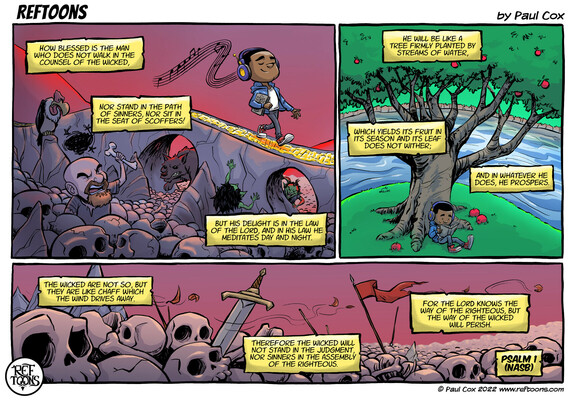
There are days when I can feel the difference between merely knowing Scripture and actually living from it. Psalm 1 gives me an image I return to often: “He shall be like a tree planted by the rivers of water, that brings forth its fruit in its season, whose leaf also shall not wither; and whatever he does shall prosper.” I picture that tree, not wild and scattered, but intentionally planted. Its roots are not guessing where moisture might be found; they are settled beside a steady source. That picture gently confronts me. I can read God’s Word daily and still let my thoughts be shaped more by headlines, opinions, and cultural noise than by the voice of God. The psalm asks me, in effect, where my roots are actually drawing life from.

I notice the downward progression the psalmist describes—walking in ungodly counsel, standing with sinners, sitting with the scornful. I have seen that drift in subtle ways, not always through obvious rebellion but through slow exposure. When I repeatedly listen to voices that dismiss faith, belittle holiness, or treat cynicism as intelligence, my inner world begins to tilt. The Word of God becomes familiar but not formative. Charles Spurgeon once observed, “The Bible in the memory is better than the Bible in the bookcase.” I feel the weight of that. Scripture must move from page to pulse. If I am not meditating—turning it over, praying it through, letting it question me—I should not be surprised when its influence in my decisions grows thin.

Jesus lived the opposite pattern. In the Gospels, I see Him regularly withdrawing to pray, quoting Scripture in moments of testing, and aligning His actions with the Father’s will. His life was rooted. When pressure came, fruit appeared rather than panic. When opposition rose, leaves did not wither. That helps me understand that biblical meditation is not passive reflection but relational engagement. The Hebrew sense behind meditation carries the idea of murmuring, pondering, rehearsing. It is like slowly steeping tea; the longer the Word rests in the waters of my attention, the richer the infusion into my character. Dietrich Bonhoeffer wrote, “We are silent before the Word because it speaks to us.” That silence is not emptiness but attentiveness, a readiness to let Scripture reshape what I assume is normal.

The image of the fruitful tree also challenges my understanding of influence. The study reminds me that people come to rest in the shade and eat the fruit. I have experienced seasons when others sought counsel or encouragement from me, and I knew instinctively it was not because of personal brilliance. It was because God’s Word had done a quiet, patient work over time. When roots go deep, stability grows. When stability grows, others feel safe nearby. That kind of life cannot be manufactured through charisma. It develops through hidden faithfulness—choosing Scripture over sarcasm, prayer over complaint, obedience over convenience. The promise that “whatever he does shall prosper” is not a guarantee of ease but of alignment. A life aligned with God’s purposes carries a lasting kind of fruitfulness that circumstances cannot easily erase.

So today, as I walk through my own “day in the life,” I ask myself where I am standing and sitting, not just physically but spiritually. Whose counsel shapes my reactions? What voices am I replaying in my mind? Am I letting God’s Word interrogate my attitudes, or am I using it only to confirm what I already prefer? When I choose to return to the river—to open Scripture slowly, to pray it personally, to obey it concretely—I feel the difference. Anxiety loosens. Perspective widens. I am reminded that growth is often quiet but never wasted. Roots are developing even when no fruit is visible yet. In time, what is nourished in secret becomes visible in season.

If you want to explore the theme of delighting in God’s Word more deeply, this article offers helpful reflection: https://www.ligonier.org/learn/devotionals/blessed-man

FEEL FREE TO COMMENT, SUBSCRIBE, AND REPOST, SO OTHERS MAY KNOW


#ChristianGrowth #discipleship #meditationOnScripture #Psalm1 #rootedFaith #spiritualDisciplines

Happiness in High-Definition

Seeing Life the Way God Designed It
DID YOU KNOW

“Blessed is the man who walks not in the counsel of the wicked, nor stands in the way of sinners, nor sits in the seat of scoffers; but his delight is in the law of the LORD, and on his law he meditates day and night.” Psalm 1 1:1–2 (ESV)

At the doorway of the Psalter, Psalm 1 functions like a lens adjustment for the soul. Before prayers are sung, before laments are voiced, before praise erupts, the psalmist clarifies what a truly happy life looks like. The Hebrew word translated “blessed” is ’ashrê, a word that carries the sense of deep, settled happiness—not momentary pleasure or circumstantial cheer, but a life that is rightly aligned. It is almost as if the psalmist is asking, “Do you want to see life clearly?” If so, Psalm 1 offers high-definition vision rooted in God’s design rather than human instinct.

This psalm confronts a widespread misunderstanding about happiness. Many assume God restricts joy in favor of obedience, as though holiness and happiness occupy opposite ends of the spectrum. Scripture consistently resists that idea. God is not opposed to happiness; He is opposed to counterfeit versions of it. Psalm 1 insists that joy flourishes when life is centered on God’s instruction, His torah, which is not merely law but guidance for living well. What follows are four “Did You Know” insights that invite us to reconsider what happiness truly is—and where it is found.

Did you know real happiness begins with discernment, not avoidance?

The psalmist describes happiness negatively before he describes it positively: not walking in the counsel of the wicked, not standing in the way of sinners, not sitting in the seat of scoffers. This is not a call to isolation but to discernment. The progression—from walking, to standing, to sitting—reveals how influence gradually shapes identity. What begins as casual exposure can become settled posture. Happiness, according to Psalm 1, involves recognizing which voices are shaping us and choosing wisely whom we allow to guide our thinking.

This discernment is echoed elsewhere in Scripture. Proverbs reminds us, “Whoever walks with the wise becomes wise, but the companion of fools will suffer harm” Proverbs 13:20. Happiness is not accidental; it is cultivated through relational and moral alignment. The psalmist does not claim that the righteous never encounter wicked counsel, but that they do not build their lives upon it. High-definition living begins when we understand that joy is shaped as much by what we resist as by what we embrace.

Did you know God-centered happiness engages the mind as much as the heart?

Psalm 1 places delight not in circumstances but in God’s law, meditated on day and night. The Hebrew word for meditate, hagah, implies murmuring, pondering, chewing over truth slowly and repeatedly. This is not detached intellectualism; it is immersive reflection. Happiness here is not shallow positivity but thoughtful engagement with God’s revealed will. The psalmist assumes that what occupies our thoughts will eventually shape our affections and actions.

This aligns with the wisdom tradition that sees the mind as a pathway to transformation. Joshua 1:8 echoes Psalm 1 almost verbatim, linking meditation on God’s Word to fruitfulness and success. The New Testament carries this forward when Paul urges believers to be transformed by the renewing of the mind Romans 12:2. God-centered happiness is not anti-intellectual; it is deeply formative. A high-def life develops when truth is allowed to reshape how we see reality itself.

Did you know happiness is described as rootedness, not restlessness?

Though Psalm 1:3 is not quoted explicitly in the study, it completes the image begun in verses 1–2: a tree planted by streams of water, yielding fruit in season, whose leaf does not wither. Happiness here is stability, nourishment, and purpose. The happy person is not constantly chasing fulfillment but drawing life from a reliable source. Rootedness implies patience, endurance, and trust in God’s timing.

This image confronts the modern tendency toward restlessness. We often equate happiness with novelty—new experiences, new achievements, new affirmations. Scripture offers a different picture. Jesus echoes this rooted vision when He says, “Abide in me, and I in you” John 15:4*. Fruitfulness flows from remaining, not roaming. A God-centered life does not shrink our joy; it deepens it, allowing happiness to endure across seasons rather than evaporate when conditions change.

Did you know self-centered living promises happiness but cannot deliver it?

The study states this plainly: a you-centered life leads to misery, while a God-centered life leads to joy. Scripture repeatedly confirms this counterintuitive truth. When the self becomes the reference point for meaning, happiness becomes fragile, dependent on control and affirmation. Ecclesiastes chronicles this exhaustion vividly as the Teacher pursues fulfillment through achievement, pleasure, and wisdom, only to declare it hebel—vapor Ecclesiastes 1:2.

Psalm 1 offers a corrective by re-centering life on God’s purposes rather than personal ambition. Happiness, in biblical terms, is not self-absorption but self-offering. Jesus later articulates this paradox: “Whoever would save his life will lose it, but whoever loses his life for my sake will find it” Matthew 16:25*. High-definition happiness emerges when life is oriented toward God’s kingdom rather than personal consumption.

As we reflect on Psalm 1, the invitation is both simple and searching. Where are your roots? Whose counsel shapes your thinking? What occupies your quiet moments? Happiness, Scripture teaches, is not withheld by God but revealed by Him. It is discovered not by chasing what feels good, but by delighting in what is good. To live a high-def life is to see clearly that joy flows from alignment with God’s design, sustained by His truth, and expressed through purposeful living.

FEEL FREE TO COMMENT, SUBSCRIBE, AND REPOST, SO OTHERS MAY KNOW


#biblicalHappiness #ChristianGrowth #GodCenteredLiving #meditationOnScripture #Psalm1 #spiritualJoy
🌿 Psalm 1 highlights two paths: a life blessed by following God's ways and a life leading to ruin by rejecting them. The blessed find joy in God's teachings, rooted like strong trees. In contrast, those apart from God are like scattered chaff, lacking purpose and security. Our choices matter. Choose God's path for stability and peace. 📖 #Psalm1 #Faith #Choices #SpiritualJourney https://young-catholics.com/13415/psalm-1-choose-the-best-path/
Psalm 1: Choose the Best Path

Psalm 1 introduces the Book of Psalms. It describes two different paths in life: the way of the righteous and the way of the wicked. This psalm is clear in its message. There are only two ways to live—one that leads to life and blessing, and another that leads to loss and ruin. Psalm 1…

Young Catholics
Psalms 1:1-6

Sermon from 2024-10-20 by Spencer Baumgardner.

Blessed is the man

Blessed is the man
Who walks not in the counsel of the [a]ungodly,
Nor stands in the path of sinners,
Nor sits in the seat of the scornful;
But his delight is in the law of the Lord,
And in His law he [b]meditates day and night.
He shall be like a tree
Planted by the [c]rivers of water,
That brings forth its fruit in its season,
Whose leaf also shall not wither;
And whatever he does shall prosper. Psalm 1.1-3

#faithwalk #Jesus #Messiah #Psalm1

https://lightforthelastdays.co.uk/video/blessed-is-the-man/

Blessed is the man – Light for the Last Days