The many degrees of freedom of the griffin
Of late, my interest has been in watching the definition of “cryptid” expand to include anything people deem mysterious and sentient. This is the first of possibly several posts to show example of that happening in real time. This installment involves a popular idea about the origin of the mythological animal, the griffin.
Recently, Witton & Hing (2024) published a rebuttal to the idea, posed by historian and folklorist Adrienne Mayor, that the griffin, the chimeric eagle-lion creature mentioned in ancient Greco-Roman literature, was inspired by fossil remains of the dinosaur Protoceratops.
It’s a tricky tale, over 35 years old. Mayor popularized the connection, and it stuck and proliferated. The notion that fossils uncovered or discovered by pre-science civilizations served to influence the depiction of a large, quadrupedal, beaked and winged, fantastical creature was enticing. Mayor continued to popularize it through cryptozoological and natural history writings. Witton & Hing say that the hypothesis that connected these fossils to folklore does not hold up based on timing, location, and other factors.
I have many thoughts on this, but no set opinion. The connection sounds great, simple and neat. And, like many ideas that sound great on the surface, looking deeper reveals some serious flaws. I don’t think it’s fair to discard it entirely, however.
The griffin was treated in the ancient literature as a real animal. In our modern context, that seems ridiculous because there is no animal that is anywhere near matching the description. It is biologically implausible. So we classify the griffin as a mythical creature like the dragon, hydra, or minotaur. It feels wrong to call the griffin a proper “cryptid” today because no one (really) is claiming it’s out there to find. Therefore, this seems to be an example of cryptozoology trending away from the original intention of classifying an anecdotal animal as a living animal. But the premise by Mayor was that tales of the creature were based on a real animal, only one that was no longer living. Mayor proposed that this methodology be called “paleocryptozoology”. Paleocryptozoology, like its namesake, never caught on in academia. The distinct fossilized parts were real enough and they were found in the general regions where the griffin myth arose and then spread. In this way, the story of the griffin inspiration by fossils has become a beloved “geomyth”. I have a lot of reading to catch up on related to fossils and geomyths. There’s a lot. But from my research so far, folklore inspired by real things or events is inevitable, but fraught with pitfalls when one attempts to draw correlating lines from folklore to fact.
The Griffin, 15th century, Martin Schongauer, Public Domain,
https://commons.wikimedia.org/w/index.php?curid=47266496Bronze figure of a griffin, Roman (AD 50–270)
Rijksmuseum van Oudheden, CC BY 3.0 NL
https://creativecommons.org/licenses/by/3.0/nl/deed.en, via Wikimedia Commons
The truth might be present under an imaginative veneer. But sometimes, it might be mostly all imagination. Maybe there was a grain of truth to a legend, but the grain is really tiny. Unfortunately, old texts often mixed descriptions of real animals with exaggerated tales, making it difficult to distinguish zoological from fantastical. Until there were accurate ways to reproduce the true qualities, like a drawing from a living creature, a carcass, or from photographs, artistic depictions showed creatures with ambiguous or embellished traits leaving the viewers of today with multiple and disparate interpretations of what the thing was supposed to be.
Examples of known animals and the very mistaken attributes of their early descriptions would comprise several volumes. Consider what was once said of the gorilla (violent, man-eater), the platypus (a taxidermic hoax), and the giant squid (a menace to sailors) and you can get the idea of how off-base initial thinking was about newly discovered animals. When we didn’t know the reality of these animals, writers made up amazing tales and descriptions about them. Unfortunately, we can’t make out enough about the griffin to judge whether the ancient Greeks were describing real animals but we can fairly assume they were not talking about living creatures they actually saw, but ones they imagined or had heard about.
There are also many examples of fossils being used to represent fantastical monsters. This was certainly done. Witton & Hing cite some of these, but rather vehemently spell out several critiques against Mayor’s idea. The pushback is not new; the idea was never strongly supported by evidence, but mainly speculation and conjecture. Such reaching is a mainstay of cryptozoology, the field where Mayor first situated the griffin research. I agree that Mayor’s evidence put forward for the griffin+Protoceratops link is a probably a reach too far but it’s not unreasonable.
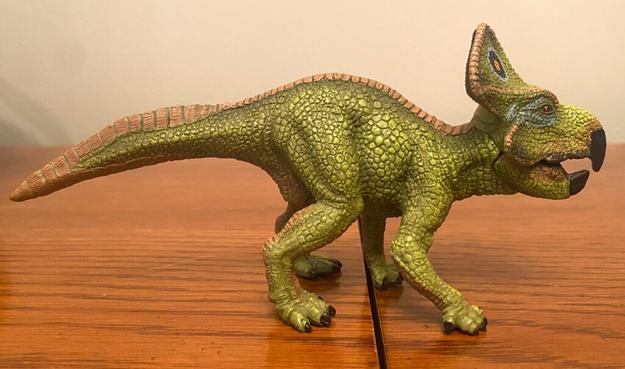
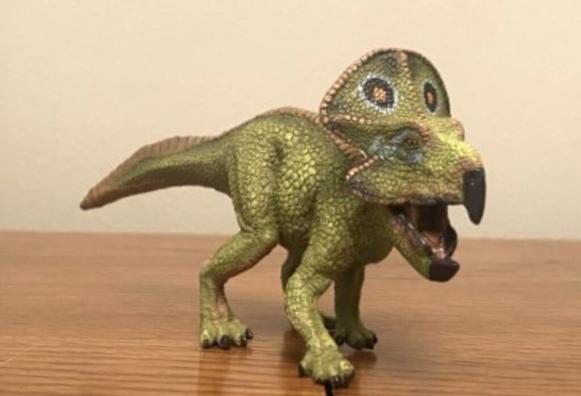
Protoceratops
Protoceratops was a beaked, quadrupedal dinosaur with a neck frill. It did not have wings. The griffin has wings and no neck frill. Some depictions of the griffin show long ears, which does look similar to a Protoceratops in profile. It’s an OK match to the Protoceratops head, in some aspects and examples. But it’s not great. Is it possible that people saw pieces of Protoceratops skulls and bodies and were inspired by them to craft depictions of the griffin? We can’t rule that out – artists and storytellers pull from all areas to inspire their creations. They left no record that they exhumed the remains, which would have been difficult without modern tools.
I have many thoughts and the scope of the topic is massive – I am not at all qualified to expound in detail upon it. My conclusion is that I don’t think we can know for sure about the Protoceratops+griffin connection so it’s incorrect to be definitive either way. The goal of this post is to show you that nothing of this nature is so simple or obvious. Human society, our writing, our art, and all our ideas involve inspiration from various sources – maybe just bits from here and there. Sometimes things get all mixed up, turned around, and tangled to the point where our proposals won’t ever be conclusive. It’s usual to have varied and embellished descriptions of mystery animals – we have no specimen for comparison. If your creature is not based on a real, living animal, then you are unconstrained from adding new and creative characteristics.
In other words, there are a lot of independent variables at play here in the formation of folkloric creatures. Cultural evolution involves taking pieces from various sources and mixing things up. Many aspects of the griffin lore are free to vary, leaving us with a complex, possibly incalculable origin and evolution.
There are no current means to confirm that Protoceratops remains were an inspiration for the gold-hoarding and dangerous griffin. If we continue to think it was so, there is little harm in that. Perhaps someday there will be a clear connection. The connection remains, and may likely forever be, ambiguous.
Resources:
Mayor, Adrienne. Paleocryptozoology: a call for collaboration between classicists and cryptozoologists. Cryptozoology 8, 1989 https://www.academia.edu/531069/Paleocryptozoology_A_Call_for_Collaboration_between_Classicists_and_Cryptozoologists
Witton, Mark P. and Hing, Richard A. Did the horned dinosaur Protoceratops inspire the griffin? Interdisciplinary Science Reviews, June 20, 2024. https://journals.sagepub.com/doi/10.1177/03080188241255543
#cryptid #Cryptozoology #fossils #geomythology #griffin #myth #protoceratops
https://sharonahill.com/?p=8658
 Dinosaur Toy Blog
 Suzi Dragonlady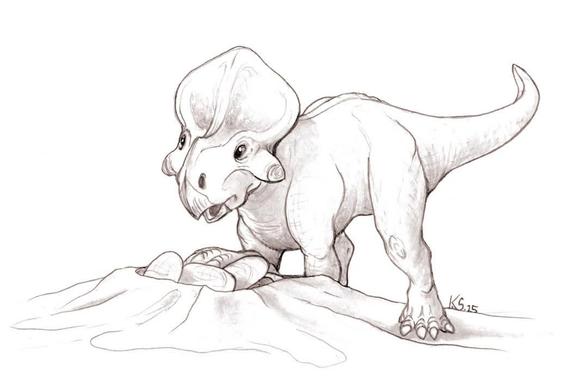
 Ele Willoughby, PhD
 Vetrina ✿
 Sharon A. Hill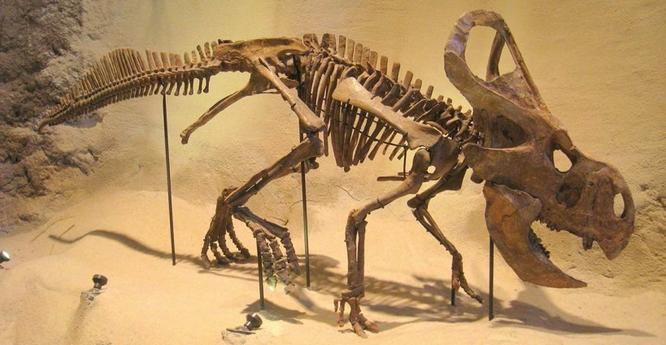

 scinexx - das wissensmagazin