🧩 Could structural AI finally decode the complex language of T-cell antigen recognition?

🔗 STAG-LLM: Predicting TCR-pHLA binding with protein language models and computationally generated 3D structures. Computational and Structural Biotechnology Journal, DOI: https://doi.org/10.1016/j.csbj.2025.09.004

📚 CSBJ: https://www.csbj.org/

#StructuralBiology #ProteinLanguageModels #Immunotherapy #ComputationalBiology #Bioinformatics #MachineLearning #Immunology #ProteinEngineering #TCR #HLA #DrugDiscovery #AI

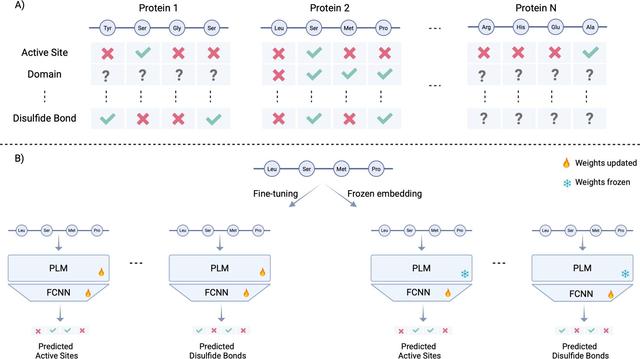
🤖 Are protein language models the next revolution in functional genomics?

🔗 Fine-tuning protein language models to understand the functional impact of missense variants. Computational and Structural Biotechnology Journal, DOI: https://doi.org/10.1016/j.csbj.2025.05.022

📚 CSBJ: https://www.csbj.org/

#Genomics #AI #ProteinLanguageModels #Bioinformatics #PrecisionMedicine #PLM #MissenseVariants #MachineLearning #ClinicalGenetics #AIinHealthcare #InterpretableAI #VariantInterpretation

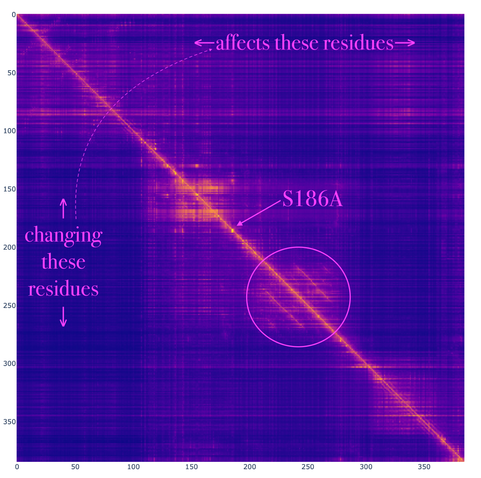
I calculated the embeddings for each possible Alanine/Glycine substitution (X->A and A->G) of DSB-1 and then asked for each position, which other residues are most affected. Again the key phosphoresidue S186 shows up brightly (very highly changed from its original value), and there is suggestion of something going on in the disordered domain (circled). Does anyone working with #proteinEmbeddings or #proteinLanguageModels have any pointers for me?