
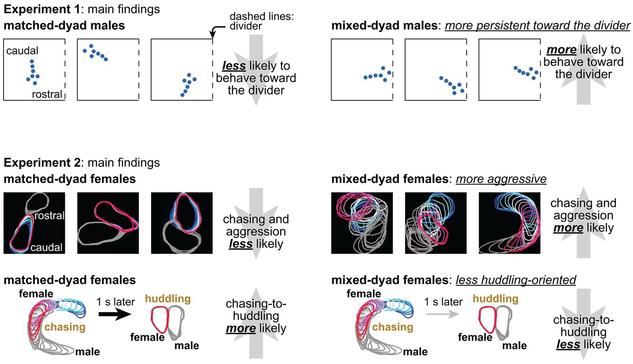
Human behavioral studies indicate that people have stronger social affinity for people with matched 'neurotypes'. This study reveals a similar phenomenon in #PrairieVoles; #voles have higher #social affinity for the opposite sex when placed in matched- versus mixed-neurotype dyads @PLOSBiology https://plos.io/4bUJjjz
22-FEB-2024
First brain-wide map shows how sex and intimacy rewire the brain

A team of researchers has created the first #brain-wide map of regions that are active in #PrairieVoles during mating and pair bonding.

https://www.eurekalert.org/news-releases/1035262

#science #behaviour #neuroscience

First brain-wide map shows how sex and intimacy rewire the brain

<p>The first brain-wide map of regions that are active in prairie voles during mating and pair bonding reveal that bonding voles experience a storm of brain activity distributed across 68 distinct brain regions that make up seven brain-wide circuits. Most of these brain regions the researchers identified were not previously associated with bonding, so the map reveals new places to look in the human brain to understand how we form and maintain close relationships.</p>

EurekAlert!

So love is more complicated after all.
"A study published on 27 January in Neuron1 challenges decades of research that suggests a protein that detects the ‘love hormone’ oxytocin is responsible for the voles’ domestic bliss. Using CRISPR gene-editing, researchers found that prairie voles lacking the protein were still responsible parents & still formed monogamous relationships."

#Notjust_oxytocin
#CRISPR #PrairieVoles

https://www.nature.com/articles/d41586-023-00197-9#:~:text=27%20January%202023-,CRISPR%20voles%20can't%20detect%20'love%20hormone'%20oxytocin%20%E2%80%94,mates%20and%20cared%20for%20pups.&text=The%20humble%20prairie%20vole%20(Microtus,its%20unusual%20commitment%20to%20family.

CRISPR voles can’t detect ‘love hormone’ oxytocin — but still mate for life

Prairie voles lacking oxytocin receptors bonded with mates and cared for pups.

Prairie voles born via C-section can't bond: Is birth key to how we love and relate?

With their short round ears, seedlike black eyes and snout-to-tail brown coats, prairie voles might rank somewhere between field mice and hedgehogs in terms of insane cuteness if it wasn't for one thing that puts them over the top: They mate for life.

Medical Xpress

Nice summary & discussion on the new findings that #PrairieVoles lacking #oxytocin receptors still bonded with mates and cared for pups (summarised as "#social #attachment"). The story about the "#love #hormone" was, obviously, too simple to be true...!

"The wiring for attachment is so important,” he [Devanand Manoli] says. “It would be a little surprising if there were a single point of failure.”

https://www.nature.com/articles/d41586-023-00197-9

CRISPR voles can’t detect ‘love hormone’ oxytocin — but still mate for life

Prairie voles lacking oxytocin receptors bonded with mates and cared for pups.