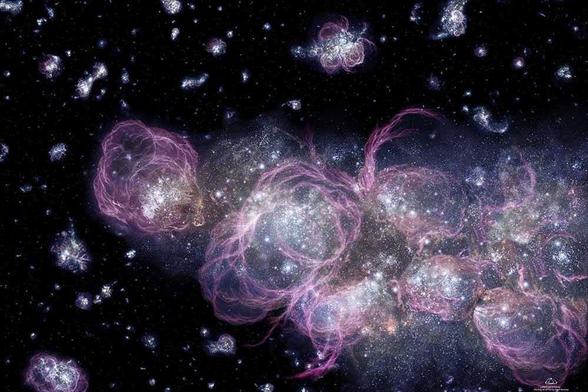
Primordial behemoths, Population III - universe's first generation of stars, very different from modern, or Population I stars, formed from pristine hydrogen and helium gas, before heavier elements were distributed throughout the universe by supernovae and powerful stellar winds, bigger and hotter than modern stars. Most Population III stars are expected to have lived and died between about 100 and 400 million years after the Big Bang, after which there would have been enough heavy elements in the cosmos to form stars that are more similar to the ones we see today.

https://www.newscientist.com/article/2521924-we-may-have-just-glimpsed-the-universes-first-stars/

non-paywall: https://web.archive.org/web/20260403065952/https://www.newscientist.com/article/2521924-we-may-have-just-glimpsed-the-universes-first-stars/

#PopulationIII #Stars #Science #Space #JWST #Hebe

We may have just glimpsed the universe's first stars

A galaxy spotted by the James Webb Space Telescope, known as Hebe, that existed just 400 million years after the big bang appears to contain extremely pure and young stars

New Scientist
GLIMPSE - An ultra-faint ≃ 105 M⊙ Pop III Galaxy Candidate and First Constraints on the Pop III UV Luminosity Function at z≃6−7: https://arxiv.org/abs/2501.11678 -> Die ersten Sterne nach dem Urknall waren wohl riesig und kurzlebig, gefunden wurde die #PopulationIII bislang nicht - das könnte sich jetzt geändert haben: https://www.heise.de/news/Die-ersten-des-Universums-Womoeglich-erstmals-Sterne-der-Population-III-entdeckt-10301518.html
GLIMPSE: An ultra-faint $\simeq$ 10$^{5}$ $M_{\odot}$ Pop III Galaxy Candidate and First Constraints on the Pop III UV Luminosity Function at $z\simeq6-7$

Detecting the first generation of stars, Population III (PopIII), has been a long-standing goal in astrophysics, yet they remain elusive even in the JWST era. Here we present a novel NIRCam-based selection method for PopIII galaxies, and carefully validate it through completeness and contamination simulations. We systematically search ~500 arcmin$^{2}$ across JWST legacy fields for PopIII candidates, including GLIMPSE which, assisted by gravitational lensing, has produced JWST's deepest NIRCam imaging thus far. We discover one promising PopIII galaxy candidate (GLIMPSE-16043) at $z=6.50^{+0.03}_{-0.24}$, a moderately lensed galaxy (mu=2.9) with an intrinsic UV magnitude of $M_{UV}$=-15.89. It exhibits key PopIII features: strong H$α$ emission (rest-frame EW $2810\pm550$Å); a Balmer jump; no dust (UV slope $β=-2.34\pm0.36$); and undetectable metal lines (e.g., [OIII]; [OIII]/H$β$<0.44) implying a gas-phase metallicity of Zgas/Zsun<0.5%. These properties indicate the presence of a nascent, metal-deficient young stellar population (<5Myr) with a stellar mass of $\simeq10^{5}M_{\odot}$. Intriguingly, this source deviates significantly from the extrapolated UV-metallicity relation derived from recent JWST observations at $z=4-10$, consistent with UV enhancement by a top-heavy PopIII initial mass function or the presence of an extremely metal-poor AGN. We also derive the first observational constraints on the PopIII UV luminosity function at z~6-7. The volume density of GLIMPSE-16043 ($\approx10^{-4}$ cMpc$^{-3}$) is in excellent agreement with theoretical predictions, independently reinforcing its plausibility. This study demonstrates the power of our novel NIRCam method to finally reveal distant galaxies even more pristine than the Milky Way's most metal-poor satellites, thereby promising to bring us closer to the first generation of stars than we have ever been before.

arXiv.org
Cᴏʀʀᴀᴅᴏ Rᴜsᴄɪᴄᴀ on Twitter

“#Astronomers Say They Have Spotted the #Universe’s #FirstStars - #Theory has it that “#PopulationIII” #stars brought light to the #cosmos. The #JamesWebbSpaceTelescope may have just glimpsed them. https://t.co/nTgorH56cQ”

Twitter
Die sogenannte Population III der Sterne war die erste nach dem Urknall. Jetzt wurden womöglich erstmals Spuren davon entdeckt.
Astronomie: Womöglich Spuren der allerersten Sterne des Universums gefunden

Die sogenannte Population III der Sterne war die erste nach dem Urknall. Jetzt wurden womöglich erstmals Spuren davon entdeckt.

heise online