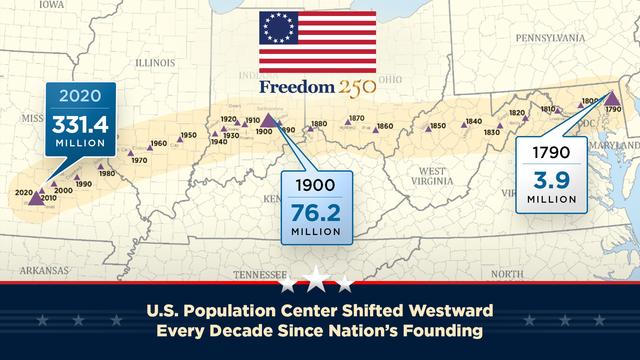
As America Turns 250 Years Old, the Census is Not Far Behind at 236
The decennial census, mandated by the framers of the Constitution, has evolved along with our nation over the course of their shared history.
'A review and evaluation of internal migration forecasting models' - Population Studies, May 2026
https://doi.org/10.1080/00324728.2026.2645544 #Demography #PopMastodon'Population tool: How will populations across the world change in the 21st century?' - Our World in Data, May 2026
https://ourworldindata.org/population-simulation-tool #Demography #PopMastodon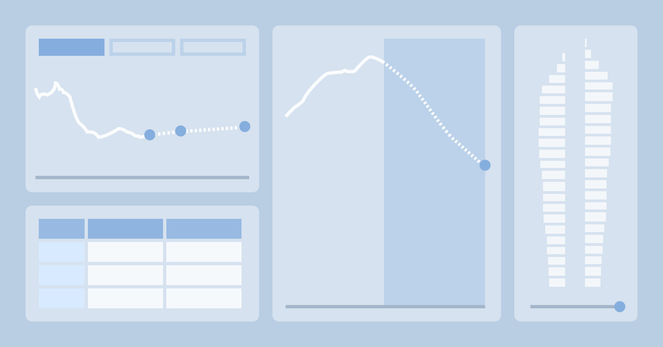
Population tool: How will populations across the world change in the 21st century?
We created an interactive tool that lets you test how changes in fertility rates, life expectancy, and migration rates will change future populations.
via Bluesky user @jschoeley.com:
"demoscapes.org is a visual atlas of demographic surfaces hosted at @mpidr.bsky.social. It is also my passion project growing out of my 2016 human mortality database explorer. Did you publish something containing Lexis surfaces? Consider reaching out and having your work featured on the site."
https://bsky.app/profile/jschoeley.com/post/3mkmm6ru2mc2b https://demoscapes.org/ #Demography #PopMastodon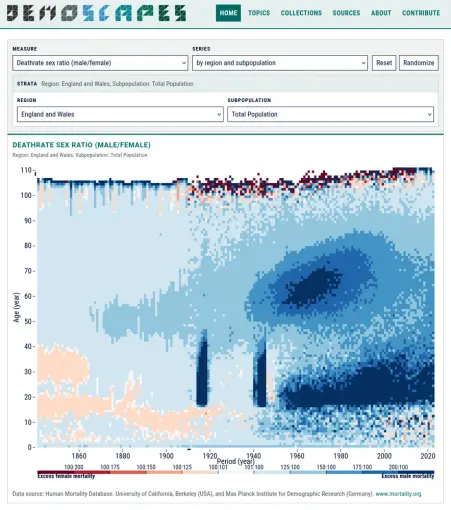
Jonas Schöley (@jschoeley.com)
demoscapes.org is a visual atlas of demographic surfaces hosted at @mpidr.bsky.social. It is also my passion project growing out of my 2016 human mortality database explorer. Did you publish something containing Lexis surfaces? Consider reaching out and having your work featured on the site.
[contains quote post or other embedded content]
'Geospatial foundation-model embeddings improve population estimation unevenly across space and scale' - Zhang et al, May 2026
https://arxiv.org/abs/2605.01650 #Demography #PopMastodon
Geospatial foundation-model embeddings improve population estimation unevenly across space and scale
Reliable subnational population estimates are essential for applications, yet remain difficult where censuses are sparse, outdated or spatially coarse. Existing population-mapping workflows rely on hand-built geospatial covariates, such as settlement extent, night-time lights, and environmental conditions, which must be assembled and harmonised across scales and geographies. Geospatial foundation models offer an alternative by learning reusable representations of place from more multifaceted and heterogeneous data sources. Here, we benchmark Population Dynamics Foundation Model (PDFM) embeddings against the harmonised geospatial covariates for subnational population estimation in Brazil, Nigeria and the United States. Under geographically structured validation, PDFM increased predictive fit by a median of 20.1% (IQR: 10.0-33.2%, across country-model comparisons) reduction in unexplained variance, and reduced Kullback-Leibler divergence by 23.2% (9.2-26.2%). However, these gains were uneven. PDFM was most advantageous where the geospatial covariates weakly characterised settlement context, such as larger and less-developed subnational areas. Moreover, PDFM performance was scale-coupled with embeddings providing less flexible transfer across spatial aggregations than geospatial covariates. These findings showed that geospatial foundation-model representations of place can improve population estimation in data poor settings, but their benefits break down predictably under spatial scale mismatch, revealing a fundamental limitation of current geospatial AI.
'A Blended Data Approach to Measuring Monthly Housing Starts: Satellite Imagery, Survey Data and More!' - NBER Working Papers, April 2026
https://www.nber.org/papers/w35113 #Demography #PopMastodon
A Blended Data Approach to Measuring Monthly Housing Starts: Satellite Imagery, Survey Data and More!
Founded in 1920, the NBER is a private, non-profit, non-partisan organization dedicated to conducting economic research and to disseminating research findings among academics, public policy makers, and business professionals.
'Nik van der Wagt on population momentum with migration' - Formal Demography Working Group meeting 14, April 2026
https://www.youtube.com/watch?v=i-0LU_HP7MQ #Demography #PopMastodon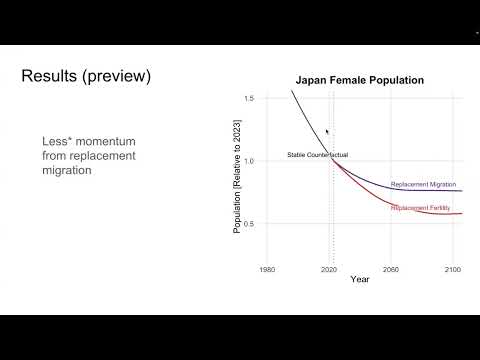
Formal Demography Working Group meeting 14
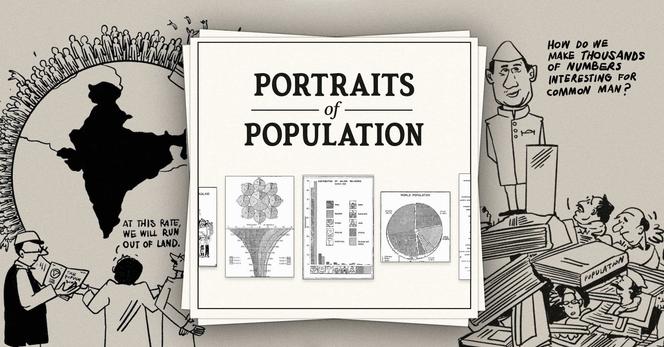
Portraits of Population
An archive of 700 hand-drawn charts and graphics from India's census, and why they were made
Very neat new article on birth and death trends in Alaska, by Eric Sandberg:
https://live.laborstats.alaska.gov/trends-magazine/2026/March/a-quiet-driver-of-population-change #Alaska #Births #Deaths #Demography #PopMastodon 'A quiet driver of population change: Birth-death balance that powered growth is narrowing' - Alaska Economic Trends, March 2026
A Quiet Driver of Population Change
 Eddie Hunsinger