 Andy Arthur - Threadinburgh
Rails to Trails: the thread about how North Edinburgh got its cycle paths
On this day (June 1st) 40 years ago, to the tune of the pipes, a councillor cut the ceremonial ribbon and opened a section of cycle path in the north of Edinburgh. This was a rather special bit of cycle path; it was the result of direct action. Over the course of a single week it had been reclaimed from the trackbed of an old railway by a group of spade-wielding and wheelbarrow-pushing volunteers. Wind the clock forward four decades and from these humble beginnings has grown a network of almost 20km (12 miles) of such paths in this part of the city. The credit for this sits almost entirely with the relentless (and often thankless) hard work of a single, slightly anarchic organisation. This thread is the story of how the North Edinburgh Path Network came to be.
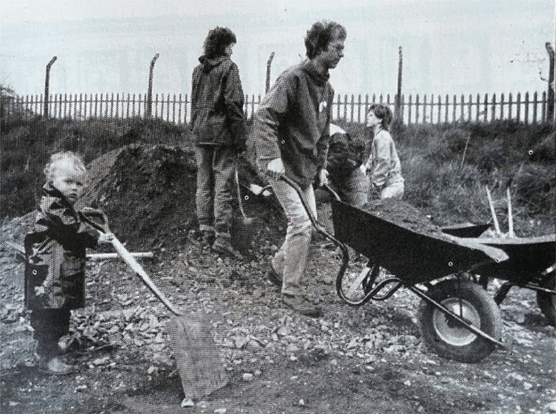
If the council won’t build your cycle path, build your own! Spokes volunteers of all ages hard at work on the Pilton Path in May 1986. Credit, Chris Hill via SpokesRailways arrived in Edinburgh in 1831 with the Edinburgh & Dalkeith Railway (better known as “The Innocent”) which approached a terminus at St. Leonard’s from the south. In the following decade four other lines converged on the city from the points of the compass. In 1842 the Edinburgh & Glasgow arrived from the west as far as Haymarket and the first section of the Edinburgh, Leith & Newhaven approached from the north to link the city with the Forth ports and from there north to Fife. In 1846 the North British blasted its way through Calton Hill from the east and in 1848 the Caledonian arrived at Princes Street from the southwest. These last two companies came to dominance, the NB in particular on the east coast. Over the next fifty or so years they fought a protracted and at times exceedingly bitter war with each other for traffic, routes and rights of access and Edinburgh was just one of the battlefields of this war. In particular each sought to corner the lucrative dock and industrial traffic of Leith and Granton, sprouting a tangled web of rival lines and counter-lines as they vied for supremacy.
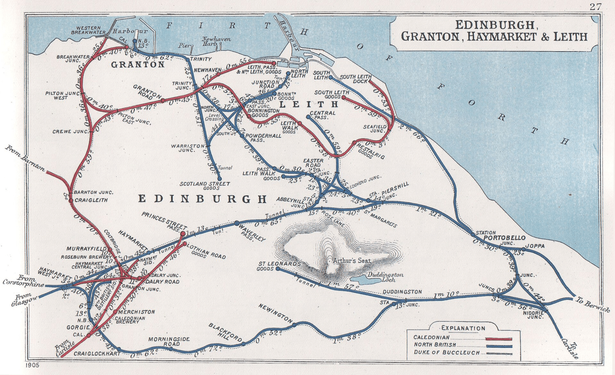
1905 Railway Clearing House diagram showing the competing Caledonian (red) and North British (blue) lines snaking their way around and through the city.Most of these lines offered passenger services but many proved to be marginally profitable from the outset and as a result stations began to be closed as early as 1905. Wartime economies in 1917 saw further closures; some were temporary but others such as Powderhall were for good. These continued during the lean economic years of the 1920s. A few new suburban halts were built as the city began to sprawl outwards in the 1930s but in the years following WW2 closures began again. Most lines remained busy with freight traffic at this time but by the dawn of the ‘Sixties, the times were a-changin’. Shifting government priorities, industrial decline and the move of passengers from rails to the roads precipitated a rapid run-down and closure of nearly all the railways in the north of the city.
This left many miles of disused railway infrastructure in the north of the city, which for generations of local government and Scottish Office planners offered an irresistible blank canvas on which to build new roads. Much of it therefore found itself reserved in strategic plans for schemes such as the Western Approach Road or the Ferry Road Relief Road. Edinburgh Corporation and its successors began to acquire the land for this purpose. It is therefore ironic that it was this car-brained official thinking that would preserve these routes from other development until an alternative use presented itself.
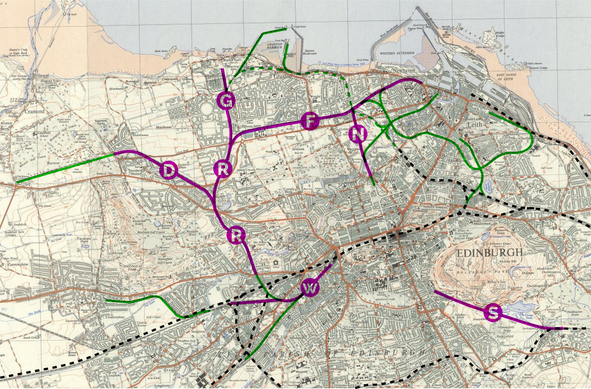
Abandoned railway trackbeds in Edinburgh in the early 1980s. The purple lines were those reserved as road corridors in strategic plans (W = Western Approach Road, R = Roseburn to Ferry Road Link Road, D = Davidsons Mains Bypass, G = Granton Spur, F = Ferry Road Relief Road or West Approach Road to Leith, N = Northern Spur, S = St Leonard’s Spur). The dashed green sections remained nominally open for rail traffic until 1984. The black, dashed lines are routes that remained open. Base map 1:25,000 OS map, 1959, reproduced with the permission of the National Library of ScotlandOne such alternative use was first mooted way back in 1968 when Colinton Amenity Association approached both Edinburgh and Midlothian with a view to acquiring the abandoned Balerno Branch railway for conversion into a “unique walkway” along the Water of Leith. This would ultimately become part of the Water of Leith Walkway. The first such railway path – the term then in vogue for such schemes – in Scotland was an 860 yard route opened at Victoria Park in Glasgow in June 1970. Neither of these schemes were cycling routes however. The first planned from the outset as such in the UK was the High Peak Trail in Derbyshire, which began in 1971. In Edinburgh it was 1975 when such a proposal was first made as part of a £90m local development and regeneration plan for Leith. This referred to the formation of “footpath[s] and cycleway[s]” on former railway lines, suggesting routes between Warriston and Coburg Street and from Pilrig to Seafield.
Cover, City of Edinburgh, Leith Local Plan, Draft Final Report, April 1975. Volume Two. Schedules and Appendices.The Leith Local Plan was published at a time of great change in Scottish local government. That year the old unitary authority of the Corporation of the City of Edinburgh was abolished (along with all the old burgh, town and county councils in the country) to be replaced by a two tier system – Edinburgh District Council and Lothian Regional Council. While the Region had transport within its remit (thus, in theory, cycle paths) the District was responsible for recreation and regeneration and therefore also had them within its remit.
Lothian Regional Council ghost sign on the former Leith Tramway Depot, 20 plus years after that authority ceased to be. Photo © SelfIn 1977 Lothian Region published its first transport strategy in its inaugural Structural Plan. Detailed in its many pages there were multiple major road schemes but not a single mention of cycling. This mobilised members of Friends of the Earth in Edinburgh who formed SPOKES, the Lothian Cycle Campaign that year specifically to represent against the plan and to lobby in upcoming council elections.
To ensure that council policies actively encourage cycling and make full provision for it, as part of an overall strategy through which all members of the public can enjoy cheap, safe and efficient travel for work and leisure
The second of Spokes’ two founding objectives, from Spokes Newsletter no. 1, early 1978The campaign group got off to a good start with the unlikely assistance of Conservative District Councillor Ralph Brereton. His irate letter to The Scotsman about their campaign to permit cycling across the Meadows provoked an unintended backlash that garnered significant free publicity and support for his intended target:
Parks are for quiet, decent people. SPOKES can get lost and take its Commie friends with it. Who wants a proletarian dictatorship anyway? Not me, and not Marchmont.
Ralph Brereton, “Conservative Councillor for Marchmont, and proud of it”. The Scotsman, May 8th 1978In 1979 further campaign pressure was applied on the Region by the Scottish Association for Public Transport who recommended turning old railways in Edinburgh into cycle paths where there was not the money to turn them into a metro or tram system. This lobbying proved effective and in December 1979 council officials were instructed to investigate further. In 1980 a price of £305,000 was agreed with British Rail for former railways to Granton and North Leith (marked G and L in red on the map below). The overlapping remits of the two authority tiers for implementing cycle paths might have found them either either working in isolation or at cross purposes. But with remarkable foresight, Spokes had used the Structure Plan consultation to insert a policy on cycling that obliged the Region and District to co-operate in this area.
Principal abandoned (or soon to be abandoned) railway trackbeds in Edinburgh in the early 1980s, not including industrial or dock lines; blue lines are former North British Railway, red the Caledonian Railway. The letters correspond to the line and branch names in the table at the bottom of the page. The black, dashed lines are routes that remained open. Base map 1:25,000 OS map, 1959, reproduced with the permission of the National Library of ScotlandThe District therefore separately began acquiring former railway routes in North Leith (marked N in blue on above map) and also between Easter Road and Seafield (marked W in red). This was financed by the Scottish Development Agency (SDA) which had jointly inherited the 1975 Leith Local Plan and its cycle path proposals. The SDA had actually been trying to get this land off of British Rail since 1976 but had found itself in the “ludicrous situation” of two public bodies squabbling amongst themselves over something of relatively inconsequential financial value. The SDA wanted a quick and cheap sale of the land valued as derelict, BR was holding out for the higher price it could get for industrial development sites.
With the two council tiers now dipping their toes deeper into path schemes, Spokes saw the opportunity to coordinate their efforts towards a coherent, contiguous, off-road cycling network for the north of the city. To this end in January 1981 they published the report Rails to Trails, which detailed a vision to “provide safe and convenient commuter links between the northern suburbs and the city centre“. This was the genesis of what would become the North Edinburgh Path Network (NEPN). Although its focus was obviously on cycling it was made clear from the outset that nothing should “conflict with the needs of pedestrians using the routes“.
Maps of former railways in North Edinburgh in the “Rails to Trails” report by Carol Crawford, published by Spokes, January 1981In May 1981 the Secretary of State for Scotland, George Younger, gave Lothian Region permission to set aside £610,000 over five years to convert its railway trackbeds in Edinburgh into paths for cycling and walking. They also sought permission to formally abandon the road schemes planned for these same lines but the Secretary of State refused to allow them to be removed from the Structure Plan. A threat thus hung over these paths before they were even begun that they might find themselves turned into roads. On July 6th that year the Region formally adopted its cycling policy statement, one which was remarkably similar to the second of Spokes ‘ founding objectives!
It is the policy of the Regional Council to allow greater freedom of movement to pedestrians or and cyclists and to encourage more people to walk and cycle for work and leisure journeys (Structure Plan – paragraphs 76 and 13l4(a)).
Lothian Regional Council circular from the Director of Highways P. J. Mason, 1981In October the Region put its proposals – which looked awfully similar to those sketched out by Spokes in Rails to Trails – out to public consultation. The race was now set between them and the District to complete Edinburgh’s first railway cycle path. The latter won, just, and on June 15th 1982 the mile and a half route between Warriston Crescent and Couper Street in Leith was opened by Lord Provost Tom Morgan. It had cost £250,000, a significant amount of money on account of the retaining wall of the river bank and four bridges needing to be repaired. John McCracken of the SDA handed the route over to the city and said it would “make a significant contribution to the agency’s environmental improvement programme which is rapidly transforming Leith“. A further £110,000 was spent on landscaping the old coal yard at Junction Bridge into the Coalie Park area and in the November the project was awarded a Civic Trust Awards commendation.
Coalie Park area and the new path in 1982. The housing of The Quilts is yet to be built on the derelict industrial land on the south (left) bank of the river here. Photo via Water of Leith Conservation TrustFrom the outset this new route was part of the nascent Water of Leith Walkway and was signed as such. At this time it was strictly speaking two separate paths, the railway between Powderhall and Granton was still in active use and cut it in half at the Bonnington Level Crossing. This resulted in a detour through the allotments at Warriston, beneath the active line. As a result each half of the path got a separate name; from Coalie Park to the level crossing it is the Water of Leith Path and further west it becomes the Warriston Path. Initially the surface was compressed whindust and cycling was only officially “tolerated” at policy level rather than formally recognised by signage. In 1984 Spokes took the authorities to task over this ambiguity after one of its members was stopped by the police for daring to cycle here. Since then blue permission signs have appeared along these and other paths to this effect.
Coalie Park opening plaque at the entrance to the path from Coburg Street. Edinburgh and Scottish Collection, Edinburgh City LibrariesLothian Region were not far behind and the first section of their Innocent Path in the southeast of the city opened on 11th August 1982, running about a mile between Duddingston Road West and the Wells o’ Wearie. Here it terminated at the entrance to the Innocent Tunnel which remained closed at this time. Again the surface was compressed whindust, making it suitable for use as a bridleway but rather useless for cycling in the winter, and as it was felt to be a rural setting no street lighting was provided. Information boards on the history of the railway here were provided, this is something has been widely repeated for other railway paths in the city. The £40,000 project budget included £27,000 provided as labour by the Manpower Services Commission (MSC).
The original 1982 information board for the Innocent Railway pathThe ribbon was cut by Lynda Chalker MP, Under-Secretary of State for the Department of Transport. Spokes attended this ceremony “in force” to “confront the Minister” over the fact that Government policy towards cycling in Scotland was lagging far behind England and Wales. They charged that there were no central studies for turning disused railways into paths, the Scottish Office had no technical or policy documents in this area, had no cycling officer and made no grants available to Councils for cycling schemes. After a consultation in 1985 on options to extend this route into the city far as St Leonard’s work commenced in 1987 to refurbish the tunnel and it was reopened in 1989.
Dave de Feu of Spokes, right, forms part of the welcoming committee for Lynda Chalker at the opening of the Innocent Path. On the left, adjusting his tie, is Conservative Councillor Ian Cramond, Convenor of Lothian Region’s Transportation Committee at that time. Credit, Chris Hill via SpokesThe Innocent however can not be considered part of the North Edinburgh routes and it was September 1982 when the Region approved the laying of a whindust surface and adding street lighting for its two lines that forked north from Craigleith to Davidsons Mains and to Crewe Toll. The former section was opened on 21st November 1983 by Tony Gaffney of the Institute of Civil Engineers having cost £63,000, three quarters of it as labour provided by the MSC. The section to Crewe Toll followed the next year, as did work on the former Corstorphine branch from Balgreen. At this time Liberal councillor and Spokes member (the late) Donald Gorrie was able to push for the adoption of a 3 metre-wide tarmac surface as a standard for future work. This was best practice developed by the forerunner of Sustrans for the Bristol & Bath Railway Path, on which they had been working since 1979.
https://www.flickr.com/photos/127340508@N05/15255410973/
The District at this time began work on their path from Quarryholes on Easter Road to Seafield and Leith Links. They specified this as a “trim track“, with numerous pieces of wooden exercise equipment added along the route. The original 1975 plans connected this route all the way to Pilrig Park but the bridges that carried it across Easter Road and Leith Walk had been demolished in 1980. The Restalrig Railway Path has therefore always been somewhat cut off from the rest of the railway path network. Its surface was the usual whindust, seasonally impassable, it had no street lighting and most of its access points were narrow steps. This was a situation not improved upon until 2009.
https://www.flickr.com/photos/beqi/3282799986/
Meanwhile back in North Leith, the District Council and the SDA had been infilling the railway cutting that ran through Victoria Park and between Gosford Place and Connaught Place. As this work approached its conclusion a path was approved to connect with the new path along the Water of Leith. This scheme was adopted by the Leith Boys’ Brigade to mark their centenary in 1983 and they raised £1,000 towards the cost of the landscaping of this section. It would be named Stedfastgate in their honour (from the traditional spelling of their motto of Sure & Stedfast) when it was opened on October 8th 1983.
Plaque commemorating the opening of the Stedfastgate section in 1983. CC-by-SA 4.0 Mike Shaw via WikimediaIn 1983 the Scottish Office, after continuous pressure from Spokes, started to play catch-up with what was happening in England. They commissioned a national feasibility study on re-opening old railway lines as cycle routes – the Scottish Railway Path and Cycle Route Project – led by John Grimshaw of Bristol-based Cyclebag (the direct predecessor of Sustrans, now the Walk Wheel Cycle Trust). Again the MSC provided the labour for this project; ten unemployed professionals were engaged as surveyors and draughtsmen and their tasking included photographing every disused railway bridge in the country! At the same time Grimshaw was also contracted by Lothian Region to undertake a similar exercise within their territory. The reports for both of these projects would be published in 1985 and would propose more than 800 kilometres of routes, 250km of which were in Edinburgh and the Lothians.
Discussing Spokes’ Pilton Path project in 1986. From left to right, Dave de Feu of Spokes; Labour councillor Donald Anderson and MEP David Martin; Ewen Jeffrey of Spokes and John Grimshaw of Cyclebag / Sustrans. Photo Credit: Chris Hill1986 proved to be a very productive year for the path network in the north of the city. The Region had been pressing on with its projects and these were now coming to fruition. An extending of the path south from Craigleith, begun in 1984, was opened by Councillor Tom Ponton on May 5th as far as the former Murrayfield Station. The District Council contributed £14,000 in labour by youths on their Special Measures Programme. The viaduct over the Water of Leith here caused problems at first, with objects being thrown from it onto houses and parked cars below. Metal barriers were installed along the parapets but a proposal by local residents to completely enclose the bridge in a wire cage was rejected. Soon afterwards the section east from Crewe Toll to the former Granton Road station also opened. The latter site proved something of an obstacle to future progress however as the trackbed had become heavily flooded and turned into something of a quagmire.
Spokes was not however content with the pace of change and decided to take matters directly into their own hands. In March 1986 they publicly announced a project to mark European Road Safety Year – they would clear and resurface a mile-long section of path north of Crewe Toll all by themselves. They gave themselves just seven days to complete this ambitious scheme, coinciding with National Bike Week from May 24th to 31st. Around fifty enthusiastic volunteers signed up to work under the supervision of John Grimshaw. Lothian Region provided a mechanical grader to strip the surface and 1,000 tons of hardcore and 250 tons of whindust dressing were laid, much of it moved by hand. These materials had been paid for by the Region who had also arranged the lease on the land from British Rail and committed to laying a tarmac surface and installing lighting within three years. Pupils from nearby St David’s R.C. Primary School helped to plant trees along the route with the Lord Provost.
Harry Henniker of Spokes on the overgrown trackbed that would become the Pilton Path just before work started, May 1986. Beneath the bridge that carried West Granton Road over the tracks.Work was completed in time for the planned opening on June 1st and the ribbon was cut by Councillor Ron Muir, Vice-Chair of Lothian’s Transportation Committee, to the accompaniment of the Nor’ Loch Highland Pipe Band. However it very nearly didn’t happen: an administrative disaster almost befell the project at the 11th hour when council lawyers decide it required the same legal consent as a road project but that they were much too busy to deal with it. It took crucial inside assistance from long-time supporter Councillor Donald Gorrie for the necessary paperwork to be rushed through and the statutory neighbour notifications were delivered by bicycle in the nick of time. Completion of this route was seen as a missing link connecting the paths to the Silverknowes Promenade, a cycling ban on which had been lifted in 1985 after lobbying by Spokes.
Opening of the Pilton Path, June 1st 1986. Councillor Ron Muir, Lothian Region’s vice chair of the Transport Committee officiates, the Nor’ Loch Pipe Band ready to lead an inaugural procession. Various members of Spokes and some local councillors stand on the embankment beyond. Photo Credit: Chris HillThat same May the Labour Party won a resounding victory in elections for Lothian Region and took majority control. One of the first actions of its new Transport Chairman – the late Alistair Darling – was to fulfil an election promise and cancel the Western Relief Road. On May 21st, just days before Spokes started work on the Pilton Path, a special meeting voted to cancel that multi-million pound road scheme once and for all. This finally removed the threat it had posed to a number of sections of recently laid railway paths. (Incidentally, the Roseburn Corridor has always remained reserved in planning as a potential public transport corridor and it was not until February 2024 where its status as an active travel path was also so affirmed.) The year was rounded off with a final victory for Spokes when both council tiers agreed in October to throw out a housing development proposed by Safeway behind their supermarket at Davidson’s Mains and to safeguard the railway trackbed there as a path (which was eventually surfaced with tarmac within the last few years).
An early Spokes rally in Holyrood Park in 1979; member Canon Bill Brockie of St Martin’s Church in Dalry addresses the crowd. The man left of centre back with his arms folded is the late Alistair Darling. Credit, Chris Hill1986 was also the year that the final sections of abandoned tracks were lifted on the railways north of Powderhall; the last regular trains having run to an oil depot at Granton along the Lower Granton Road embankment in 1984. This delay in lifting the tracks had a knock-on effect on the timescale for the acquisition of the trackbed here by Lothian Region, something that would not complete until 1989.
https://flickr.com/photos/117983829@N03/13893423695/in/album-72157643950735923
While the growth of the path network in the north of the city had progressed reasonably well, Spokes remained critical of the Regional Council’s ability to deliver such projects in a consistent manner. This was due to a lack of dedicated resource they estimated up to £400k per annum, almost three quarters of the available budgets, was going unspent as a result. To remedy this, in 1987 another Labour Party manifesto commitment that Spokes had campaigned for was enacted and the authority’s Highways Department established a dedicated, three-member cycle team. This was headed by Richard Williams and with an annual budget of £300k maintained a centre of focus and knowledge within the labyrinthine, roads-focussed organisation. This team would prove remarkably adept at also making use of the underspends in other parts of the organisation at the end of the financial year; there was always tarmac to be laid somewhere.
Lothian Region’s dedicated cycling team. On the left is Matthew Simpson, centre is Rory Summerling and on the right is Richard Williams. This team found itself constantly under threat of disbandment due to cost-cutting, but survived through to April Fools’ 1996 when the Region was abolished and the City of Edinburgh Council came into being, a loss of expertise long lamented by Spokes. Credit, Spokes.org.ukCome 1988 and there were now six sections of railway paths and the Region’s councillors sat down to agree on what to call them. It was decided they should be named after the neighbourhoods through which they ran and that they should no longer be called railway paths. Just paths was fine, Councillors Neil Lindsay and Donald Gorrie had felt the established practice was “daft” and so for instance the path between Roseburn and Craigleith became the Roseburn Path, etc. These remain the official names as adopted by Edinburgh Council in their statutory list of roads and paths. A fuller list of the various path names and their chronology can be found in Table 1 at the foot of this post.
Warriston Path signage. The red 75 marker refers to the National Cycle Network route. Photo © SelfThe paths network in the north of Edinburgh city continued to grow in 1988. At Roseburn, the bridge over busy Roseburn Terrace was refurbished and the path extended south across it to a new access point down the embankment at Russell Road. £64,000 was also spent to improve walking and cycling routes around Trinity Academy, there having been a dozen road accidents in just 3 years involving its pupils. This resulted in the path through Victoria Park to Stedfastgate being improved and also in a westward extension from there towards the quagmire at Granton Road. A major issue began to impact cycling paths projects across the UK that year however when the MSC’s Community Programme was abolished by the Government. The sudden loss of access to funded labour precipitated a national crisis in the voluntary sector that had grown up around this resource.
“Fiveways Junction” c. 1995, showing the incomplete path branches leading south and the fingerprints of Lothian Regional Council’s Highways Department all over the painted road-style markings. To the top right the people are walking towards Granton Road Station, to the left is the route to Victoria Park and Trinity Academy. Bottom right leads to the Trinity Tunnel and the two incomplete forks are the beginnings of the Chancelot and the Goldenacre Paths south. Photo Credit: Chris HillIn 1989 Lothian Region and Lothian Health Board published a booklet of sixteen runs and cycles across the city as part of a healthy living campaign. The Evening News commissioned Richard Peploe, Scottish 12 hour Mountain Bike champion, to ride one of these and report back. Richard cycled from Roseburn to Trinity and his observations give us an insight into what the paths were like to use almost thirty years ago – and to compare with how they are now. He commended the gentle gradients and segregation from traffic, but criticised that access was “through a jungle of metal” (at this time the access points had obstructive barriers designed to stop motorbikes; sometimes laid directly across the paths themselves), the graffiti, “bags of rubbish and abandoned sofas” and an “enormous amount of broken glass“.
You come across all types of people: families out on bikes, young lovers out for a stroll, a group of teenagers, people walking their dogs. And dogs. Lots of dogs – and lots of dog dirt.
Users of the Roseburn Path, described by Richard Peploe. Edinburgh Evening News, 29th July 1989Peploe noted that the tarmac of his route ran east as far as Granton Road, beyond which it was passable by bike “only with great difficulty“. He finished with a call to the newspaper’s readership to go and explore the paths for themselves:
If you live anywhere near one of the many access points to the paths, you may have seen the blue and white signpost. Go and investigate them one day, and you will see parts of Edinburgh you’ve never seen before!
Users of the Roseburn Path, described by Richard Peploe. Edinburgh Evening News, 29th July 1989It was not just the benefits of paths to human health that were being recognised. That same year a study by Lothian Region highlighted the biodiversity value of the wildlife that had made its home along the embankments. In 1990 a management scheme and annual budget was approved to fund volunteer groups to help maintain and improve this habitat.
Come 1991 Sustrans’ engineer in Scotland, Dave Holladay, told the Scotsman that “Lothian stands out in front of the whole of the UK“. There were by this time a total of thirty miles of railway paths across the region, although much of this was outwith Edinburgh. A survey that year found 100 cyclists a day were using the path between Craigleith and Crewe Toll, half during commuter rush-hour. In an effort to better publicise the growing network in October that year Spokes published the second, improved edition of their cycling map of the city. These maps continue to be updated and published to this day and have become an exemplar standard of the genre.
The cover of the first edition of the Spokes cycling map of Edinburgh published in 1987. Credit, Spokes.org.ukCompletion of the section between the “impassible” quagmire at Granton Road Station through to Victoria Park that Peploe had commented upon had been delayed by years – something blamed by Spokes on the intransigence of British Rail. The actual work itself took a mere couple of weeks in 1994 after the final bureaucratic obstacles had been overcome. The drainage situation at Granton Road proved so severe that a more pragmatic solution was found to just leave it flooded and to run the path up and over the old railway platform – something that endures to this day.
With this missing link completed, Spokes now felt that their vision of a traffic-free cycling route through north Edinburgh was sufficiently complete that it constituted a network, describing it at the time as “a 7km path almost half around the city… and on 3m width tarmac”. To celebrate this achievement they distributed 50,000 of their maps via the Herald & Post paper to all houses in Trinity and Leith. On May 29th the North Edinburgh Path Network was formally inaugurated in a ceremony during Environment Week. After the ribbon was cut by Malcolm Chisholm MP there was a novelty bike ride through Victoria Park. Spokes put its success in bringing its vision to reality down to “consistent pressure, year-by-year” and recommended that all its members who had spent the last 13 years lobbying and letter-writing should now get out on their bikes and enjoy riding these paths.
Fiveways Junction in 2026, the hub from which the various spokes of the North Edinburgh Path Network radiate. Behind the camera is the route through Trinity Tunnel to the McKelvie Parade and Lower Granton Road. To the left is the Hawthornvale Path towards Victoria Park. To the right is the Ferry Road Path all the way to Roseburn and beyond, and forwards are the Chancelot Path (left fork) and Goldenacre Path (right fork) towards Canonmills. Photo © SelfIn the next few years incremental additions and improvements would be made to the network. In 1995 Spokes arranged for the path east of Craighall Road to Hawthornvale – passable only on foot and with some difficulty – to be opened up in conjunction with the arrival of the Cutty Sark Tall Ships in Leith. Over a long weekend, ten volunteers armed with a mini digger, roller and materials supplied by the Regional Council cleared and surface-dressed this quarter of a mile link.
The Hawthornvale Path clearance and surfacing by Spokes in 1995, at the former Newhaven Station. Photo credit, Chris HillThe following year, 1996, the volunteers were again out in force on the Pilton Path to extend it along the trackbed all the way to Granton Square (although this section has now been largely built over by a new roads and paths, or fenced off and has become totally overgrown.) A significant setback had come on April Fools’ Day however when a new unitary system of local government replaced Lothian Region and its cycle team (and also Edinburgh District Council) with the new City of Edinburgh Council (CEC). With the cycle team went decades of combined professional experience. The organisational upset caused by such a huge restructure and the emergence of new political priorities would now substantially set back the pace of progress on the path network.
Two wheels good, four hoofs better. The Chancelot Path from the St Mark’s Park / Warriston Allotments in the mid-1990s heading north to Fiveways Junction, before it was surfaced – something which would not happen for almost 20 years. Photo Credit: Chris HillInherited projects were initially continued with by CEC; in 1997 the path from Fiveways to Canonmills was surfaced, known as the Goldenacre Path for much of its length. This was followed in 1998 by the section north through Trinity Tunnel: the Trinity Path. New Council priorities however also soon brought a serious challenge to the continuity of the NEPN. In 1997 plans were announced to build a road over the Pilton Path (that built by Spokes back in 1986) and to demolish the bridge over the junction where it met Ferry Road, severing the Telford Path. This was to create a new access route for the Granton Waterfront regeneration. Initial plans replaced the bridge with a multi-stage road crossing and with these CEC was about to get its first real taste of Spokes’ ability to energetically apply political pressure. A vigorous counter-campaign ensued that would result both in a shared use path built alongside the new road and – most importantly – a new bridge being built across the junction. The Red Bridge as it has come to be known was opened in 1999 and the late Sandy Scotland, a Spokes stalwart, has been given much credit for this achievement.
Installing the Red Bridge in 1999. Photo credit, Tim Smith via Spokes1999 was also the year that Sustrans launched its Millennium National Cycle Network (NCN). Sections of the North Edinburgh paths were incorporated and branded into the NCN at this time into Routes 1 (the North Sea Cycle Route along the entire east coast of the UK) and 75 (the Clyde to Forth Cycle Route from Edinburgh to Kintyre). This brought with it funding for improvements such as better access and signage, and of course Sustrans’ trademark ornamental fingerposts.
National Cycle Network millennium finger post sign for Route 75 on the Water of Leith Path. Photo © SelfWith most of the former railways of north Edinburgh now converted to paths expansion naturally slowed in the 21st century. Further progress was not helped by shifting political priorities, allocation of resources by central government and endless pressure on council budgets. The mismatch between capital and revenue budgets continued to be a problem; maintenance went wanting but money was occasionally found for big-ticket items. In 2009 a substantial improvement was made by connecting the NEPN south to the New Town and Stockbridge by re-opening the blocked Rodney Street tunnel. This was something first suggested by Spokes over a decade before. The ceremony was performed on July 21st by then transport convenor Councillor Gordon Mackenzie.
The abandoned and impassible Rodney Street tunnel in 2006, looking south towards Scotland Street and King George V Park. Photo © SelfIn 2011 the poorly-surfaced and unlit Chancelot Path was tarmacced, signed and given lighting, upgrading it from something of a dog toilet and vandalism hot-spot to a useful route. Along the foreshore towards Wardie, where the railway embankment along Lower Granton Road had been demolished in 1989, a proper crossing was provided to the McKelvie Parade promenade in 2014. The path was finally extended all the way along the foreshore to Granton Square in 2019, opened on September 4th by then transport convenor Councillor Lesley Macinnes.
The Chancelot Path in 2006, a very muddy and unsatisfactory surface to cycle on, even in summer, before tarmac was laid and street lighting installed. This bridge carries Ferry Road over the trackbed, looking north. Photo © SelfThe last big addition to the NEPN was opened on December 9th 2024 when a long-campaigned-for link to (almost) the Union Canal opened; Roseburn to Union Canal or R2UC. This 800m stretch of 4m wide path had cost an eye-watering £17m due to substantial engineering challenges; a huge embankment had to be cut down, a significant new bridge laid across an active mainline railway, the embankment widened alongside the West Approach Road and a further bridge built across Dalry Road. A new crossing was installed on the West Approach Road to avoid the awkward Telfer Subway and environmental improvements such as a new park and planting were undertaken. As a result of all this work the NEPN was no longer isolated in the north of the city and the groundwork was laid to ultimately connect it to the city’s other key cycling corridors.
Transport Secretary Fiona Hislop MSP cuts the ribbon on the R2UC path, with city transport convenor Stephen Jenkinson to her right and Santa Claus behind. Credit, City of Edinburgh Council.At the time of writing the NEPN has almost completely rehabilitated all former railway trackbeds in north Edinburgh, with one glaring omission. Until 2016 a section of railway (marked A in red on the previous map) remained in use as far as Powderhall, where the Council’s waste transfer station sent landfill by rail to East Lothian once a week. That depot was demolished in 2019 but beyond its security fences there still lies three kilometres of technically active railway track – and the opportunity for a significant extension of the path network to the southeast. This would provide a further bridge across the Water of Leith and take you through the most densely populated neighbourhood in Scotland all the way to Meadowbank (and beyond?) Despite regular political support (such as inclusion in the SNP’s 2026 election manifesto for the Scottish Parliament) and enthusiastic noises from the Council there has been disappointingly little progress in the decade since the last train ran. Not for the first time does an arm of local government find itself in Kafkaesque legal and financial wrangling with a state-owned railway agency over disused tracks in Edinburgh… And not for the first time has a group of interested citizens felt the need to try and get things moving again with this opportunity.
The end of the line… for now? Looking south at the former Bonnington Level Crossing towards Powderhall. The unsurfaced trackbed here ends at a security fence 200m ahead, where the abandoned railway tracks of the former Powderhall waste transfer station are met. Photo © SelfThis thread would not have been possible without significant help from others. Chris Hill provided many of the photos and facts and months of motivation. Leslie Hills was most insistent on proof-reading it multiple times and gave much honest and constructive feedback. Dave du Feu trawled the back-catalogue of Spokes Bulletins to pin down missing dates. And of course Spokes, who have made a vast repository of almost fifty years of historical material freely available on their website.
Table 1. Chronology of Former Railways turned into Paths
Former RailwayPath known asRouteLengthOpened as a PathL – Leith North branchWater of Leith Path / Warriston PathCoalie Park to Warriston1,750m1982B – Barnton branchSilverknowes PathCraigleith to Davidson’s Mains1,780m1983G – Granton branchTelford PathCraigleith to Crewe Toll1,450m1983W – Leith New LinesVictoria Path / StedfastgateVictoria Park to North Leith Path250m1983W – Leith New LinesRestalrig Railway PathQuarryholes to Seafield and Leith Links2,450m1983G – Granton branchRoseburn PathCraigleith to Roseburn1,600m1986G – Granton branchPilton PathCrewe Toll to West Granton1,600m1986G – Granton branchRoseburn PathRoseburn to Russell Road300m1988G – Granton branchHawthornvale PathCraighall Road to Hawthornvale500m1995G – Granton branchPilton Path (extension)West Granton to Granton Square700m1996N – Edinburgh, Leith & NewhavenGoldenacre PathFiveways to Canonmills1,350m1997N – Edinburgh, Leith & NewhavenTrinity PathFiveways to Trinity Crescent650m1998N – Edinburgh, Leith & NewhavenRodney Street TunnelKing George V Park to Canonmills275m2009A – Abbeyhill DeviationChancelot Path Fiveways to North Leith Path800m2011N – Edinburgh, Leith & NewhavenMcKelvie ParadeTrinity Crescent to Lower Granton Road550m2014N – Edinburgh, Leith & NewhavenMcKelvie ParadeLower Granton Road to Granton Square600m2019G – Granton branchRoseburn to Union CanalRussell Road to West Approach Road800m2024Refer to following tableThe path names are as per the Council signage and formally adopted namesRounded to nearest 25mSurfaces and access varied when first opened, many were informally passable and in use long before officially surfaced and designatedTable 1 – chronological list of principal sections of railway cycle path in north Edinburgh
Table 2. List of principal closed former railway lines in Edinburgh
LineRailway (pre-1923)OpenedClosed (Passengers)Closed (Final)A – Abbeyhill DeviationNorth British188619642016B – Barnton branchCaledonian189419511960Y – CaledonianCaledonian184819651965C – Corstorphine branchNorth British190219681968I – Edinburgh & DalkeithNorth British183118471968N – Edinburgh, Leith & NewhavenNorth British184619471986G – Granton branchCaledonian1861196219681E – Leith Central branchNorth British190319521972W – Leith New LinesCaledonian1903n/a1973L – Leith North branchCaledonian186419621967Letters refer to the key of the map1923 was the year of “Grouping”, when North British passed to LNER and Caledonian to LMS. Both nationalised into British Railways in 1947The first opening date for passenger or goods trafficClosure may have been progressive, the date will reflect the last passenger station to close on the lineClosure may have been progressive, the date will reflect the last regular traffic of any form on the lineTable 2. List of principal former railway lines and their opening and closure dates in north Edinburgh.If you have found this site useful, informative or amusing then you can help contribute towards its running costs by supporting me on ko-fi. This includes my commitment to keeping it 100% advert and AI free for all time coming, and in helping to find further unusual stories to bring you by acquiring books and paying for research.
Or please do just share this post on social media or amongst friends and like-minded people, sites like this thrive on being shared.
Explore Threadinburgh by map:
Travelers' Map is loading...If you see this after your page is loaded completely, leafletJS files are missing.
These threads © 2017-2026, Andy Arthur.
NO AI TRAINING: Any use of the contents of this website to “train” generative artificial intelligence (AI) technologies to generate text is expressly prohibited. The author reserves all rights to license uses of this work for generative AI training and development of machine learning language models.
#Lochend #Logan #Restalrig #StMargaret
 Whistling Treason
 kayleighoneill
 Sally Miranda