Using our #openscience #publishing solution designed for #project consortia & our integration with #ARPHA #Preprints, the #PROMICON #Horizon2020 project team added their Policy Brief to their project-branded collection!
🔗 Policy Brief: https://doi.org/10.3897/arphapreprints.e158692.
📚 Collection: https://doi.org/10.3897/rio.coll.239.

Designing Microbial Communities For Enhanced Biohydrogen Production
Phototrophic microbial communities – groups of tiny organisms whose energy for growth comes from light – play a significant role in global primary production by absorbing carbon dioxide and nitrogen gas. With the growing challenges of energy demands and environmental concerns, researchers are exploring scientifically designed (synthetic) phototrophic communities as a promising alternative to traditional energy generation methods. These consortia can efficiently convert CO₂ and N₂ gases, along with water and solar energy, into bioenergy products, offering a potential solution to today’s energy and sustainability problems.In this context, the development of synthetic phototrophic communities has attracted increased attention due to their ability to divide tasks among different species, allowing them to function more efficiently and remain stable. However, challenges remain, particularly in maintaining balance among strains and ensuring stable performance in environments that do not replicate the complex natural conditions in which these consortia typically thrive.To address these challenges, recent PROMICON studies have focused on how cyanobacteria interact with purple nonsulfur bacteria (PNSB). These bacteria, including Rhodopseudomonas palustris (R. palustris), have shown potential in producing biohydrogen and lipids by capturing nitrogen in oxygen-free environments. Nevertheless, a key limitation is that they need a carbon-based food source (e.g., acetate) to produce energy. A promising approach to overcome this issue involves growing R. palustris with cyanobacteria, which can pull carbon dioxide from the air and turn it into the organic carbon that R. palustris needs to thrive.
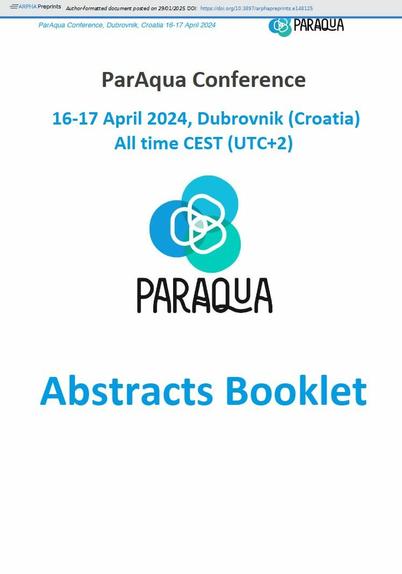
🆕 The abstracts booklet from the #ParAqua #COSTAction conference held last April was added to the project's dedicated #openscience outcomes collection.
👇 Thanks to our intergration with #ARPHA #Preprints, the collection shares the original PDF file.
🔗 Explore all ParAqua COST Action outputs published to date in the collection: https://doi.org/10.3897/rio.coll.192
🔗 Check out the booklet at: https://doi.org/10.3897/arphapreprints.e148125
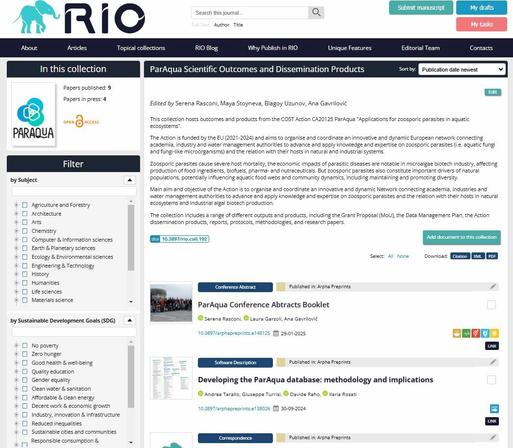

ParAqua Scientific Outcomes and Dissemination Products
This collection hosts outcomes and products from the COST Action CA20125 ParAqua "Applications for zoosporic parasites in aquatic ecosystems".
The Action is funded by the EU (2021-2024) and aims to organise and coordinate an innovative and dynamic European network connecting academia, industry and water management authorities to advance and apply knowledge and expertise on zoosporic parasites (i.e. aquatic fungi and fungi-like microorganisms) and the relation with their hosts in natural and industrial systems.
Zoosporic parasites cause severe host mortality, the economic impacts of parasitic diseases are notable in microalgae biotech industry, affecting production of food ingredients, biofuels, pharma- and nutraceuticals. But zoosporic parasites also constitute important drivers of natural populations, potentially influencing aquatic food webs and community dynamics, including maintaining and promoting diversity.
Main aim and objective of the Action is to organise and coordinate an innovative and dynamic Network connecting academia, industries and water management authorities to advance and apply knowledge and expertise on zoosporic parasites and the relation with their hosts in natural ecosystems and industrial algal biotech production.
The collection includes a range of different outputs and products, including the Grant Proposal (MoU), the Data Management Plan, the Action dissemination products, reports, protocols, methodologies, and research papers.
There has already been overwhelming support in the scholarly community for the EU 🇪🇺 Conclusions on scholarly publishing, e.g.,
https://www.coalition-s.org/open-science-stakeholders-welcome-european-efforts-towards-publicly-owned-and-not-for-profit-scholarly-communication/
and now this support extends even to certain publishers! #Pensoft and #ARPHA support the transition away from the current conglomerate of monopolists towards a genuine market with actual competition, which is one of the targeted outcomes:
https://blog.pensoft.net/2023/08/21/pensofts-statement-on-the-european-unions-conclusions-on-oa-scholarly-publishing/
"what drives innovation and revolutionary technologies is competition."

Open Science: stakeholders welcome European efforts towards publicly owned and not-for-profit scholarly communication | Plan S
<p>For European public research and innovation actors, scholarly knowledge is a public good. Publicly funded research and its results should be immediately and openly available to all without barriers such as subscription fees or paywalls. This is essential in driving knowledge forward, promoting innovation and tackling social issues. Key representative organisations of the public research […]</p>
 RIO Journal
 Björn Brembs