 Dr Mircea Zloteanu 🌺🌞🍃
#statstab #536 The Role of Item Distributions on Reliability Estimation: The Case of Cronbach’s Coefficient Alpha
Thoughts: Part of a series of papers by Zumbo arguing for an ordinal alpha (that others contest)
#statstab #536 The Role of Item Distributions on Reliability Estimation: The Case of Cronbach’s Coefficient Alpha
Thoughts: Part of a series of papers by Zumbo arguing for an ordinal alpha (that others contest)
#statstab #461 Interpreting Ordinal and Disordinal interactions
Thoughts: Interactions are not simple things. Their shape can determine many things (including sample size and effect size)
#design #ANOVA #interaction #effectsize #ordinal #crossover
https://www.jolley-mitchell.com/Appendix/WebAppOrdinalInteraction/WebAppOrdinalInteractions.htm
#statstab #444 {popower}: Power and Sample Size for Ordinal Response
Thoughts: Not the most intuitive but useful if you know the DGP will use ordinal data.
#statstab #420 {misty} item.alpha: Coefficient Alpha, Hierarchical Alpha, and Ordinal Alpha
Thoughts: If #419 and #418 made you consider reporting ordinal alpha, here is a package to do it
#ordinal #likert #reliability #psychometrics #mesurement #rstats
https://www.rdocumentation.org/packages/misty/versions/0.7.4/topics/item.alpha
<p>This function computes point estimate and confidence interval for the coefficient alpha (aka Cronbach's alpha), hierarchical alpha, and ordinal alpha (aka categorical alpha) along with standardized factor loadings and alpha if item deleted. By default, the function computes coefficient alpha based on unweighted least squares (ULS) parameter estimates using pairwise deletion in the presence of missing data that provides equivalent results compared to the formula-based coefficient alpha computed by using e.g. the <code>alpha</code> function in the <span class="pkg">psych</span> package by William Revelle (2025).</p>
#statstab #419 A Measurement Is a Choice and Stevens’ Scales of Measurement Do Not Help Make It: A Response to Chalmers
Thoughts: #418 convincing for not adopting ordinal α? This rebuttal may change your mind
#ordinal #likert #mesurement #psychometrics #cronbachalpha #reliability #testtheory #CTT #scales #debate #rebuttal

Chalmers recently published a critique of the use of ordinal α proposed in Zumbo et al. as a measure of test reliability in certain research settings. In this r...
#statstab #418 On Misconceptions and the Limited Usefulness of Ordinal Alpha
Thoughts: Ordinal α seemed cool. Then I read this paper. Takeaway: methods need good peer review and debate.
#statstab #410 Ordered Regression Models: a Tutorial
Thoughts: A very comprehensive paper on analysing ordinal data.
#orderedregression #regression #ordinal #tutorial #likert #probit #logit
https://link.springer.com/article/10.1007/s11121-021-01302-y

Ordinal outcomes are common in the social, behavioral, and health sciences, but there is no commonly accepted approach to analyzing them. Researchers make a number of different seemingly arbitrary recoding decisions implying different levels of measurement and theoretical assumptions. As a result, a wide array of models are used to analyze ordinal outcomes, including the linear regression model, binary response model, ordered models, and count models. In this tutorial, we present a diverse set of ordered models (most of which are under-utilized in applied research) and argue that researchers should approach the analysis of ordinal outcomes in a more systematic fashion by taking into consideration both theoretical and empirical concerns, and prioritizing ordered models given the flexibility they provide. Additionally, we consider the challenges that ordinal independent variables pose for analysts that often go unnoticed in the literature and offer simple ways to decide how to include ordinal independent variables in ordered regression models in ways that are easier to justify on conceptual and empirical grounds. We illustrate several ordered regression models with an empirical example, general self-rated health, and conclude with recommendations for building a sounder approach to ordinal data analysis.
#statstab #404 {latent2likert} simulate Likert response variables from hypothetical latent variables
Thoughts: Most of psych is Likert type data. This R pkg can help simulate effects and check model fit.
#likert #ordinal #r #latent #simulation #data
https://latent2likert.lalovic.io/articles/using_latent2likert
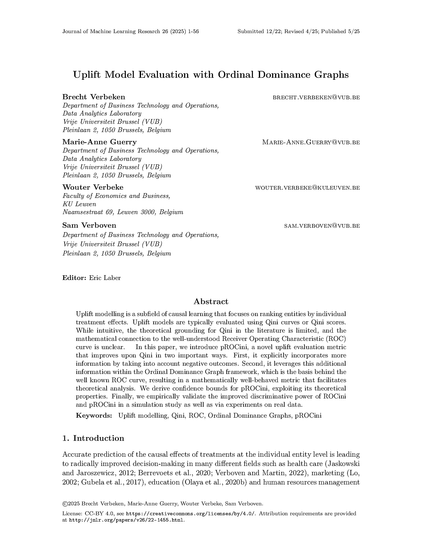
'Uplift Model Evaluation with Ordinal Dominance Graphs', by Brecht Verbeken, Marie-Anne Guerry, Wouter Verbeke, Sam Verboven.
http://jmlr.org/papers/v26/22-1455.html
#ranking #ordinal #uplift

 JMLR
JMLR