 Journal of Plant Ecology
【🎉Latest accepted article】
The leaf economics spectrum drives soil #Nitrification in subtropical forests
#Ammonia_oxidizingArchaea | #LeafTraits | #ResourceUseStrategies | #TreeSpecies
【🎉Latest accepted article】
The leaf economics spectrum drives soil #Nitrification in subtropical forests
#Ammonia_oxidizingArchaea | #LeafTraits | #ResourceUseStrategies | #TreeSpecies
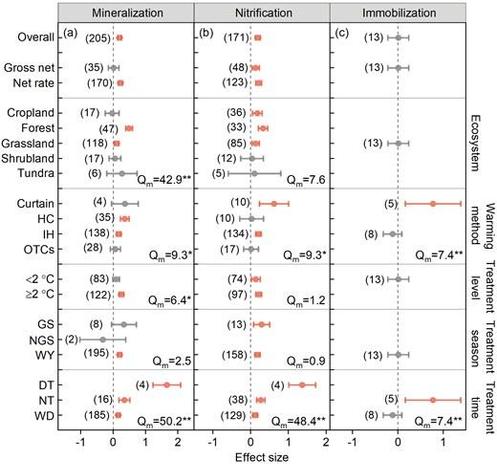
Chao Mao et al. conducted a meta-analysis, using 755 paired data points from field observations worldwide to explore the effects of #Warming and #AlteredPrecipitation on soil N transformation rates and to assess possible drivers of these effects.
#NitrogenCycling | #NitrogenMineralization | #Nitrification | #MicrobialImmobilization
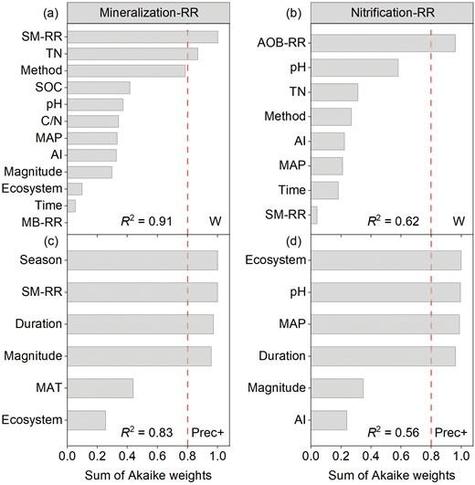
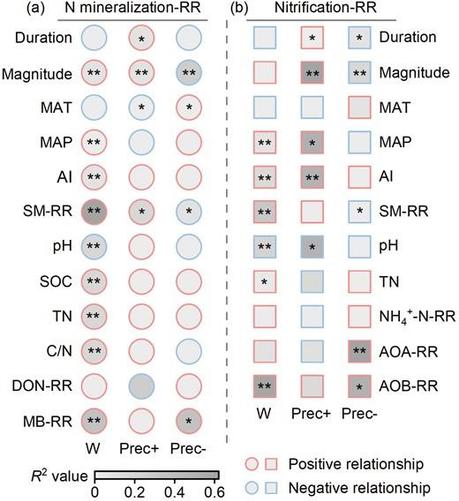
‼️ Effects of #Warming (W) and precipitation (P) change on soil nitrogen (N) cycles ♻️
Method: meta-analysis
Results:
1️⃣ W⬆️ / P ⬆️, #SoilNMineralization & #Nitrification rates ⬆️, #MicrobialImmobilization rate ➖
2️⃣ W⬆️ / P ⬆️, #SoilNCycling⬆️, soil N availability⬆️

The permeable silicate sediments which cover more than 50% of the continental shelves are a major, but poorly constrained sink for the vast amount of anthropogenic nitrogen (N) that enters the ocean. Surface-attached microbial communities on sand grains remove fixed-N via denitrification, a process generally restricted to anoxic or low oxygen (O2) environments. Yet, in sands, denitrification also occurs in the centimeters thick well-oxygenated surface layer, which leads to additional and substantial N-loss. So far however, the underlying mechanisms that drive denitrification in oxic sands are poorly resolved. In this study, we applied a non-invasive microfluidic technique to visualize and quantify how sediment-attached microorganisms shape O2 availability on the surface of silicate sand grains. This revealed a remarkable heterogeneity in rates; with colonies of O2 consuming and producing microorganisms situated within micrometers of each other. Using a mechanistic approach to model respiration on the surface of a single silicate sand grain we showed that the high rates of O2 consumption within the microbial colonies on the sand-grain surface outpace O2 supply from the surrounding pore water. As a result anoxic microenvironments develop on the sand grain surface, which so far have been invisible to conventional techniques. The model results indicate that anaerobic denitrification occurring in these anoxic microenvironments can account for up to 74% of denitrification in oxygenated sands, with the remainder occurring in the presence of oxygen. In a preliminary upscaling approach, using a global dataset we estimated that anoxic microenvironments in oxygenated surface layers could be responsible for up to a third of the total N-loss that occurs in silicate shelf sands. Consequently, denitrification in anoxic microenvironments drives substantial anthropogenic-N removal from continental silicate shelf sands.
The permeable silicate sediments which cover more than 50% of the continental shelves are a major, but poorly constrained sink for the vast amount of anthropogenic nitrogen (N) that enters the ocean. Surface-attached microbial communities on sand grains remove fixed-N via denitrification, a process generally restricted to anoxic or low oxygen (O2) environments. Yet, in sands, denitrification also occurs in the centimeters thick well-oxygenated surface layer, which leads to additional and substantial N-loss. So far however, the underlying mechanisms that drive denitrification in oxic sands are poorly resolved. In this study, we applied a non-invasive microfluidic technique to visualize and quantify how sediment-attached microorganisms shape O2 availability on the surface of silicate sand grains. This revealed a remarkable heterogeneity in rates; with colonies of O2 consuming and producing microorganisms situated within micrometers of each other. Using a mechanistic approach to model respiration on the surface of a single silicate sand grain we showed that the high rates of O2 consumption within the microbial colonies on the sand-grain surface outpace O2 supply from the surrounding pore water. As a result anoxic microenvironments develop on the sand grain surface, which so far have been invisible to conventional techniques. The model results indicate that anaerobic denitrification occurring in these anoxic microenvironments can account for up to 74% of denitrification in oxygenated sands, with the remainder occurring in the presence of oxygen. In a preliminary upscaling approach, using a global dataset we estimated that anoxic microenvironments in oxygenated surface layers could be responsible for up to a third of the total N-loss that occurs in silicate shelf sands. Consequently, denitrification in anoxic microenvironments drives substantial anthropogenic-N removal from continental silicate shelf sands.
SciTech Chronicles. . . . . . . . .Feb 21st, 2025
#"Younger Dryas" #Laacher #sulfate #geochronology #recycle #nitrification #pH #f-NBD #thermoelectric #ingots #doped #efficient ##superbugs #co-scientist #antibiotics #immune #Fetal #acetaminophen #plasma #CANDLE
Closing the recycle loop: #Waste-derived #nutrients in liquid #fertilizer.
#mightymicrobes #nitrification #agriculture #sustainable #nitrogen #phosphorus #hydroponics
https://phys.org/news/2025-02-recycle-loop-derived-nutrients-liquid.html
 Victor
 Victor
 John Vaccaro (johniac)
 CellBioNews