Spearheaded by the unstoppable Leili Mortazavi with Elnaz Ghasemi and Charlene C. Wu , this culminates > 15 years of work!
The findings imply that some #FMRI findings are more robust than commonly thought (with respect to reliability, validity, and generalizability).
Special thanks to the editors and reviewers at PNAS Nexus and for support from Stanford University 's #Neurochoice Initiative and the #ToyotaResearchInstitute ! (#AffectiveNeuroscience , #Neuroeconomics )
Election Touchscreen Map Takes Deeper Look Inside Key Swing Voter | Onion News Network

ONN political analyst Jason Copeland breaks down the latest presidential polling trends going on inside Pennsylvania resident Nick Camden.Have a written reco...

YouTube

A new thinkpiece on Policy Consequences of the New Neuroeconomics Framework.

We argue that #neuroscience provides a framework to build new models in #microeconomics with actual #policy consequences.

#addiction #ContingencyManagement
#microfinance #SunkCostFallacy #BehavioralEconomics #Neuroeconomics

A.D. Redish, H.S. Chastain, C.F. Runge, B.M. Sweis, S.E. Allen, A. Haldar (2024) Policy consequences of the new neuroeconomic framework. #arXiv unreviewed preprint.

https://arxiv.org/abs/2409.07373

Policy consequences of the new neuroeconomic framework

Current theories of decision making suggest that the neural circuits in mammalian brains (including humans) computationally combine representations of the past (memory), present (perception), and future (agentic goals) to take actions that achieve the needs of the agent. How information is represented within those neural circuits changes what computations are available to that system which changes how agents interact with their world to take those actions. We argue that the computational neuroscience of decision making provides a new microeconomic framework (neuroeconomics) that offers new opportunities to construct policies that interact with those decision-making systems to improve outcomes. After laying out the computational processes underlying decision making in mammalian brains, we present four applications of this logic with policy consequences: (1) precommitment to avoid falling into the trap of sunk costs, (2) media consequences for changes in housing prices after a disaster, (3) contingency management as a treatment for addiction, and (4) how social interactions underlie the success (and failure) of microfinance institutions.

arXiv.org

Intracranial electrical stimulation of the #AnteriorInsula decreases risky choice by increasing loss salience, but of the #MedialPrefrontalCortex increases risky choice by decreasing loss salience (causally supporting #AnticipatoryAffect predictions; #Neuroeconomics; #AffectiveNeuroscience):

https://www.nature.com/articles/s41467-024-51822-8

Direct stimulation of anterior insula and ventromedial prefrontal cortex disrupts economic choices - Nature Communications

Activity in the vmPFC and anterior insula is associated with economic choice and confidence, but their causal involvement is unclear. Here, the authors show that intracranial stimulation of subregions of these areas has distinct effects on risk-taking, loss sensitivity and confidence judgments.

Nature
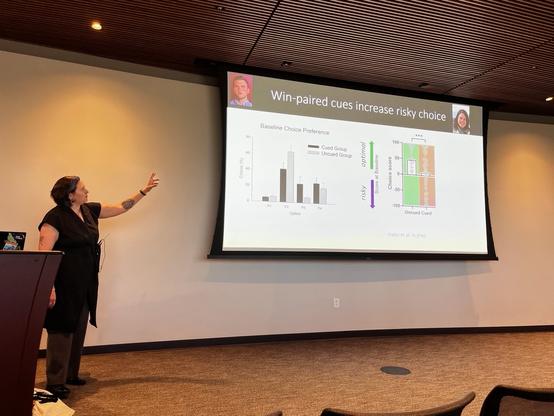
Catharine Winstanley of #UniversityofBritishColumbia updates the #Stanford Neuroscience crowd on how incidental cues promote risky gambling -- in #rats! (#AnticipatoryAffect , #AffectiveNeuroscience , #Neuroeconomics )

Pleased and honored to appear on the @danafoundation panel on "How the brain decides" with colleagues @[email protected] and Paul Glimcher. We had fun contemplating the past and future of #DecisionNeuroscience (#Neuroeconomics)...

https://www.youtube.com/watch?v=hyQRrkumyxU

How the Brain Decides - A Dana Discovery Dialogues Series

YouTube

Revisiting this wise interview with Camerer for an upcoming class: "There is so much low-hanging fruit in #Neuroeconomics !"

https://www.moneyonthemind.org/post/interview-with-colin-camerer

Well, that was fun! Thanks to my wonderful #neuroeconomics colleagues and our adroit interviewer! ( video to be posted at @danafoundation )
Fascinating @neurochoice presentation by #NeirEshel on the #neuroeconomics of striatal #dopamine (23.12.12):

_BRAIN$?_ is out!
Where I comment that while #neuroeconomics researchers have met historical goals of using brain activity to predict and even forecast choice, the goalposts may have shifted (#neuroforecasting)...

https://myscp.onlinelibrary.wiley.com/doi/10.1002/jcpy.1398