neurochoice

23 Followers
33 Following
128 Posts
The (open) voice of #neurochoice ...

Now out in @[email protected] :
"#Neuroforecasting reveals generalizable components of choice" (link below)!

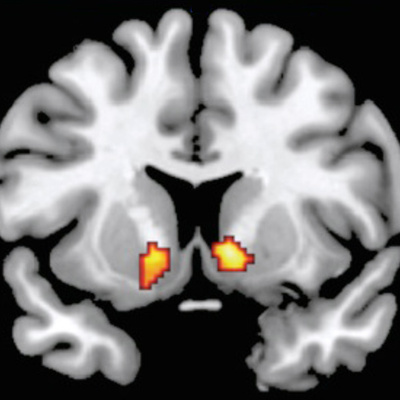
Led by the intrepid Alex Genevsky , we examined how deep brain activity (in the Nucleus Accumbens or #NAcc ) can forecast choices out of sample in much larger groups (e.g., in #crowdfunding and #videoviewing markets).

We found that while behavioral forecasts depended on demographic match, neural forecasts (from the NAcc) did not, potentially supporting inferences from smaller samples. So, beyond considering #representativeness of a sample, researchers might also benefit from considering representativeness of different choice components.

Thanks to the Wu Tsai Neurosciences Institute #Neurochoice Initiative for support, to the reviewers for constructive suggestions, and to #PNASNexus for a smooth publishing experience!

https://academic.oup.com/pnasnexus/article/4/2/pgaf029/8016018

Congratulations to Laramie Duncan and #Stanford collaborators on publishing "Mapping the cellular etiology of schizophrenia and complex brain phenotypes" in @natureneuro !

Combining brain-wide genetics and transcriptomics analyses implicated different cell types in #schizophrenia (e.g., retrosplenial excitatory and striatal MSN) versus other disorders (e.g., D2 MSN in alcohol consumption). Excited to explore and learn more with this promising new approach...

https://www.nature.com/articles/s41593-024-01834-w.epdf

Mapping the cellular etiology of schizophrenia and complex brain phenotypes | Nature Neuroscience

Psychiatric disorders are multifactorial and effective treatments are lacking. Probable contributing factors to the challenges in therapeutic development include the complexity of the human brain and the high polygenicity of psychiatric disorders. Combining well-powered genome-wide and brain-wide genetics and transcriptomics analyses can deepen our understanding of the etiology of psychiatric disorders. Here, we leverage two landmark resources to infer the cell types involved in the etiology of schizophrenia, other psychiatric disorders and informative comparison of brain phenotypes. We found both cortical and subcortical neuronal associations for schizophrenia, bipolar disorder and depression. These cell types included somatostatin interneurons, excitatory neurons from the retrosplenial cortex and eccentric medium spiny-like neurons from the amygdala. In contrast we found T cell and B cell associations with multiple sclerosis and microglial associations with Alzheimer’s disease. We provide a framework for a cell-type-based classification system that can lead to drug repurposing or development opportunities and personalized treatments. This work formalizes a data-driven, cellular and molecular model of complex brain disorders. Duncan and colleagues link specific human brain cell types to schizophrenia and other complex brain phenotypes, providing mechanistic insights and a cellular taxonomy for psychiatric disorders.

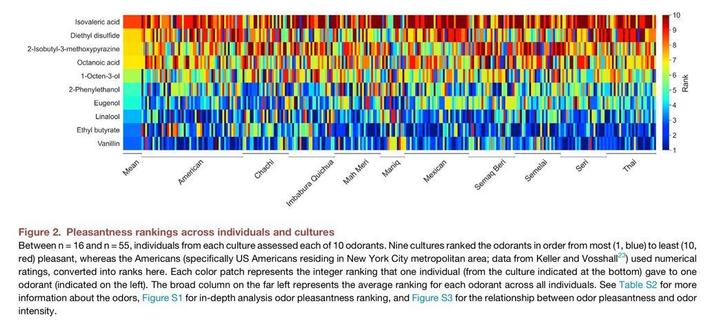
What determines which odours we find pleasant? Research suggests the variance is mostly explained by personal taste (54%) and molecular identity (41%), with culture only explaining 6%, research suggests:
https://www.cell.com/current-biology/fulltext/S0960-9822(22)00332-3?_return=

Floyd Bloom, who died on 8 January at age 88, authored the classic textbook “The Biochemical Basis of Neuropharmacology” and expanded our understanding of the roles of neurotransmitters in the brain.

By Sydney Wyatt

https://www.thetransmitter.org/neuropharmacology/remembering-the-life-of-floyd-bloom/?utm_source=mastodon&utm_medium=org-social&utm_campaign=20250124-obit-floyd-bloom

Remembering the life of neuropharmacologist Floyd Bloom

The co-author of the classic textbook “The Biochemical Basis of Neuropharmacology” and pioneer in studying the roles of neurotransmitters in the brain died on 8 January at 88 years old.

The Transmitter: Neuroscience News and Perspectives

Scientific #discovery involves making mistakes, but these are often omitted from official reports. In this preprint, I recount a #mistake which led to the discovery that #rats were making ultrasonic #vocalizations while playing. Scientific serendipity is worth celebrating! (thanks to Markus Wöhr for encouragement to submit the tale for a special issue on ultrasonic vocalizations).

https://papers.ssrn.com/sol3/papers.cfm?abstract_id=5108903

How We Stumbled Upon the Rat Vocalizations

Over a quarter of a century later, most rodent researchers know that specific types of ultrasonic vocalizations in rats appear to index distinct affective state

Engaging backstory on the evolution of meta-analyses and large scale collaborations ( i.e., #ABCD ) by Angela Laird as interviewed by Peter Bandettini on the #neurosalience podcast ( #FMRI , #neuroscience , #ohbm ):

https://www.youtube.com/watch?v=d7Jh7JFGf1Q

Neurosalience #S5E2 with Angela Laird - Forging the meta-analysis movement in neuroimaging

YouTube

Check out this very clear and insightful podcast with my favourite #DecisionMaking #Neuroscientist @adredish ! A lot of food for thought about the decisions we make, the habitual ones, the deliberative ones, the instinctive ones, and what happens when these systems are in conflict:

https://neuromatch.social/@adredish/113624315622020263

Redish Lab (@[email protected])

I was interviewed on the podcast The One You Feed with Eric Zimmer. We discuss #morality, #addiction, and the general structure of #DecisionMaking. check it out! https://www.oneyoufeed.net/changing-how-we-choose-with-david-redish/

Neuromatch Social

75+ Nobel Prize winners have signed a letter urging senators not to confirm Robert F. Kennedy Jr. as head of the Department of Health and Human Services.

The letter marks the first time in recent memory that Nobel laureates have banded together against a Cabinet choice.

https://www.nytimes.com/2024/12/09/health/kennedy-hhs-nobel-laureates.html

Nobel Laureates Urge Senate to Turn Down Kennedy’s Nomination

Elevating Mr. Kennedy to secretary of H.H.S. “would put the public’s health in jeopardy,” more than 75 laureates wrote.

The New York Times

#Neurochoice codirector Keith Humphreys notes a silver lining of learning from drug policy changes in the Pacific Northwest on @NPR :
"Humphreys says what the state is trying to do is find a balance between the nation's historical war-on-drugs approach to addiction and Oregon's experiment in decriminalization."

https://www.npr.org/2024/12/05/nx-s1-5200007/heres-whats-happened-in-the-3-months-since-oregon-changed-its-drug-rules

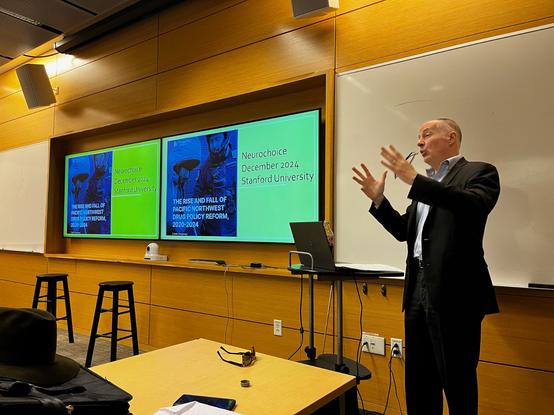
Codirector Keith Humphreys updates the @neurochoice gang on the drug policy front in his talk: "The rise and fall of Pacific Northwest drug policy reform"...