Because of careful planning, sheer {un}luck and Quantum Entanglement, I can add significantly important components to this present that I have gotten, a very short while ago, to boost the functionality of this very nice, made and produced in the UK, Nano computing system of which you can see the name in the photograph {Alt text included}

I can go from the basic storage that was provided in the present 🎁 all the way up to Two Hundred Fifty Six GB. I even got a very nice Red White enclosure with an important cooling fan for the system, with the inclusion of cooling blocks!

I also got a neat 27 Watts USB-C power supply for the system.

The only things missing are the two Micro HDMI to HDMI cables.

That also means that I cannot power up the system and see what actually goes on.

What I can see however, is that the moment I apply Power to the system, the status Led goes from dark to red stays a second or four at that state, then becomes green which means that the POST has executed successfully.

**Note
The unluck, I was referring to, is the fact that the 256 GB microSD card has been extracted from my extremely broken Xiaomi Redmi Note 12S Android, which lived for just a year and a few months before it catastrophically burnt itself out due to extremely extremely poor cooling Management in the system.

Xiaomi put a high performance battery in a casing without a super high performance cooling system. From day one that phone reached between 39 and 46° C on the battery which means that the actual temperature was about 15° higher.

Due to that failure of Xiaomi I know have a Fantastic micro SD card free for my nano Computing System!
Now that is neat

#NanoPC #64Bits #microHDMI #LPDDR4x #8192GB #POE #PCIe #HAT+ #GPIO #TRXcom #Cam #NCC #NTC #CMIIT #IFT #Abrocon #AMATEL

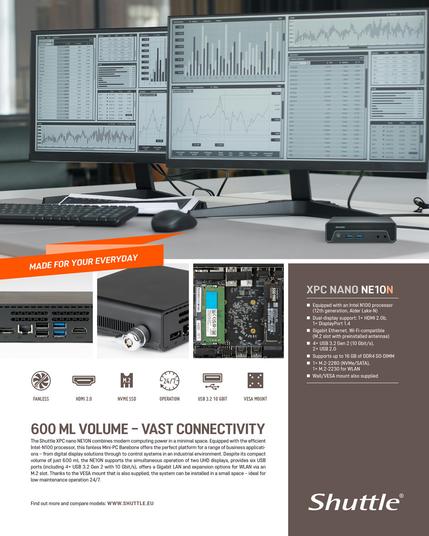
Our XPC nano family continues to grow: the fanless NE10N now joins the line-up, combining ultra-compact design (just 600 ml) with impressive connectivity and expandability. Despite its size, it supports two 4K displays at 60 Hz and connects up to six USB devices. Inside, there's room for a fast M.2-2280 NVMe SSD and a DDR4 memory module - ideal for demanding yet space-constrained applications. Discover the NE10N: https://go.shuttle.eu/Oo0Ns

#NanoPC #ShuttleEurope

« #MusePi Pro is a feature-packed, credit card-sized SpacemIT M1 #RISCV SBC with HDMI, GbE, 4x USB, M.2 and mPCIe sockets »

https://www.cnx-software.com/2025/04/27/muse-pi-pro-feature-packed-credit-card-sized-spacemit-m1-risc-v-sbc/

#Hardware #NanoPC

Muse Pi Pro is a feature-packed, credit card-sized SpacemIT M1 RISC-V SBC with HDMI, GbE, 4x USB, M.2 and mPCIe sockets - CNX Software

Muse Pi Pro is a feature-packed, credit card-sized SBC powered by the SpacemIT M1 octa-core 64-bit RISC-V AI SoC with a 2 TOPS NPU and equipped with up to

CNX Software - Embedded Systems News

Choose your AI engine! Our latest XPC nano Barebones NT10H5 and NT10H9 have the same DNA as their AMD Ryzen-based teammate NA10H7 and offer high-performance computing in the most compact form factor. These systems achieve an AI performance of up to 34 TOPS and are therefore perfectly suited for advanced AI workloads and high-end multitasking. AMD or INTEL - what's your choice? Learn more: https://go.shuttle.eu/ShuttleAI-Barebone-PC

#ShuttleEurope #AIPC #AIComputing #MiniPC #AI #Shuttle #nanopc

NA10 / NT10 - Shuttle Europe

Most single board computers are affordable and come with the typical two HDMI outputs. But only a few single board computers have an additional HDMI input to capture video built-in to the board. Meet the Orange Pi 5 (16GB) and the NanoPC-T6.

#single_board_computers #orangepi #orangepi5 #nanopc #hdmi

I thought that booting Seriously Bad Computers in ACPI mode is crippled compared to booting in DeviceTree mode.

NanoPC-T6 is otherwise. Same 6.11-rc2 kernel gives working system in ACPI mode and fail-to-boot one in DT.

DT = no USB, no PCIe while rootfs is on NVME cause it worked fine in ACPI mode.

And DT is from 6.11-rc2 kernel.

#SystemNotReady #ACPI #DeviceTree #SBC #RK3588 #FriendlyELEC #NanoPC-T6

« But the #OrangePi 5 Max is powered by a different processor and has a few things you won’t find on any Raspberry Pi Model B to date including a 2.5 GbE Ethernet port, a built-in M.2 slot for a PCIe 3.0 SSD (or other add-ons) and support for WiFi 6E »

https://liliputing.com/orange-pi-5-max-is-a-credit-card-sized-rk3588-pc-with-2-5-gbe-ethernet-pcie-3-0-and-wifi-6e/

#Hardware #SBC #SingleBoardComputer #ARM #NanoPC #SelfHosting

Orange Pi 5 Max is a credit card-sized RK3588 PC with 2.5 GbE Ethernet, PCIe 3.0, and WiFi 6E - Liliputing

Orange Pi 5 Max is a credit card-sized RK3588 PC with 2.5 GbE Ethernet, PCIe 3.0, and WiFi 6E

Liliputing
I'm thinking about a small personal ARM server for testing shit. And by small I mean the smallest I can get. So I've been looking into the #SBC market and found some devices with #RK3399, 4G LDDR4 RAM and a PCIe (2x/4x) to connect an #SSD. My favourites so far are #NanoPi M4v2 and #NanoPC T4 but I'm not sure how it is with power while using the SSD.
Je recherche une solution pour faire un écran (mini 17 pouces) capable d'afficher un site web qui se mettrait à jour automatiquement toutes les xx minutes. Pas besoin de tactile, juste un accès au net filaire ou wifi. Je pensais à un #Raspberry #Arduino ou qqchose du genre avec un OS + navigateur connecté à un vieil écran 17 ou 19 pouces Des idées à me proposer ? (totalement novice sur la question) #nanopc #ecran #geek
Briefly documented my #WireGuard experience on the #NanoPC T4 switching from #OpenVPN.

Was a bit of a pain to set up, but the results have been great so far.

https://write.with.parts/adasauce/wireguard-on-nanopc-t4-with-boringtun
Wireguard on NanoPC-T4 with BoringTun

I was in the midst of implementing a little POC migration of a small deployment from using OpenVPN to WireGuard for a pre-production netw...