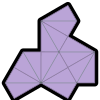
Raphael APPENZELLER
Bad Apple!! but it's an aperiodic tiling using the hat monotile.
See also on PeerTube and YouTube:
https://makertube.net/w/fs3rbUMqJeVcZagdZQ6RfH
https://www.youtube.com/watch?v=RLZx-5ymfDU&list=RDRLZx-5ymfDU
Bad Apple!! but it's an aperiodic tiling using the hat monotile.
See also on PeerTube and YouTube:
https://makertube.net/w/fs3rbUMqJeVcZagdZQ6RfH
https://www.youtube.com/watch?v=RLZx-5ymfDU&list=RDRLZx-5ymfDU
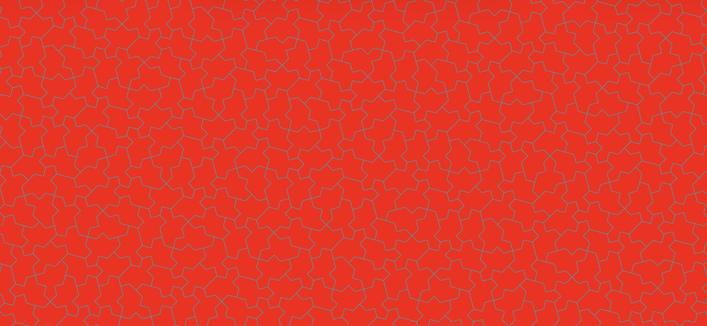
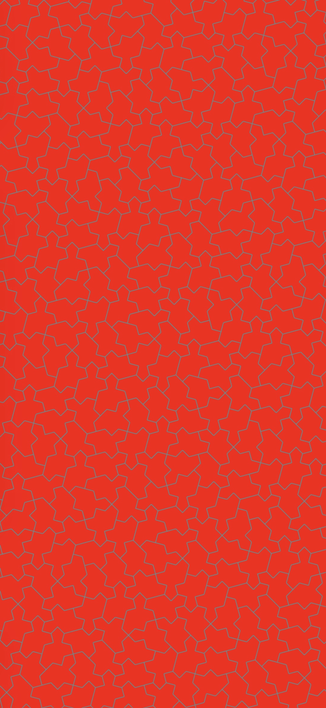
Here is a grouping of similarly made turtle tiles.
I’ve finally started playing around with the idea of spectre tiles and have noticed something that looks somewhat interesting.
I wonder if it is specific to the particular tiling that I was looking at, or if it is true in general for tilings using spectres.
I noticed that the spectre tile can be decomposed into two pieces, one a 3-fold symmetric thing involving the head part of the spectre and the other a mirrored pair of irregular 120°-120°-90°-120°-90° pentagons (like those in the Cairo tiling that is also the dual of the snub-square tiling). An image search later led me to Dave Smith’s site (https://hedraweb.wordpress.com/2023/07/16/wheel-tiling-and-the-spectre/) where he described these as the propeller and bow-tie used in the wheel tiling, and how they relate to the spectre.
Using a spectre tiling from https://cs.uwaterloo.ca/~csk/spectre/, I was trying something involving squares, triangles and equilateral-but-not-equiangular hexagons, and that ended up making me notice a lot of triangular groupings of 1, 3, and 6 hexagons showing up. I thought that it might be worth looking at how the propellers fit on that tiling instead.
I coloured the propellers such that the same colour indicates the same orientation. The parts with green showing through are from the “odd tiles” in the original picture. Each odd tile is surrounded by six triangular groupings of propellers which alternate in colour.
I do not know if this is a fluke because of particular choices made when constructing that patch of tiling.
Any ideas? Has someone tried it using a patch from a different spectre tiling?
I apologize in advance if it is something that is already well-known. I haven’t read much of the relevant literature at this point…only enough to start playing 😊.
@csk #monotile
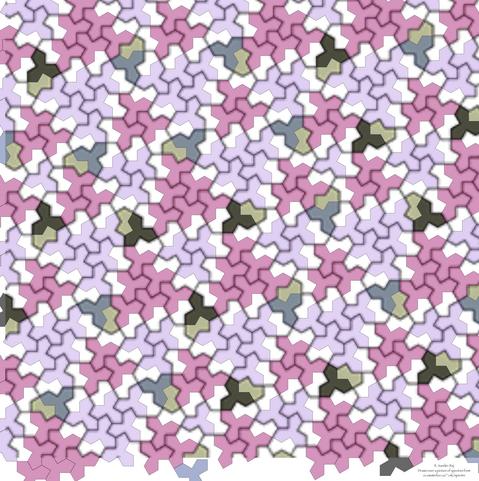
Some of my patterns are based on tilings with can be thought of as having overlapping parts, this overlap often consists of something that looks like a border.
An example is this sequence in which the “borders” are unclear until they resolve into borders of a snub square tiling, or its Cairo-type tiling dual.
https://mathstodon.xyz/@HypercubicPeg/109043217999286054
————
Often when I do something like this, I can find an infinite class of “tiles” where the pattern along the border can be incremented in some predictable way.
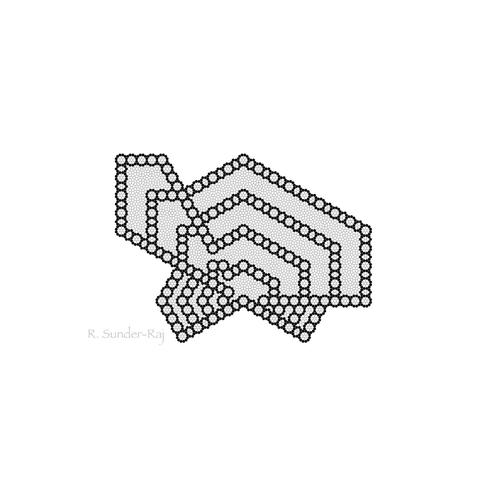
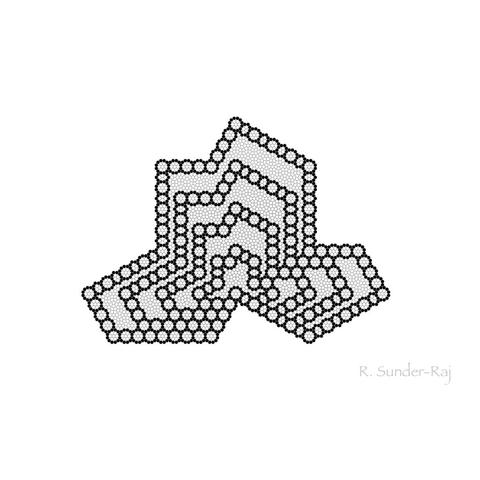
A little while back, I had a go at trying to interpret the Hat tile in a similar way using edge-touching dodecagons. Here is one of the versions that I liked.
#mathart #mathsart #aperiodicMonotile #monotile #tiling #tilingTuesday
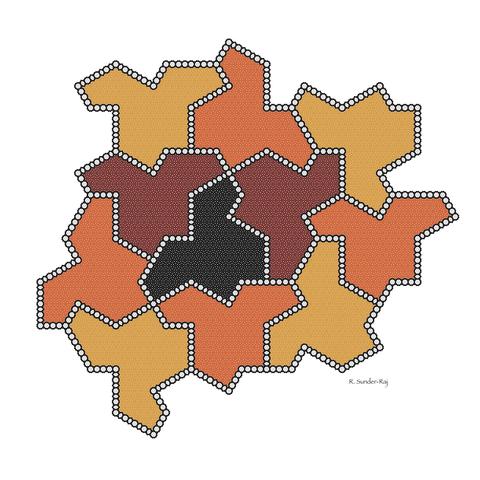
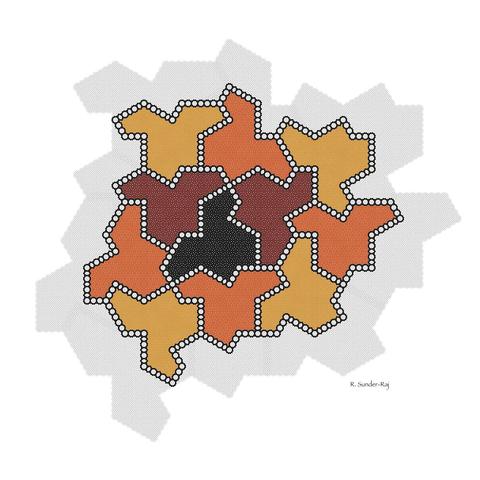
What do you get when your #ADnD #Dungeon master is a #maths nerd? You get a #MathsPuzzle like this: there's a weirdly shaped hole in the wall, and a bunch of puzzle pieces on the floor looking all the same... #monotile
Note: I'm not looking for a solution, we want to figure it out in our next session!
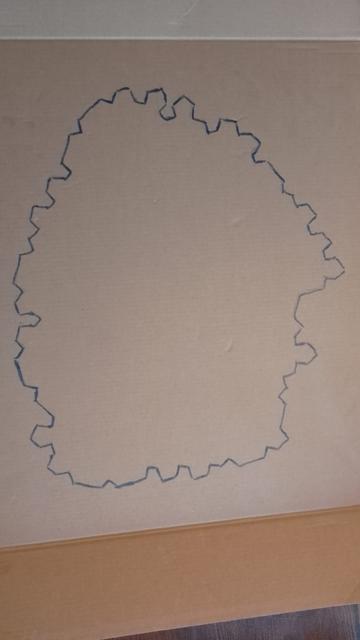
Found the posting.
The game was Fjords, plural, and the link to the pieces is included.
Back in probably 2023, someone posted their monotile tile for 3D printers, for the purpose of replacing their hexagon tiles in, I think, the game Fjord.
I don't have a 3D printer, and I'm not close to anyone who does, but it doesn't matter, because The Game Crafter has them! They are listed as 53 and 43 mm across, I presume by measuring their longest and second-longest cross-sections.
#monotile #AperiodicMonotile #BoardGames
https://www.thegamecrafter.com/parts?query=infunity%20tiles%20hat
 Mark Dingemanse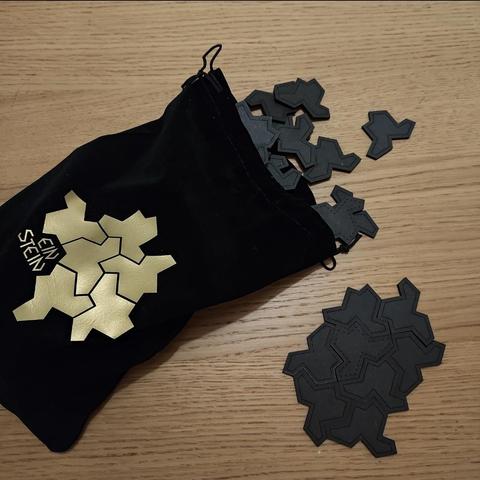
 RevK
RevK 
 R. Sunder-Raj
 Christ van Willegen
 John M. Gamble
 Petra Schwer