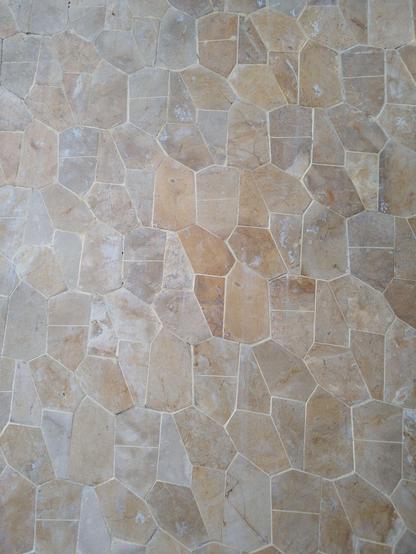
Happy #TilingTuesday with these stone tiles from the Chinese Garden in Jardin Botanique de Montreal

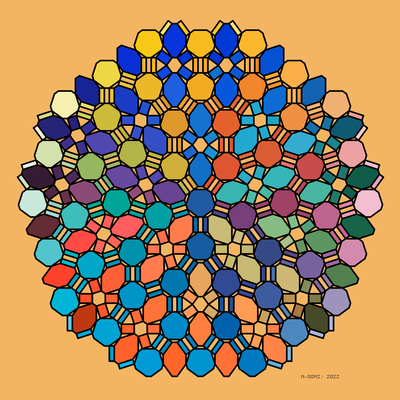
Using a ½-weight triangle as our base cell, we get 12 ways to combine 5 of them into polyiamonds where cells can have weight ½ or 1. (More compactly, my notation for this set is 5·½▲. The blog post where I explain how fractions work is in progress.)

I'm using a sort of pinwheel dissection of triangles to show overlapping ½-weight cells belonging to different pieces. The solid triangles represent two overlapping cells belonging to the same piece.

#TilingTuesday

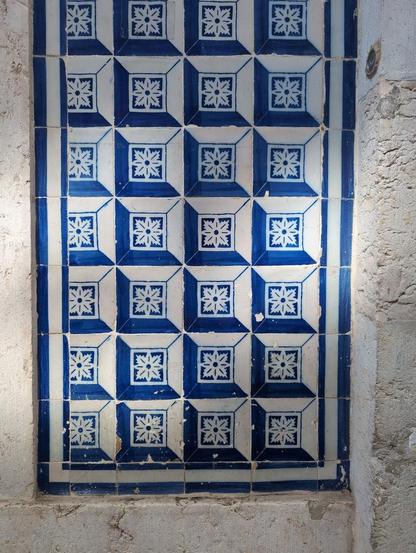
An azulejo from Portugal.

#TilingTuesday

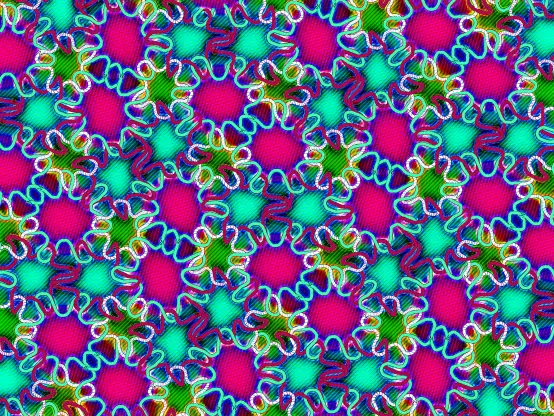
#TilingTuesday but wiθ ocd particle physics 🤨🤨🤨🤨🤨🤨🤨
(ðey attract/repel based on distance & color, & bounce)

#creativecoding #simulation #mathart #physics #animation

A ceiling of hexagons (presumably inspired by a symbol of Manchester, the worker bee), Manchester Airport, England

#TilingTuesday #geometry #tiling #MathArt #photography #design #pattern #manchester

The Topkapi Scroll: Geometry and Ornament in Islamic Architecture
by Gülru Necipoğlu (1996, 384 pages, free PDF download)

https://www.getty.edu/publications/virtuallibrary/9780892363353.html

#TilingTuesday #Geometry #Pattern

As a follow up to last week's post on Markov partitions for Hat (hat and turtle) and Spectre (hats in turtles and turtles in hats) tilings (https://mathstodon.xyz/@pieter/116484517078239617), here is a way of colouring such tilings. For each control point, we colour the tile according to its distance from the boundary of the fractal window it lies in.

The first image shows a patch of a turtle tiling using the colour map in the second. Control points that lie near the boundary of the fractal window are close to flipping between the two states of a Conway worm, so this is a nice way of highlighting subsets of tiles that are 'close' to being Conway worms.

One of the things on my to-do list is to create an animation of a patch as the triangular grid moves slowly relative to the underlying pattern, but if anyone wants to take a stab at this, please do.

(1/2)

#TilingTuesday #AperiodicMonotile

Peter Selinger has come up with a great way of generating hat tilings by overlaying a triangular grid on a periodic pattern, and placing a tile at each point that is not white, with the orientation and handedness of the tile determined by the colour of the point. A more thorough explanation is given in this preprint
https://arxiv.org/pdf/2604.20964,
where he and Sébastien Labbé show that this is a Markov partition. As mentioned in the paper, I came up with a similar construction a few years ago, but it required separate steps for tiles of a given orientation modulo 120.

In this series of posts, I'll attempt to explain the connection between the two constructions, and demonstrate the analogous constructions for the hats-in-turtles and turtles-in-hats versions of the Spectre tiling. The aim is to give a sense of the main ideas, rather than a rigorous proof that this works.

Before I get into the details, here is a Markov partition for turtle tilings, where control / anchor points are located on the underside of the turtle's shell.

[Edit: For more background about the paper, see Sébastien's blog post: http://www.slabbe.org/blogue/2026/03/a-construction-of-the-hat-tilings-by-a-markov-partition/ This includes some printable files that can be used to construct patches of hat tilings in practice.]

(1/n)

#TilingTuesday #aperiodicTilings #aperiodocMonotile

Es #tilingTuesday y sigo testeando el Tesela.

Cambios:
- Corregido bug: no cargaba correctamente la configuración anterior al retomar la sesión.
- Estadísticas sin tener que finalizar la partida.
- Botón para exportar la figura generada en PNG.

🧩 I played Tesela and scored 440 points!
-----------------------
📦 Bag size and distribution: Ideal
💎 Total tiles: 45
-----------------------
🎨 Colors: 92
🖼️ Profile: 208
⚪ Spaces: 140
-----------------------
Juega aquí: https://tesela.netlify.app