#Polyhedron #Polygons #tiles #opticalillusion #MathArt #MathsArt
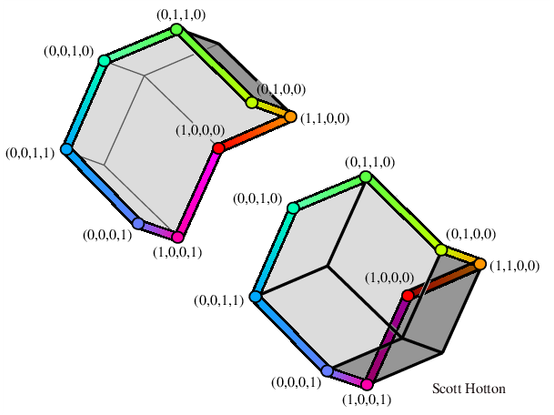
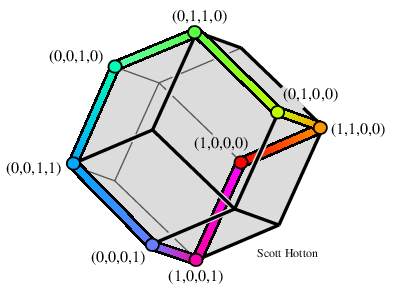
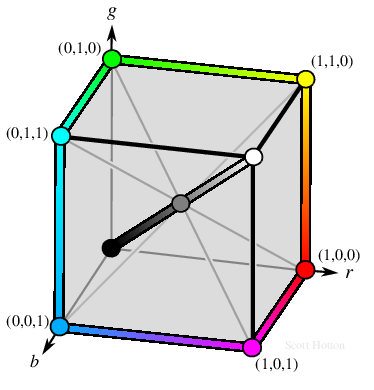
The set of all \((r,g,b)\) values for monochromatic light is the color cube \([0,1]^3\) shown in the figure. More generally each \((r,g,b)\) in the color cube generates some color experience or qualia. The norm of \((r,g,b)\) represents the subjective brightness of the color. When \(r=g=b\) the color is black, white, or a shade of gray, depending on its brightness. The \(r=g=b\) diagonal is the achromatic axis. The saturation ("colorfulness") of a color is the distance of \((r,g,b)\) from the achromatic axis. Maximum saturation occurs at the 6 vertices of the color cube that are not on the achromatic axis. These are the chromatic vertices.
The vertices \((1,0,0), (0,1,0), (0,0,1)\) are the fully saturated primary hues. The vertices \((0,1,1), (1,0,1), (1,1,0)\) are the fully saturated secondary hues. The primary and secondary hues alternate along the hexagon's vertices.
The set of all colors with a particular hue is the intersection of the color cube with a halfplane whose boundary contains the achromatic axis. Each hue is maximally saturated at one of the chromatic vertices or on an edge connecting adjacent chromatic vertices. These 6 vertices and edges form a nonplanar equilateral hexagon on the boundary of the color cube. We'll call it the hue hexagon (color wheel).
(2/6)
 Phracker
 Scott Hotton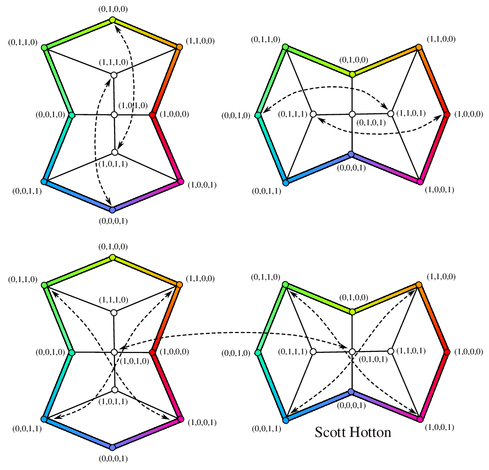
 R. Sunder-Raj