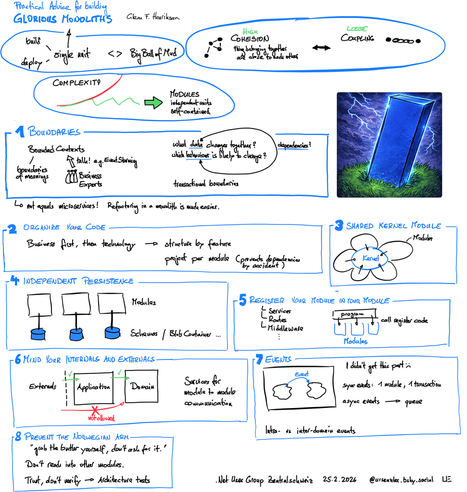
Sketchnote from Wednesday's .NET user group Zentralschweiz meet-up with Glenn F. Henriksen about practical advice to build glorious monoliths:
#Development #Comics
The one true way Β· Whatβs the best architecture for software? https://ilo.im/169rwu
_____
#Debates #Software #Monoliths #Microservices #DevOps #WebDev #Backend
Microservices Killed Our Startup. Monoliths Would've Saved Us
#HackerNews #Microservices #Monoliths #Startup #Failure #SoftwareArchitecture #TechLessons
"All of time, space, and... microservices?"
Catch Christian Kuemmel at #JCONUSA25 during #IBM #TechXchange as he rethinks #microservice persistence. Ditch the database #monoliths and unlock future-ready solutions!
π
Oct 6-9 | π Orlando, FL
ποΈ https://usa.jcon.one/register
For those of you who care about trends: #modular #monoliths are listed in the βearly majorityβ section of the @infoq 2025 Software Architecture And Design Trends report (again). If you haven't jumped the bandwagon, yet: you can still spearhead a movement! πππ¦
Both microservices and monolithic architectures have their pros and cons, and the choice depends on factors like scalability, complexity, team size, and business needs. ## <br>Monolithic Architecture ### <br>What is it? A monolithic application is a single, unified codebase where all components (UI, business logic, and database) are tightly integrated. ### When to Use Monoliths β Small Teams or Startups - If you're in the early stages of a project with limited resources, monoliths are easier to build and deploy. β Simple Business Logic - When your application has straightforward functionalities without the need for independent scaling. β Faster Development & Deployment - No need for complex inter-service communication, making it easier to test and deploy. β Performance-Critical Applications - Since everything runs within the same process, monoliths tend to have lower latency than microservices (no network calls between services). β Tight-Knit Codebase - When development is centered around a single team managing all features without requiring distributed teams. ## <br>Microservices Architecture ### <br>What is it? Microservices break down an application into multiple loosely coupled services that communicate via APIs, allowing independent development, deployment, and scaling. ### <br>When to Use Microservices β Scalability & High Traffic Applications - If different components of your system have different scaling needs, microservices allow you to scale parts of your application independently. β Large Teams & Distributed Development - When multiple teams work on different features, microservices enable parallel development and independent deployments. β Complex Business Domains - If your system is large and growing, microservices help in maintaining modularity and flexibility. β Continuous Deployment & DevOps - If your organization follows CI/CD and wants frequent deployments without downtime, microservices facilitate rolling updates. β Polyglot Programming - When you need different tech stacks for different components (e.g., Python for machine learning services, Node.js for APIs, and Go for performance-critical services). β Resilience & Fault Isolation - If one microservice fails, the rest of the system can still function, reducing downtime. ## <br>When to Transition from Monolith to Microservices? 1. Growing Complexity β If your monolithic app becomes difficult to maintain and deploy. 2. Scalability Issues β If scaling the entire app is inefficient and costly. 3. Team Expansion β If teams are getting blocked waiting for other parts of the system to be ready. 4. Frequent Updates β If continuous deployment is crucial for your business. ### <br>Final Thought - Start monolithic if you're in the early stages or working with a small team. - Move to microservices when the system outgrows monolithic constraints and demands modularity and scalability. Given the complexity of the issue, we welcome all contributions. Leave your contribution in the comments