“[W]e owe it to ourselves to name the world we cannot live without, even as we diagnose the world we cannot live within.” (Benjamin 2022, 279)

“[T]ransformative change happens when we are willing to build the things that we know must exist.” (Hayes and Kaba 2023, 13)

Disabled people know how to live in a world that wishes we would die. Technology has long been in the business of writing disabled and otherwise oppressed people out of the future. The chapters of this book describe technological projects that enact eugenics through medical exclusion, educational exclusion, employment exclusion, and incarceration which produce layers of stratification and removal of disabled and oppressed people from public life. With every breath, disabled people write a disabled future, one in which we all belong, regardless of the circumstances of our births or the collisions of our fragile flesh with a harsh and sometimes toxic earth. Disabled articulations, our sociotechnical assemblages, chart a new future for us all by undermining what we believe is possible in the present.

This book has been an exercise in working my own way out of hopelessness. Sometimes, it can feel as though the structures of oppression are fractally distributed in never-ending spirals (Williams 2021). These structures become legible at every layer of our sociotechnical world, not merely because oppression has been built into technology, but because the structures of oppression are human. This revelation is not cause for despair but for hope and for action. Fundamentally, oppression is about human relationships — specifically toxic ones, neglectful ones, and domineering ones. We often talk about human relationships as a way out of our contemporary dystopia (Hayes and Kaba 2023; Piepzna-Samarasinha 2018; 2022), and I believe that, firmly. However, we sometimes interpret our social problems as stemming from absences of relation, from which relation will save us. Instead, it is necessary to understand that while our current relations are ones of alienation and subjugation, they are still relations. We are not tasked with building relations where there previously were none, but with forging new relations, healing relations, and growing relations away from toxic and hateful ones. This configuration requires that we acknowledge our role in oppression. We must abolish our internal metaeugenic logics, our ideologies of replacement, and our fascist alienation and domination as a part of this revolution.

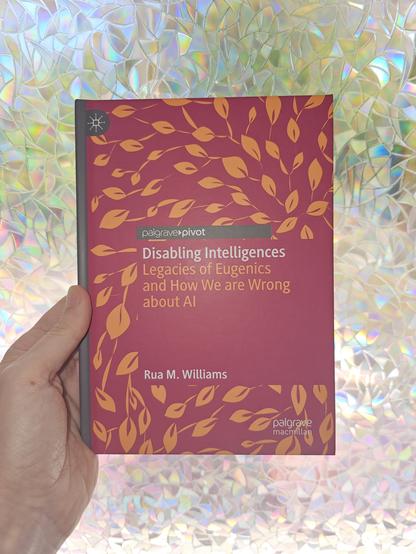
This book is titled “Disabling Intelligences” for many reasons. First, because so-called “AI” is built off of historical projects committed to the excision of disability from the classification of humanity. Second, because technochauvinism has created the conditions of disablement for many. And finally, I have named this book “Disabling Intelligences” because the concept of intelligence is inextricable from the heart of eugenics and must be dismantled as a socially constructed, metrically derived, and algorithmically upheld category of oppression.

https://link.springer.com/book/10.1007/978-3-032-02665-1

[image is the cover of Rua M. Williams's Disabling Intelligences: Legacies of Eugenics and How We are Wrong about AI, a deep pink cover with orange vines published by palgrave macmillan, held in front of a rainbow glass background.]

#ArtificialIntelligence #AI #AIHype #DisabilityJustice #eugenics #metaeugenics

I forgot that I did eventually edit the first line of the book. It was originally, "I did not want to write this book."

Disabling Intelligences eBook is available now https://link.springer.com/book/10.1007/978-3-032-02665-1

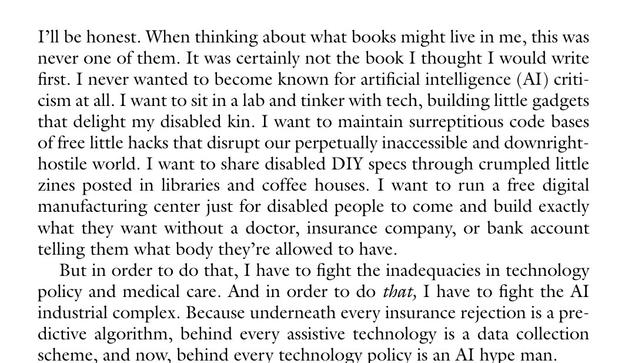
Image text : I’ll be honest. When thinking about what books might live in me, this was never one of them. It was certainly not the book I thought I would write first. I never wanted to become known for artificial intelligence (AI) criticism at all. I want to sit in a lab and tinker with tech, building little gadgets that delight my disabled kin. I want to maintain surreptitious code bases of free little hacks that disrupt our perpetually inaccessible and downright-hostile world. I want to share disabled DIY specs through crumpled little zines posted in libraries and coffee houses. I want to run a free digital manufacturing center just for disabled people to come and build exactly what they want without a doctor, insurance company, or bank account telling them what body they’re allowed to have.
But in order to do that, I have to fight the inadequacies in technology policy and medical care. And in order to do that, I have to fight the AI industrial complex. Because underneath every insurance rejection is a predictive algorithm, behind every assistive technology is a data collection scheme, and now, behind every technology policy is an AI hype man.

#AI #AIhype #Disability #eugenics #metaeugenics

My book, Disabling Intelligences, is on the way from Palgrave MacMillan starting in October.

Why are the negative consequences of so-called AI so consistently directed at disabled and racialized people? Disabling Intelligences details the ongoing effects of the eugenicist mindset on our corporate ventures and our interpersonal relationships.

Eugenics is more than a failed social movement driving debunked and outdated race science. Eugenics was and remains a collection of beliefs that persist throughout our societies, undergird our scientific inquiry, and shape our public policy as well as our interpersonal relationships.

While AI products are still largely discussed as an eminent future transformation, they are increasingly pitched as new and immediate solutions to problems both profound and mundane. A new wave of AI hype has transformed the conditions for which any kind of algorithmic feature is described as AI.

Entrepreneurial culture has become an elite gambling scheme—any proposed product or service promised by startups is often a cover for extracting user data which is then sold as a speculative revenue prospect. The promised products, sometimes even medical devices which users have become dependent on, are then abandoned and the resources rolled into some other venture. Are we willing to bet it all on a project which has repeatedly broken its promises?

The desire for AI has been expressed as “taking away the tasks we hate.” But who designates contemptable tasks? And what does our contempt for this work say about how we regard the people who do it? A history of raced and gendered labor, combined with industrialization and the “Ghost Work” of the digital era have produced an Ideology of Replacement that promises the elimination of inconvenience without any concept of the human cost of convenience.

Our collective belief in our own inadequacy is required to sustain the AI project—a metaeugenic worship of intelligence and a belief that most people do not possess enough of it.

My intention is to provide readers with encouragement and empowerment through concrete actions that readers can take in their day to day, online, educational, and professional lives. Readers will come away from this text equipped with a clarity of perception and "a Just AI toolkit" for evaluating and resisting metaeugenics in technology.

https://link.springer.com/book/9783032026644

#eugenics #metaeugenics #AI #ArtificialIntelligence #Disability

Disabling Intelligences

This book discusses the influences of eugenics on the AI industry and the impacts of AI opportunism on disabled people.

SpringerLink

Newly available:

"Only the Old and Sick will Die": reproducing 'eugenic visuality' in covid 19 data visualization

COVID-19 illness and death has disproportionately impacted marginalized groups the world over. In the United States, Black and Indigenous people have endured the largest risk of death. Disabled and chronically ill people have continued to isolate as their peers “return to normal”, bearing sole liability for their own safety in a society that deems their lives not worth the “sacrifice” of public health measures. While public and institutional policy makers bare personal responsibility for “survival of the fittest” approaches to public health, data science and visualization has contributed to and legitimized many of these eugenic policy decisions through design tropes I characterize as ‘eugenic visuality’. In this paper, I explore how inadequacies and obscurities in COVID-19 data visualization have contributed to and sustained public narratives that devalue marginalized lives for the comfort of white-supremacist and capitalist social norms. While I focus on visualizations and statements provided by the CDC, the implications extend beyond any individual or institution to our collective preconceptions and values. Namely, unexamined biases and unquestioned norms are embedded in data science and visualization, constraining how data is represented and interpreted. These assumptions limit how data can be leveraged in the pursuit of just social policy. Therefore, I propose guiding principles for a Just Visuality in data science and representation, supported by the work of disabled activists and scholars of color.

https://ieeexplore.ieee.org/document/10227111

https://www.researchgate.net/publication/373448965_Only_the_Old_and_Sick_Will_Die_-_Reproducing_'Eugenic_Visuality'_in_COVID-19_Data_Visualization

Or find my email.

#COVID19 #CovidIsAirborn #ThePandemicIsNotOver #Eugenics #Metaeugenics

“Only the Old and Sick Will Die” - Reproducing ‘Eugenic Visuality’ in COVID-19 Data Visualization

COVID-19 illness and death has disproportionately impacted marginalized groups the world over. In the United States, Black and Indigenous people have endured the largest risk of death. Disabled and chronically ill people have continued to isolate as their peers “return to normal”, bearing sole liability for their own safety in a society that deems their lives not worth the “sacrifice” of public health measures. While public and institutional policy makers bare personal responsibility for “survival of the fittest” approaches to public health, data science and visualization has contributed to and legitimized many of these eugenic policy decisions through design tropes I characterize as ‘eugenic visuality’. In this paper, I explore how inadequacies and obscurities in COVID-19 data visualization have contributed to and sustained public narratives that devalue marginalized lives for the comfort of white-supremacist and capitalist social norms. While I focus on visualizations and statements provided by the CDC, the implications extend beyond any individual or institution to our collective preconceptions and values. Namely, unexamined biases and unquestioned norms are embedded in data science and visualization, constraining how data is represented and interpreted. These assumptions limit how data can be leveraged in the pursuit of just social policy. Therefore, I propose guiding principles for a Just Visuality in data science and representation, supported by the work of disabled activists and scholars of color.

Summary of "Metaeugenics and Metaresistance: From Manufacturing the ‘Includeable Body’ to Walking Away from the Broom Closet

I will start this summary by explaining the title. I usually skip that part. This time I am going to explain the title because the title is so long, and so annoying. In "Academia" (which is just a fancy way to say college), there is a joke about how professors choose titles for their papers. It's not a specific joke. But everyone likes to make fun of titles that go like this "short catchy title": "long title with complicated meaning". I choose this kind of title a lot, because I think it's fun. I don't take myself too seriously.

The first part of this title is "Metaeugenics and Metaresistance". Something-ics is a kind of science, or a way of thinking, like economics, or politics. Eugenics is a way of thinking that says there are good bodies and bad bodies, and that human beings have a moral duty to keep their bodies "good" and to only have children with "good" bodies. Eugenics also says that governments are responsible for making sure their citizens are only people with "good" bodies. Eugenic science was overtly racist and ableist.

Most people believe that eugenics is over. They believe it was a bad science that happened in the past, and that we don't believe in it anymore. The problem with believing eugenics is over is that it makes it hard for you to notice when it is still happening. When more black and Indigenous people die from a virus, some people understand that this is because of racism in medicine. But when more disabled people die, we think it is because their bodies are weaker - That they do not have "good" bodies. The truth is that disabled people are dying more not /just/ because they are vulnerable but also because we made public choices that endanger their lives.

We made these choices because we still believe in good bodies and bad bodies. We still believe that it is everyone's moral duty to make their body as strong as possible. We still believe that some people deserve to die because of the body they are in. This is metaeugenics.

For something to be meta- is for it to exist without being said or written out loud. It is important to be clear that when we say disabled people, we do not mean just white disabled people. Understanding metaeugenics helps us to understand why we are okay with so many disabled people dying. It also helps us to understand that black and Indigenous people are not just vulnerable to racism, but to ableism also, even when they are not disabled in ways that are obvious to us. Because we do not care about disabled people, we allowed black and Indigenous people to be put at greater risk from racism in public health. Metaeugenics can help us understand how racism and ableism work together.

Resistance means to work against something. In this paper I want us to think about the ways we can work against metaeugenics by paying attention to metaresistance. To notice metaresistance, you have to think differently about what you are seeing when you see people resisting something. You have to notice both what someone is directly working against, and also notice how that resistence “speaks” or does resistance against other things that are not clear - like metaeugenics. I will give some examples later.

The next part of the title is “manufacturing the includable body”.

The “includable body” is something disability scholars write about. When we talk about inclusion, we usually mean that society should be open and accessible to everyone, no matter their disability. But when we “do” inclusion, schools and workplaces usually set some rules about what a person must do or be or look like in order to be included. Some scholars that write about this are Tania Titchkosky, Sara María Acevedo, Joe Stramondo, Eunjung Kim, and Anne McGuire. When a disabled child has to “earn” their place in the mainstream classroom by graduating from certain therapies, this means they have been made “includable”.

This is one way we uphold metaeugenics. We make disabled people work to make their bodies “includable” in therapies before we will accommodate them in “mainstream” spaces. Disabled people are morally obligated to make their bodies as “good” as possible, and if they don’t, they are called “non compliant”.

If you know anything about inclusion, you might be a little confused. Inclusion is a right! In the United States, we have the Americans with Disabilities Act and the Individuals with Disabilities Education Act which means disabled people have the right to accommodations to access public life, work, and school. Unfortunately, rights and laws do not work without people doing the right thing. Even if you have the "right" to be included, who decides what counts as inclusion?

The problem with rights is that someone else is always in charge of deciding what "counts".

The United Nations has the Convention on the Rights of People with Disabilities (CRPD) and the Convention on the Rights of the Child (CRC). In my paper, I try to explain that when you put these documents together, they show a global metaeugenic attitude toward disability. The CRPD says that disability must be recognized as a natural part of human diversity, but that adult decision makers have the authority to determine the "best interests" of a disabled child. In the CRC, adults are responsible for considering the "best interests of the Child" and children are guaranteed the right to "develop healthily". What does this mean when the child is born into a body that the world declares is "unhealthy" or "disordered"? Basically, a disabled child has the right to be "fixed". Our rights comand us to manufacture an includable body for any person whose body is not "normal".

The final part of this paper's title is "Walking away from the broom closet". Ursula K. le Guin was a famous science fiction author. She wrote a book called "The Ones who Walk away from Omelas". In this book, Omelas was a Utopic society. A utopia is a place where everyone is happy and cared for. In the story, people find out that Omelas's happiness is only possible because there is a child, locked in a broom closet, who takes on all the suffering so that everyone else can be happy.

I think that in the real world, we have lots of broom closets where we make people suffer so that we can have our happy idea of normal. I think prisons are an example of broom closets. I also think that for many disabled children, the "intensive interventions" we force them to do in their "best interests" are a kind of broom closet. They suffer so that we can have our happy idea of a future without disability.

Attitudes toward children can tell us about attitudes toward the future. If we want to ensure our children do not have to be disabled, then we must also want a future where there are no disabled people. The disabled community is large and diverse. There are some conditions which are painful and some people want treatments that help them feel at peace in their own bodies. But that doesn't mean that you can eliminate disability. Disability is a natural part of human life. The society that wants to eliminate disability can only hope to eliminate itself.

I will end this summary with some stories.

On August 2, 2018, NBC News’ Health website published an article praising Google Glass
and researchers at Stanford University for the creation of a wearable app that may improve eye
contact for children with autism (Scher, 2018).
In preschool, [he] struggled socially with other kids. One hit him in the
face with a rubber mallet and another in the shoulder with a metal shovel.
“He didn’t see it coming,” [she] told NBC News. “When you don’t look
kids in the face, you can’t see their reactions or know what to expect.”
When he was 5, he was diagnosed with autism.
[N]ow 9, [he] started working one on one with a therapist using applied
behavioral analysis, a technique to improve social behavior, but [his
mother] saw little progress.
“Nothing really changed,” she said. “Until Google Glass.”

This child was assaulted by his peers. Because he was disabled, the solution was to put him in therapy. To use technology to change his behavior. To put him in a broom closet. So that other people could be happy.

In another project, researchers made a smart watch that would buzz to notify a child that they were behaving inappropriately. In this example, even "hand flapping" was considered inappropriate. At one point, "Child 5" was buzzed. He looked up and noticed that his teacher was too far away to stop him, and he continued flapping his hands. This child is my patron saint of noncompliance. His microresistance, written down in a scientific paper, is a testimony for all to see that the researchers are focusing on the wrong idea.

There are other examples, like the children who run away from robots designed to teach them social skills, or the children who scream at their therapists.

If we pay attention to where our participants are resisting our research, we can learn to recognize these broom closets, unlock the doors, and take these children out of Omelas forever.

https://ojs.library.carleton.ca/index.php/cjcr/article/view/1976

Hashtag soup
#SciComm #ScholarComm #STS #CDS #HCI #DisabilityStudies #HumanComputerInteraction #HumanRights #ChildrensRights #CRPD #CRC #Metaeugenics #Metaresistance #Eugenics #Omelas #UrsulaKLeGuin #Autism #Disability #DisabilityJustice #TechJustice #Technoableism #ColiberationLab

Metaeugenics and Metaresistance: From Manufacturing the ‘Includeable Body’ to Walking Away from the Broom Closet | Canadian Journal of Children's Rights / Revue canadienne des droits des enfants

My #Introduction. AKA the Hashtag Explosion. My name is Rua M Williams and I am a #Disabled #Mad #Autistic #CommonCyborg and an #Academic studying #TechEthics #DisabilityJustice #MadRhetoric #Crip #Technoscience and #Autistic #Technoculture.

I work in the #STS #CriticalDisability and #HCI disciplines. I idolize #Histodon and #HistMed. I also study contemporary eugenics, which I clal #MetaEugenics.

I'm a #JustTech fellow with the #SSRC Social Science Research Council's #JustTechPlatform. My project is #CyborgImaginaries (formerly #Cyborg Coalitions but that sounded too neoliberal.. Which I did on purpose to get the award 🙃).