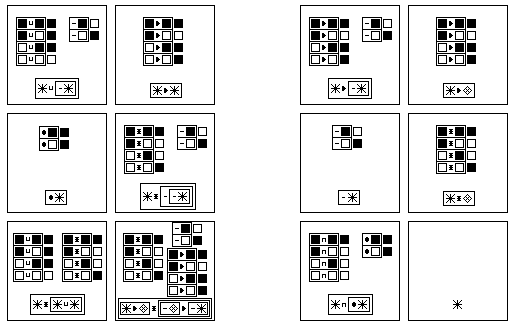
Solutions of all sub-problems:
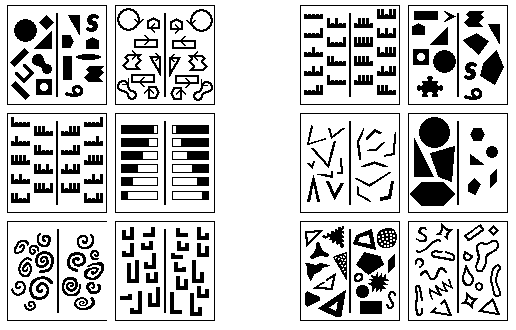
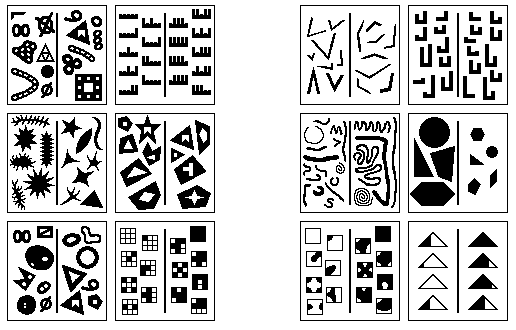
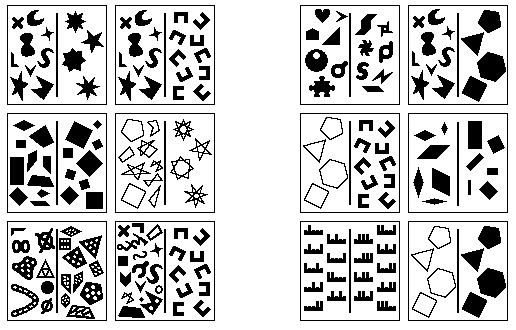
1: objects with an even number of holes / odd number of holes;
2: combs with 2 or less teeth / combs with 3 or more teeth;
3: objects with many sharp points / with few (5 or less) sharp points;
4: filled polygons with one polygonal hole inside that has less sides than the enclosing polygon / filled polygons with inside one polygonal hole that has more sides than the enclosing polygon;
5: objects with 2 holes / objects with 1 hole;
6: 3x3 matrices with less than 5 black squares / 3x3 matrices with 5 or more black squares;
- - - -
7: acute angles / obtuse angles;
8: U shaped figures longer on the right / U shapes figures with longer left legs;
9: short curved lines / long curved lines;
10: large filled objects / small filled objects;
11: mostly white squares / mostly black squares;
12: triangles mostly filled with white / triangles mostly filled with black.
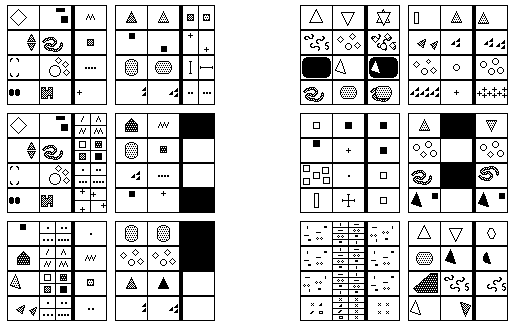
So my solution to Aaron David Fairbanks BP 92 is: in the left boxes the solving rules of the sub-problems are based on a integer quantitative difference. In the right boxes the sub-problem rules are based on a analog-like quantity (we ignore that these Bongard problems are represented with images made of discrete pixels).
#bongardproblem #mathpuzzle #puzzle #visualmath
 leonardo m.