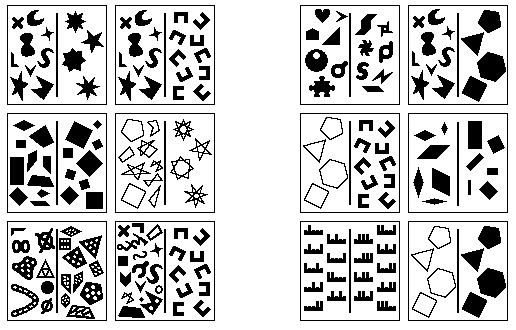
This is Aaron problem n. 77. This and the next four are meta-Bongard problems, but they are designed a little differently from the past meta-Bongard problems, there aren't sub-boxes here. So each of the 12 boxes is divided in two, vertically, and the two sets of figures differ in some way. You need to solve these sub-problems first, each one distinct from the other. The solution of the global Bongard problem is a rule that tells apart what's different between the sub-problems of the left and the sub-problems on the right. Successive problems will be a little less easy. Try to write your solution (with a spoiler if you want). I'll give my solution tomorrow.

For more info about Bongard problems in general take a look at my first messages:
https://mathstodon.xyz/@leonardom/116110015131667314
https://mathstodon.xyz/@leonardom/116110093951382315
#bongardproblem #mathpuzzle #puzzle #visualmath

Solutions of all sub-problems:
1: concave objects / stars;
2: concave objects / C shaped objects;
3: generic filled quadrilaterals / filled squares;
4: generic polygons also with intersecting sides / regular star polygons;
5: objects with some holes / convex polygons with 6 holes;
6: generic objects / C shaped objects;
- - - -
7: objects with bilateral symmetry / objects with rotational symmetry;
8: concave objects / regular (convex) filled polygons;
9: empty regular polygons / C shaped objects;
10: non-square rhombuses / rectangles (oblongs and squares);
11: rod with 5 spaces and 2 pegs up / rod with 5 spaces and and 3 pegs up;
12: regular empty polygons / regular filled polygons.

So my solution to Aaron David Fairbanks BP 77 is: in sub-problems of the left boxes the rule that identifies the objects on the right is a specialization (denotes a subset) of the objects on the left. In the right boxes the objects on the right aren't a subset of the objects on the left (so if you want to identify both exactly you need two different rules).

#bongardproblem #mathpuzzle #puzzle #visualmath