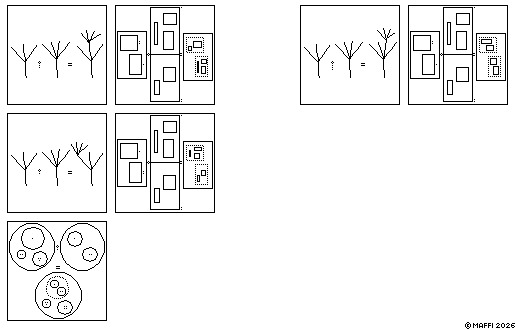
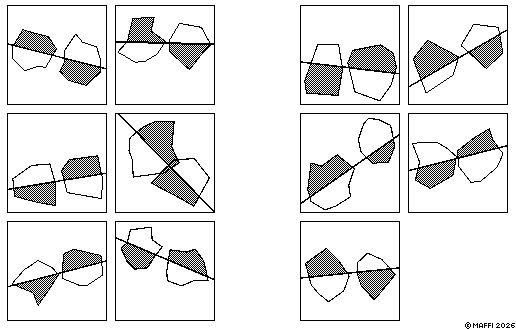
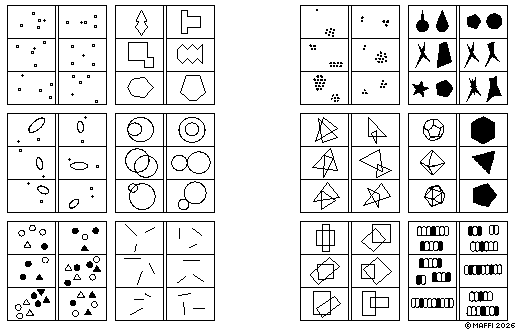
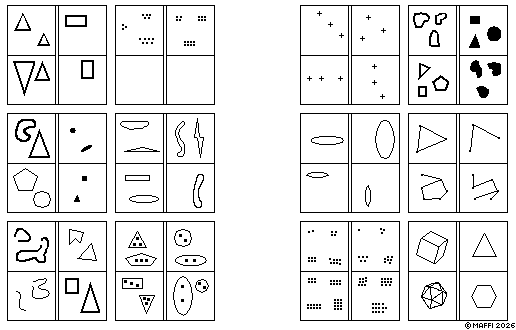
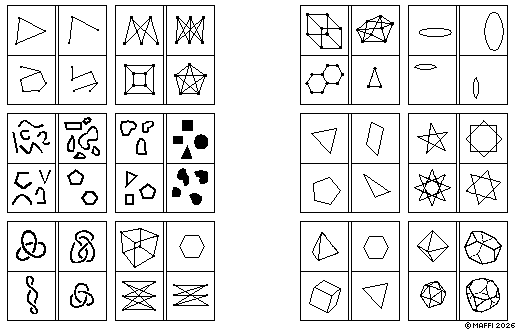
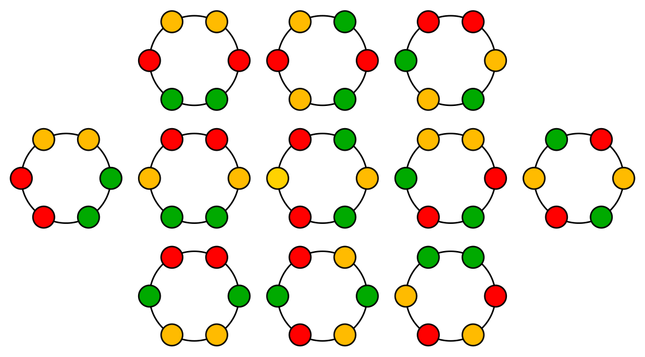
I think this was one of my best (meta) Bongard problems :-) 🥳
Sub-BP solutions (rules just about the left sides):
1: deleting the circlet closer to the cross, you get the vertices of an equilateral triangle;
2: the vertices of the polygon lay on the line of their axis of symmetry;
3: the cross is on the line of the major axis of the ellipse;
4: at least one circle lays on the center of another circle;
5: the black objects are linearly separable from the empty (stroked) ones;
6: the 3 segments lay on lines that intersect (approximately) in one point;
- - - -
7: the biggest number of points is divisible by the other number;
8: the right figure is the convex hull of the figure on the right;
9: every triangle vertex is outside the other triangle or lays on a side of the other;
10: platonic solids;
11: the two rectangles intersect in 4 points;
12: there are three groups of white pills (ellipses), that are separated by black pills (or by background space).
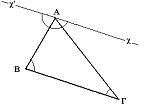
So the solution to my meta-Bongard problem 47 is: to solve the sub-Bongard problems on the left you need to add one or more imaginary points, segments or lines. While for the problems on the right you can find points, but (I think) you don't need to add primitives.
In mathematics you can find examples of both kinds of problems :-)
See also about auxiliary constructs:
https://en.wikipedia.org/wiki/Auxiliary_line
#bongardproblem #mathpuzzle #puzzle #visualmath
 leonardo m.