 Kit Peters
WRU doubles down on three-team plan after EGM as Ospreys supporters warn of “lasting damage” to Welsh rugby
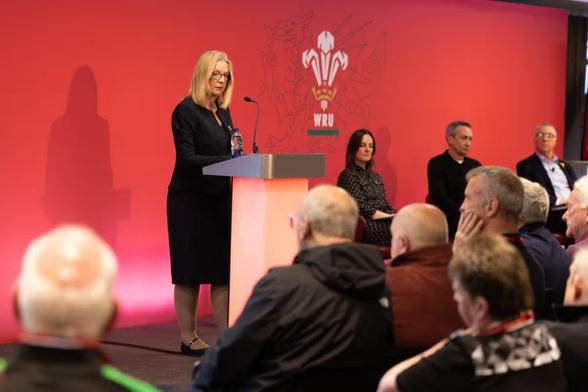
The EGM, held at the Principality Stadium on Monday evening, proceeded despite all three original motions being withdrawn at the start of the meeting after the announced departures of WRU chair Richard Collier-Keywood and Professional Rugby Board chair Malcolm Wall. Around 124 of the WRU’s 284 member clubs and districts attended either in person or online — meaning more than half stayed away entirely.
With no votes to cast, the meeting became a lengthy presentation by WRU leadership followed by an hour and a half of questions from the floor. CEO Abi Tierney reiterated the case for reducing to three professional teams, arguing that Wales is attempting to spread a limited talent pool too thinly and that years of underinvestment in development pathways had brought the game to its current point.
In the days before the meeting Swansea Bay News had warned it could end up as nothing more than a chat — and so it proved, with Tierney unable to offer any concrete timeline, detail on how the reduction would be delivered, or clarity on the Cardiff sale process.
Both Tierney and Collier-Keywood admitted during the meeting that they had made mistakes — specifically that they had spent too long trying to maintain four teams and persuade them to sign a new Professional Rugby Agreement before Cardiff went bust. Collier-Keywood said they tried to maintain four sides for too long amid disputes with the regions, with both agreeing the current benefactor model in Welsh rugby is not sustainable in the long term.
It was also suggested the union had suffered a £6 million shortfall in revenue due to poor Six Nations ticket sales, including a record low crowd for the home match against France. Former Principality Building Society COO Rob Regan — a vocal critic of the WRU’s plans who has been working on an alternative model — used the meeting to ask Tierney directly to admit mistakes in order to help rebuild public trust.
The reaction from the Ospreys community was swift and unequivocal. The Ospreys Supporters Club said it was “extremely disappointed, though not surprised” by the outcome, adding that the WRU’s position remained unchanged despite recent leadership changes.
In a statement, the supporters group described the current situation as “the result of years of chronic mismanagement and neglect at the top of the game” and warned that removing a professional side in west Wales would risk “causing lasting damage to the sport in one of its strongest heartlands.” The OSC called on the WRU to “urgently reconsider its position, rebuild trust through genuine engagement, and work collaboratively with stakeholders before further damage is done.”
Swansea Council leader Rob Stewart had urged clubs to maintain maximum pressure going into the meeting, warning that not voting to remove Collier-Keywood — even though he had already announced his departure — “would send all the wrong messages and is open to misrepresentation by the WRU.” He confirmed that Swansea Council’s legal action remains ready, a CMA referral remains live and the commitment to the Ospreys remains at “100%.”
Stewart also confirmed that work on the St Helen’s redevelopment is expected to start soon as part of the co-investment plan agreed with the Ospreys, with the aim of creating a new venue ready for the start of the 2026/27 season.
Torsten Bell MP also called on clubs to use the meeting to oppose the three-team plan, describing the stakes as “not about technical governance issues” but about “safeguarding the soul of Welsh rugby.” He said Wales deserved a WRU that “brings everyone to the table and explores every option before making decisions that will see major changes to our game.”
The meeting heard a notable moment of contrast on the floor. CGRU representative Chris Morgan argued that Wales’s period of international success had been built on four professional teams and that abandoning that structure without a credible alternative amounted to “a dereliction of duty that could destroy Welsh rugby.” His remarks drew applause from parts of the room. However, a separate club representative later claimed a significant proportion of clubs remained firmly behind the WRU’s proposals — drawing what was reportedly the loudest and most sustained applause of the evening.
Tierney, speaking to journalists after the meeting, said she was confident in strong grassroots support for the three-team plan but was unable to provide further detail on how or when a decision would be reached. She denied the reduction automatically meant a straight shootout between the Ospreys and Scarlets for the western licence, saying there were “a few different permutations.” She also declined to comment on the status of the Scarlets’ legal action against the WRU.
On the Cardiff sale, Tierney admitted no deal had yet been agreed with Y11 Sport & Media, with the exclusivity period due to end on April 22 and reports suggesting Y11 may be reconsidering its position. She also confirmed the WRU is working closely with the United Rugby Championship but was unable to say whether a replacement for the fourth Welsh side in the competition had been found.
The WRU confirmed it will use external headhunters to appoint a new independent chair, with the process to begin in May and the new person expected to be in place by early summer. As Swansea politicians called for a reset following Collier-Keywood’s initial announcement, the mood in Welsh rugby remains one of deep uncertainty — and the questions that defined this EGM remain entirely unanswered.
Related stories from Swansea Bay News
WRU EGM: Welsh rugby’s extraordinary meeting — but it could end up as nothing more than a chat
Our preview of Monday’s meeting and what was at stake.
Ospreys lifeline as council seals historic St Helen’s deal
The groundbreaking agreement that could secure the Ospreys’ future in Swansea.
Collier-Keywood quits: Rugby Union chair says he’ll leave in July
The announcement that changed the shape of the EGM.
Ospreys fans close in on 10,000-name petition target
The scale of opposition to the WRU’s three-team plan.