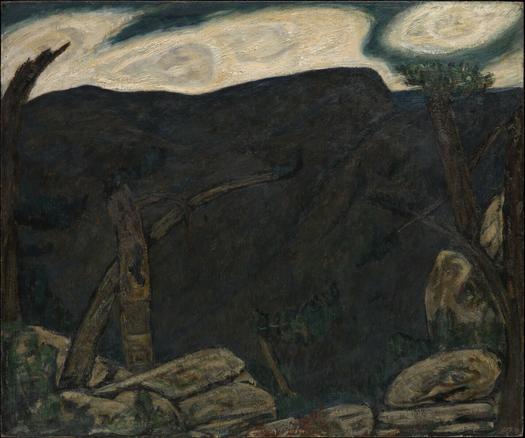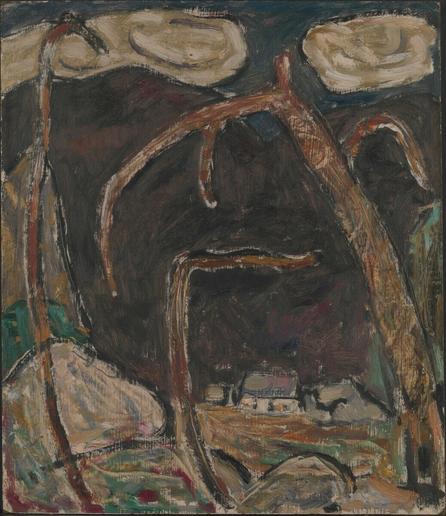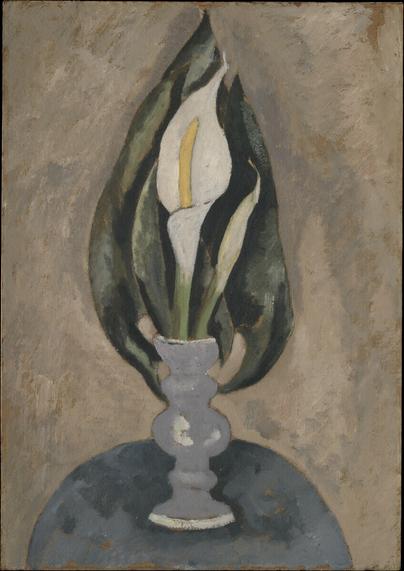
"Popocatepetl, Spirited Morning - Mexico," Marsden Hartley, 1932.

A born Down Easter, Hartley (1877-1943) started off with Maine landscapes, but then traveled to Europe in the early 20th century and discovered Cubism and Modernism in Paris and Berlin. He was tired of doing the same old thing and launched into a new phase of his career.

He traveled around a lot after WWI, including Europe and Mexico in the 30s, where he painted this landscape, inspired by Aztec and Maya lore and art.

He returned to Maine in the late 30s and focused then on local art, depicting the Maine landscape and its people in his own particular way.

He was also a writer, publishing poems, essays, and stories in various magazines, on such topics as art, Maine, and Nova Scotia, where he had close friends who gave him the stable, happy family he lacked as a child.

From the Smithsonian American Art Museum, Washington, DC.

#Art #AmericanArt #MarsdenHartley #Modernism #QueerHistory

Cemetery, New Mexico is an early 20th century painting by American artist #MarsdenHartley. Done in oil on canvas, the painting depicts a cemetery in #TaosPuebloNewMexico. The work is in the collection of the #MetropolitanMuseumOfArt.

"Earth Warming," Marsden Hartley, 1932.

Hartley (1877-1943) was America's preeminent Modernist painter in the first part of the 20th century. His technique borrowed from Cubism but he was generally very representational in his work, even if sometimes it seemed abstract.

Here we have the rugged landscape in Mexico, where Hartley went to work and study for a year after receiving a Guggenheim fellowship in 1931.

From the Montgomery Museum of Fine Arts, Montgomery, AL

#Art #AmericanArt #Mexico #MarsdenHartley #Modernism

"The Ice Hole, Maine," Marsden Hartley, 1908.

Artist, poet, and essayist Hartley (1877-1943) was a seminal figure in the development of modern art in America. A devotee of Transcendentalist philosophy, he viewed painting as a spiritual quest.

A native of Maine, he spent a lot of time in the village of Lovell, where he painted this and many other landscapes, which he viewed as his first mature works. He traveled to Europe in 1912 and began to experiment with Abstract and Cubist styles. He traveled about the world, but late in life became focused on depicting life in Maine...and then, in his 60s, painting a series of homoerotic portraits that are now seen as him affirming and admitting his sexuality.

But yeah, the title is just a tiny bit unfortunate, what with today's lingo. "You ICE HOLE!" we might shout at another driver...

From the New Orleans Museum of Art.

#Art #AmericanArt #ModernArt #MarsdenHartley #Maine

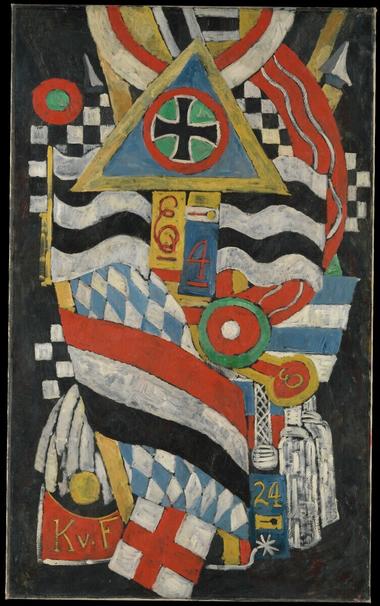
Marsden Hartley, Portrait of a German Officer, 1914 #metmuseum #marsdenhartley https://www.metmuseum.org/art/collection/search/488486
Marsden Hartley | Portrait of a German Officer | The Metropolitan Museum of Art

The Metropolitan Museum of Art
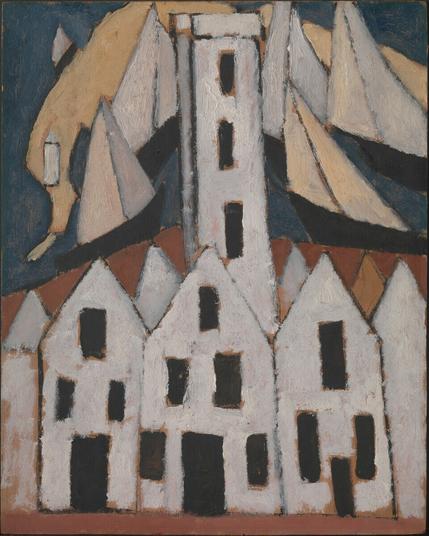
Marsden Hartley, Movement No. 5, Provincetown Houses, 1916 #marsdenhartley #themet https://www.metmuseum.org/art/collection/search/488487
Marsden Hartley | Movement No. 5, Provincetown Houses | The Metropolitan Museum of Art

The Metropolitan Museum of Art
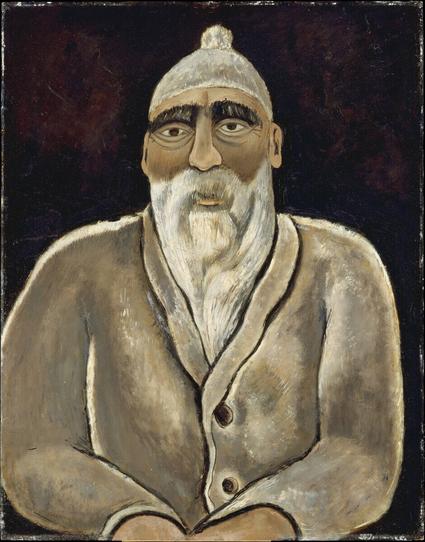
Marsden Hartley | Albert Pinkham Ryder | The Metropolitan Museum of Art

The Metropolitan Museum of Art
Marsden Hartley | The Dark Mountain, No. 2 | The Metropolitan Museum of Art

The Metropolitan Museum of Art
Marsden Hartley | The Dark Mountain, No. 1 | The Metropolitan Museum of Art

The Metropolitan Museum of Art
Marsden Hartley | Still Life No. 16 | The Metropolitan Museum of Art

The Metropolitan Museum of Art