🌍 At the 3-day TropEcS symposium, hosted by the Leibniz Centre for Tropical Marine Research (ZMT) in #Bremen to launch a new program on tropical coastal regions, our #MPI_scientists Nils Brüggemann, Mia Sophie Specht, and Bjorn Stevens had the opportunity to share insights on 🔬 km-scale modeling, 🌪️ tropical cyclones & 🌊 tropical instability waves in high-resolution climate models. Check out the program at: https://zac.leibniz-zmt.de/tropecs/

Exciting #collaborations ahead! #ClimateScience #Oceanography

🌱🌎 Yesterday, #climate & #sustainability researchers from Asia, Africa, South & Central America visited #MPIM &#DKRZ. The meeting was part of a Germany trip in the scope of the introductory seminar for the @HumboldtStiftung's #ClimateProtection Fellows.👩‍🎓👨‍🎓 #MPI_scientists presented selected aspects of climate research at our institute. At DKRZ, the visitors enjoyed a tour of the supercomputer. It was a pleasure having them here! ✨
#AvH #ClimateProtection #SustainabilityResearch #NewLeaders
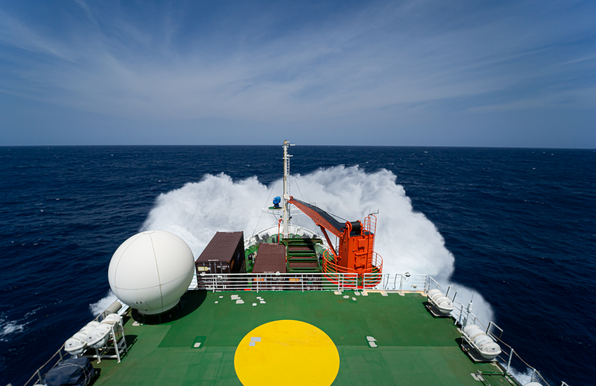
For 6 weeks during January & February, #MPI_scientists Lennéa Hayo, Hannah Gaenslen & Marius Schulz were traveling on the RV#Meteor in the tropical Atlantic to carry out atmospheric measurements around the Intertropical Convergence Zone (ITCZ). They used weather balloons to launch radiosondes at 3-hour intervals to record pressure, temperature, humidity, & wind speed. The high-resolution data helps #MPIM researchers to better understand the structure & dynamics of the ITCZ. @geomar_de
©M.Schulz
📚New research! #MPI_scientists Mia Sophie Specht et al. explore instabilities below the surface of the Atlantic that can occur at sharp ocean temperature fronts formed by Tropical Instability Waves. Using a high-resolution simulation, they show that these instabilities, heavily influenced by seasonal ocean circulation patterns, mainly occur in summer w/ possible implications for #ocean mixing – a key factor in understanding ocean heat distribution & nutrient cycling! 🌊
https://agupubs.onlinelibrary.wiley.com/doi/10.1029/2023JC020041

#MPI_Scientists are being extremely productive at the @nextgems_eu hackathon at Wageningen University! Extremes is what they’re looking at: They are analyzing the first global 30-year storm-resolving climate simulations for key indicators of fire, extreme heat and precipitation extremes. We can’t wait to learn about the outcomes of this intensive week!

Read more on high-resolution modelling on our website: https://mpimet.mpg.de/en/communication/news/a-new-generation-of-models-for-kilometer-scale-climate-predictions

Image credit: nextGEMS

A new generation of models for kilometer-scale climate predictions

Imagine a future where climate science offers the appropriate tools to predict and thus help mitigate the impacts of climate change. This future is within reach – with an array of advanced climate models that are currently being developed. The Max Planck Institute for Meteorology is at the forefront of these efforts: It coordinates and participates in a number of national and international projects that are paving the way toward a new quality of climate predictions.

It is #campaign time: As you might now lots of our #MPI_scientists are currently joining the international field campaign #ORCESTRA.
In this group photo you can see our #HALO crew currently located in Cape Verde. 🛩️☁️🌴

If you want to learn more about our campaign see https://wisskomm.social/@MPI_Meteo/112937224091540568 or check out the campaign webpage https://orcestra-campaign.org/intro.ht.

MPI für Meteorologie (@[email protected])

Angehängt: 1 Bild The time has come: the international field campaign ORCESTRA starts today! 🛩️⛴️🔭🌧️ In collaboration with our amazing international partners, the #MPIM leads the sub-campaigns BOWTIE ⛴️ and PERCUSION 🛩️. Until the end of September, we will be intensively surveying the atmosphere and the ocean in the east and west of the Atlantic such as along the equator. Here's to capturing fascinating phenomena right in the focus of our instruments! Check out our Webpage: https://orcestra-campaign.org/intro.html

Wissenschaft trötet
On March 23 we celebrated World Meteorological Day 🌍🥳.
It's a special day for us, because we care about weather and climate. All our #MPI_Scientists are working every day to increase our knowledge and understanding of our planet’s physics. Right now we are measuring live data at our weather station on Barbados, which we process at #MPIM into scientific publications.
Read more about it on our website and and enjoy the sunrise 🌞 over the Atlantic from the webcams:: https://barbados.mpimet.mpg.de/
Barbados Cloud Observatory | Max-Planck-Institut für Meteorologie, Hamburg, Germany

Barbados Cloud Observation Station -

💥 Paper alert: Here come the first efforts to evaluate the open-ocean tides on our new ocean model #ICON-O. In this paper, #MPI_Scientists, quantify the model's ability to realistically simulate the barotropic tides. Such a quantification is crucial to ensure the realistic representation of internal tides which are difficult to evaluate

Check out the details of their work here: https://gmd.copernicus.org/articles/16/5179/2023/

Open-ocean tides simulated by ICON-O, version icon-2.6.6

Abstract. This paper evaluates barotropic tides simulated by a newly developed multi-layer ocean general circulation, ICON-O, and assesses processes and model configurations that can impact the quality of the simulated tides. Such an investigation is crucial for applications addressing internal tides that are much more difficult to evaluate than the barotropic tides. Although not specially tuned for tides and not constrained by any observations, ICON-O is capable of producing the main features of the open-ocean barotropic tides as described by the geographical distributions of amplitude, phase, and amphidromic points. An error analysis shows, however, that the open-ocean tides simulated by ICON-O are less accurate than those simulated by two other ocean general circulation models (OGCMs), especially when not properly adjusting the time step and the parameters used in the time-stepping scheme. Based on a suite of tidal experiments, we show that an increase in horizontal resolution only improves tides in shallow waters. Relevant for using ICON-O with its telescoping grid capacity, we show that spatial inhomogeneity does not deteriorate the quality of the simulated tides. We further show that implementing a parameterization of topographic wave drag improves the quality of the simulated tides in deep ocean independent of the model configuration used, whereas the implementation of a self-attraction and loading (SAL) parameterization in a low-resolution (40 km) version of ICON-O degrades the quality of tides in shallow ocean. Finally, we show that the quality of tides simulated by ICON-O with low resolution (40 km) can be significantly improved by adjusting the time step or the parameters in the time-stepping scheme used for obtaining the model solution.

New publication 📣

What's the point of modelling with higher resolution? 🌍 As #MPI_Scientists Henning Franke & Marco Giorgetta show, the effect of warming on the Quasi-Biennial Oscillation (QBO) can directly be simulated with the high-resolution ICON-A model — while previous models struggled to reliably resolve the relevant wave and convection processes. Warming is likely to strengthen gravity waves and deep convection, leading to a speed-up of the QBO. 🌬️

More here: https://rmets.onlinelibrary.wiley.com/doi/10.1002/qj.4534 📚