 🅱🅸🅶🅾🆁🆁🅴.🅾🆁🅶
Aviation weather for Esquipulas airport (Guatemala) is “MGES 051500Z 00000KT 9999 SCT018 BKN200 24/18 QFE 908.3” : See what it means on https://www.bigorre.org/aero/meteo/mges/en #esquipulas #guatemala #esquipulasairport #mges #metar #aviation #aviationweather #avgeek #airport vl

Aviation weather for Esquipulas airport (Guatemala) is “MGES 051500Z 00000KT 9999 SCT018 BKN200 24/18 QFE 908.3” : See what it means on https://www.bigorre.org/aero/meteo/mges/en #esquipulas #guatemala #esquipulasairport #mges #metar #aviation #aviationweather #avgeek #airport vii3
 Amelia Cervera 🧬
Giant extrachromosomal element “Inocle” potentially expands the adaptive capacity of the human oral microbiome.
#MobileGeneticElements #MGEs #ExtrachromosomalElements #Plasmids #Microbiome #EnvironmentalStress

Giant extrachromosomal element “Inocle” potentially expands the adaptive capacity of the human oral microbiome - Nature Communications
This study identified prevalent giant extrachromosomal elements from the human oral microbiome. The genetic and ecological analysis provides insight on the potential contribution of this element in adaptation against multiple oral environmental stressors.
 PLOS Biology
Why do #bacterial species' #TransformationRates vary so dramatically? @epcrocha @labXC &co show that #Legionella & #Acinetobacter transformation rates evolve by sudden changes, likely caused by conflicts between #MGEs and the host bacterium #PLOSBiology https://plos.io/4dMviTR
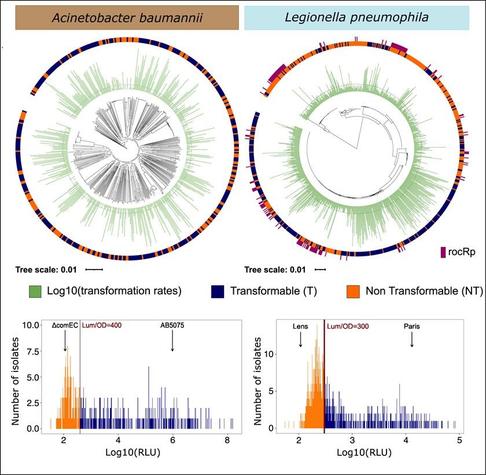

Intragenomic conflicts with plasmids and chromosomal mobile genetic elements drive the evolution of natural transformation within species
Bacterial species exhibit large variations in their transformation rates. This study of Legionella pneumophila and Acinetobacter baumannii shows that their transformation rates evolve by sudden quick changes, likely caused by intragenomic conflicts between mobile genetic elements and the host bacterium.