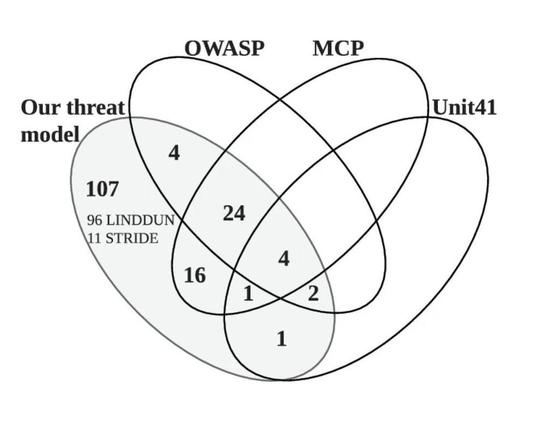
πŸš€ Our latest paper on "Threat Model-Driven Test Framework for Security and Privacy of Agentic LLM Applications" has recently been published!

The paper systematically breaks down the security and privacy landscape for agentic LLM applications and put the theory to the test.. But I don't want to spoil too much, so here's the link:

πŸ”— https://link.springer.com/chapter/10.1007/978-3-032-27993-4_6

#cybersecurity #research #threatmodel #LLM #AI #test #framework #MCP #application #OWASP #STRIDE #LINDDUN #privacy

Explore the world of privacy with LINDDUN! 🌐 This powerful framework helps identify and mitigate privacy threats in software systems, ensuring your design is secure from the start. πŸ”’βœ¨ With tools like LINDDUN GO and PRO, you can navigate the complexities of privacy threat modeling effectively. Let’s build a safer digital environment together! πŸ’»πŸ” #PrivacyByDesign #LINDDUN #DataProtection #CyberSecurity #GDPR

πŸ”— https://linddun.org/

P. Das Chowdhury et al., "Threat Models over Space and Time: A Case Study of E2EE Messaging Applications"ΒΉ

Threat modelling is foundational to secure systems engineering and should be done in consideration of the context within which systems operate. On the other hand, the continuous evolution of both the technical sophistication of threats and the system attack surface is an inescapable reality. In this work, we explore the extent to which real-world systems engineering reflects the changing threat context. To this end we examine the desktop clients of six widely used end-to-end-encrypted mobile messaging applications to understand the extent to which they adjusted their threat model over space (when enabling clients on new platforms, such as desktop clients) and time (as new threats emerged). We experimented with short-lived adversarial access against these desktop clients and analyzed the results with respect to two popular threat elicitation frameworks, STRIDE and LINDDUN. The results demonstrate that system designers need to both recognise the threats in the evolving context within which systems operate and, more importantly, to mitigate them by rescoping trust boundaries in a manner that those within the administrative boundary cannot violate security and privacy properties. Such a nuanced understanding of trust boundary scopes and their relationship with administrative boundaries allows for better administration of shared components, including securing them with safe defaults.

#arXiv #ResearchPapers #STRIDE #LINDDUN #ThreatModel #E2EEncryption #MessagingApplications
__
ΒΉ https://arxiv.org/abs/2301.05653

Threat Models over Space and Time: A Case Study of E2EE Messaging Applications

Threat modelling is foundational to secure systems engineering and should be done in consideration of the context within which systems operate. On the other hand, the continuous evolution of both the technical sophistication of threats and the system attack surface is an inescapable reality. In this work, we explore the extent to which real-world systems engineering reflects the changing threat context. To this end we examine the desktop clients of six widely used end-to-end-encrypted mobile messaging applications to understand the extent to which they adjusted their threat model over space (when enabling clients on new platforms, such as desktop clients) and time (as new threats emerged). We experimented with short-lived adversarial access against these desktop clients and analyzed the results with respect to two popular threat elicitation frameworks, STRIDE and LINDDUN. The results demonstrate that system designers need to both recognise the threats in the evolving context within which systems operate and, more importantly, to mitigate them by rescoping trust boundaries in a manner that those within the administrative boundary cannot violate security and privacy properties. Such a nuanced understanding of trust boundary scopes and their relationship with administrative boundaries allows for better administration of shared components, including securing them with safe defaults.

arXiv.org