 Joxean Koret (@matalaz)
A Cool Earth-sized Planet Candidate Transiting a Tenth Magnitude K-dwarf From K2

A Cool Earth-sized Planet Candidate Transiting a Tenth Magnitude K-dwarf From K2
The transit method is currently one of our best means for the detection of potentially habitable "Earth-like" exoplanets. In principle, given sufficiently high photometric precision, cool Earth-sized exoplanets orbiting Sun-like stars could be discovered via single transit detections; however, this has not previously been achieved. In this work, we report a 10-hour long single transit event which occurred on the $V=10.1$ K-dwarf HD 137010 during K2 Campaign 15 in 2017. The transit is comparatively shallow ($225\pm10$ ppm), but is detected at high signal-to-noise thanks to the exceptionally high photometric precision achieved for the target. Our analysis of the K2 photometry, historical and new imaging observations, and archival radial velocities and astrometry strongly indicate that the event was astrophysical, occurred on-target, and can be best explained by a transiting planet candidate, which we designate HD 137010 b. The single observed transit implies a radius of $1.06^{+0.06}_{-0.05}$ $R_\oplus$, and assuming negligible orbital eccentricity we estimate an orbital period of $355^{+200}_{-59}$ days ($a=0.88^{+0.32}_{-0.10}$ AU), properties comparable to Earth. We project an incident flux of $0.29^{+0.11}_{-0.13}$ $I_\oplus$, which would place HD 137010 b near the outer edge of the habitable zone. This is the first planet candidate with Earth-like radius and orbital properties that transits a Sun-like star bright enough for substantial follow-up observations.
 NASA
NASA
 NASA [Unofficial]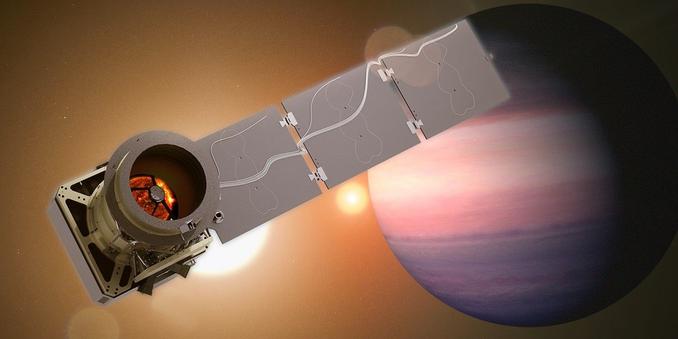


 AstroAdamski