 lokatzi
Innen-Illustration von Theo Thomas für
"Gift" von Katherine MacLean (Contagion)
aus Utopia SF Magazin 26, Pabel Verlag Juni 1959
(AmeS)
#sciencefiction #UtopiaMagazin #KatherineMacLean #TheoThomas
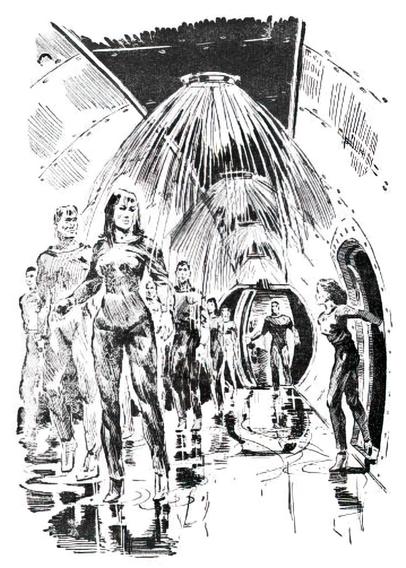
Innen-Illustration von Theo Thomas für
"Gift" von Katherine MacLean (Contagion)
aus Utopia SF Magazin 26, Pabel Verlag Juni 1959
(AmeS)
#sciencefiction #UtopiaMagazin #KatherineMacLean #TheoThomas
Innen-Illustration von Paul Pierre für
"Contagion" von Katherine MacLean
aus Galaxy, October 1950
(archive.org)
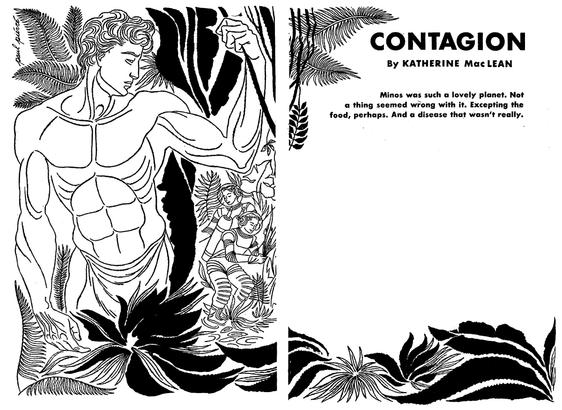
Katherine MacLean #KatherineMacLean wurde am heutigen Tag, dem 22. Januar, geboren.
My 2025 in Review (Best Science Fiction Novels and Short Fiction, Reading Initiatives, and Bonus Categories)
Here’s to happy reading in 2026! I hope you had a successful reading year. Whether you are a lurker, occasional visitor, a regular commenter, a follower on Bluesky or Mastodon, thank you for your continued support. As I say year after year, It’s hard to express how important (and encouraging) the discussions that occur in the comments, social media, and via email are to me. I’m so thankful for the lovely and supportive community of readers, writers, and discussion partners that stop by.
What were your favorite vintage SF reads–published pre-1985–of 2025? Let me know in the comments.
Throughout the later part of the year I’ve dropped hints about a research project. Perceptive readers might have parsed together the contours of the research: late 19th/early 20th century, utopian, African American, the American South, radical politics… It’s taking longer than expected. I’ve read a good ten monographs, five dissertations, countless articles. I’ve written twenty pages. I hoped to have it posted by early in this year. Alas. It’s coming together–slowly. Stay tuned.
Without further ado, here are my favorite novels (I only read a few) and short stories (I read a ton of those) I read in 2025 with bonus categories. I made sure to link my longer reviews where applicable if you want a deeper dive.
Check out my 2024, 2023, 2022, and 2021 rundowns if you haven’t already. I have archived all my annual rundowns on my article index page if you wanted to peruse earlier years.
My Top 5 Science Fiction Novels of 2025
1. Octavia E. Butler’s Clay’s Ark (1984), 4.5/5 (Very Good). Full review.
Octavia E. Butler’s Clay’s Ark is the final published volume of her Patternist sequence (1976-1984). It is the third novel according to the internal chronology of the series. Clay’s Ark is, without doubt, the most horrifyingly bleak science fiction novel I have ever read. It’s stark. It’s sinister. It’s at turns deeply affective before descending into extreme violence and displaced morality. The moral conundrum that underpins the central problem, the spread of an extraterrestrial disease, unfurls with an unnerving alien logic. Butler’s characters are trapped by the demands of the alien microbes, scarred by the pervasive sense that their humanity is slipping away, and consumed by the fear of starting an epidemic. A true confrontation of the moment cannot lead to anything other than suicide or the first steps towards an apocalyptic transformation.
2. Kim Stanley Robinson’s Icehenge (1984), 4.5/5 (Very Good). Full review.
Kim Stanley Robinson’s Icehenge, a fix-up from two previously published stories “To Leave a Mark” (1982) and “On the North Pole of Pluto” (1980), tells three interconnected tales that all connect to a mysterious monolith left on Pluto (the titular Icehenge). By design Icehenge instead follows the action after the action: men and women attempting to figure out their own place in a world characterizes by lifespans that stretch hundreds and hundreds of years. And its this brilliant interconnection between self-conception and the operations of history that Robinson succeeds and casts his spell. The story is well-told, polished, and filled with fascinating details (technological and sociological).
3. Joe Haldeman’s All My Sins Remembered (1977), 4/5 (Good). Full review.
The vast Confederación is comprised of radically distinct worlds ruled by the entire spectrum of political systems with both alien and non-alien inhabitants. There are few rules: don’t take advantage of indigenous populations and don’t wage wars on neighboring planets. At 22, the naive Otto McGavin, an Anglo-Buddhist, joins the Confederación as an agent to protect the rights of humans and non-humans. But there’s a twist. Under deep hypnosis a construct of Otto McGavin will be created for each mission. He’ll take on the identity–under a sheath of plasticine flesh–of whatever person he needs to be depending on the task. The story follows Otto on three missions over many years. The interlocking segments convey the deep trauma Otto must confront before he’s immersed in another persona and sent on another mission. His idealism clashes with the violence he must perpetuate. His sense of self conflicts with the violent actions of his “constructs.” The looming sense of dread and despair must finally have its reckoning.
4. Zoë Fairbairns’ Benefits (1979), 3.75/5 (Good). Full review.
Zoë Fairbairns charts the struggles of the British women’s liberation movement in a dystopic near future. An anti-feminist fringe political party called FAMILY comes to power, simultaneously proclaiming family values while systematically dismantling the welfare state. Benefits effectively eviscerates governmental doublespeak and champions the need to organize and educate in order to fight against patriarchal forces and messianic movements that promise to solve all our ills.
5. Edgar Pangborn’s The Company of Glory (1975), 3.5/5 (Good). Full review.
Edgar Pangborn is an unsung SF hero in my book. At his best, he’s a deeply humanistic writer interested in moments of effective metafictional play on the nature of narrative. The Company of Glory (serialized 1974, 1975) is the third novel in the Tales of Darkening World sequence. It forms a prequel to Pangborn’s masterpiece Davy (1964). As with Davy, The Company of Glory attempts to create multiple interlocking layers of narrative, stories within the stories, quotations from various diaries, and the interjections of the overarching narrator of the entire collection of texts who remains anonymous until the final pages. Unfortunately, The Company of Glory is a deeply flawed novel. Recommended only for Pangborn’s fans. Read Davy first if you’re new to his work.
My Top 20 Science Fiction Short Stories Reads of 2025 (click titles for my full review)
1. Philip K. Dick’s “Foster, You’re Dead” (1955), 5/5 (Masterpiece): I featured on a podcast about this story. When the episode is posted, I’ll make sure to link it. Mike Foster spends his school days practicing survival skills–digging, making knives, weaving baskets–in case of a nuclear attack. The kids snicker at him as he walks past. They don’t own a fallout shelter at home. His father refuses to pay into the NATS (National Security fund). If a bomb hit, Mike wouldn’t even be granted access to the school shelter. He’s possessed by a deep, perpetual, encompassing trauma.
2. Fritz Leiber’s “Coming Attraction” (1950), 5/5 (Masterpiece): A rare reread! Leiber imagines an America transformed after a limited nuclear war with the Soviet Union. The physical landscape mirrors the psychological scars of New York’s inhabitants. Perverse new forms of TV entertainment, in particular male wrestlers pitted against masked women, transfix all audiences.
3. Jack Dann’s “A Quiet Revolution for Death” (1978), 5/5 (Masterpiece): Roger and his family head out of the city for a picnic in a vast cemetery. Roger dreams that he is an angel of God guiding mankind through the realm. Visiting the cemetery is an act of devotion. While other kids plug themselves into feelies, Bennie is a fanatic disciple of his father’s pseudo-philosophy of embracing the macabre. Sandra, Roger’s wife, plays along. The kids see through her dislike of the cemetery and the burial rituals happening around them.
4. Izumi Suzuki’s“Terminal Boredom” (1984, trans. by Daniel Joseph 2021), 4.5/5 (Very Good): A nameless young female main character recounts her interactions her one-time boyfriend. HE wants to reconnect with his mother, who abandoned his family. HE joins a staged show called The Psychoanalysis Room in an attempt to convince his mother to take “pity and come and find” him. She also has a dysfunctional family. Her mother, a TV executive, struggles/refuses to connect to her daughter. Like some manifestation of the modern hikikomori, they often refuse to communicate with others, eat as a group or eat at all for days on end, or leave their dwellings for the sun and vista of the aboveground. Both find solace and escape in the vacuities and artifice of television.
5. Philip K. Dick’s “Explorers We” (1959), 4.5/5 (Very Good): Six astronauts return to earth from a voyage to Mars. But they are not treated as heroes. Instead people flee. I found “Explorers We” a well-crafted existential terror. The story plays with narrative expectation and hints at a cosmic enormity that will, at least in this iteration, remain unknown.
6. James Tiptree, Jr.’s “Painwise” (1972), 4.5/5 (Very Good): An explorer who feels no pain is hurled mercilessly from planet to plant where is he tortured, experimented upon, and broken again, and again, and again. His sense of time dissipates. Space becomes a hellscape that he cannot escape. And each time he’s lifted back to his scout ship where a mechanical boditech stitches him back together.
7. Jack Dann’s “The Dybbuk Dolls” (1975), 4.5/5 (Very Good): Chaim Lewis works at a sex shop down below in the Undercity, one of many identical spheres, one mile in diameter, buried one thousand feet below the ground. As Chaim finishes up his shift in the dingy shop, a group of visitors ask about his hook-ins and 21st century pornos. Eventually one of them asks him about his alien sex doll collection. And when he returns to the room with the dolls, he discovers they’ve all been unpacked and they imprint themselves on his mind! Cue a descent into the bizarre…
8. Jack Williamson’s “Guinevere for Everybody” (1955), 4.5/5 (Very Good): An artificially created Guinevere stands “chained” in a “vending machine” tempting sleepy passengers in an airport with her plaintive calls. I did not know Williamson had this type of vision in him! The surprise of the year!
9. George H. Smith’s “The Last Days of L. A.” (1959), 4/5 (Good): A nameless character (“you”) wakes from a recurring dream: “the dream that has haunted the whole world since that day in 1945.” A dream of apocalyptic annihilation, in infinite variations. A narrative repetition takes form: Nuclear nightmare. The waking moment. The aimless quest for understanding. Communing with other lost souls. The retreat to the bottle. Fragments of the news suggest a world unraveling.
10. Theodore Sturgeon’s “The Stars Are the Styx” (1950), 4/5 (Good): The premise: Humans created Curbstone, an artificial satellite around Earth, to facilitate the ultimate scientific achievement–near instantaneous transportation across the galaxy. How? Individual spaceships, with a solitary crew person or couple, will be hurled out from Curbstone at various points across the space time continuum. The story revolves around the aging (and rotund) Senior Release Officer on Curbstone, who certifies, counsels, and guides the strange collection of humans who gather at the station willing to take such a risk.
11. Richard Matheson’s “Dance of the Dead” (1955), 4/5 (Good): In a drug and alcohol drenched near-future, a group of young adults take a break-neck road drip and stray from the path set out by parents and small town community. Manifesting the SPEED of the car, Matheson’s prose resonates with pulse and hum, snippets of song and signage, slang and youthful lust. It’s frantic. It’s zappy. It’s vibrant. Recommended for fans of the more linguistically experimental (and bleak) of 50s visions.
12. Jack Dann’s “Rags” (1973), 4/5 (Good): Joanna wanders the streets without seeing a single person. Everything she sees—from garbage cans to parked cars–seem in be various states of decay (“dented, rusted, and discolored”). She teaches herself a new way to walk to avoid the “invisible beings” that flit around her (6). She remembers a past sickness. Deaths in the family. She makes new rules of movement and perception as an act of preservation. And suddenly she sees The Purple Cat.
13. Jack Dann’s “Fragmentary Blue” (variant title: “There are no Bannisters”) (1973), 4/5 (Good): he elderly dwell underground in large domed cities. It’s a commercial and media-inundated world — tiny machines grant “feeling” as you watch commercials. Professor Fleitman, who “could not rationalize having an orgasm over a cigarette advertisement,” presents a new idea to galvanize the elderly to Entertainment Committee. Rather than a feelie or a movie he wants to put on a circus.
14. Arkady and Boris Strugatsky’s “Wanderers and Travellers” (1963, trans. 1966), 4/5 (Good): Stanisław Ivanovich spends his days submerged in lakes and rivers tagging septopods, a new octopus-like species discovered on Earth. His daughter, Marsha, assists from above. When he emerges from a lake, Marsha is deep in conversation with Leonid Andreevich Gorbovsky, an astroarchaeologist implied to be on leave from an expedition. The two scientists–IIvanovich, with his eyes on earthly mystery, and Gorbovsky, untangling the traces of potential intelligences across the cosmos–and Marsha engage in a series of discussions about the nature of the universe.
15. John Wyndham’s “The Man From Beyond” (variant title: “The Man from Earth”) (1934), 3.5/5 (Good): Somewhere on the Venusian surface the Valley of Dur, with its amalgamation of gasses, traps unsuspecting denizens who wander into its depths. In the city of Takon, Venusians, six-limbed creatures with silvery hair, ogle the strange beasts extricated and caged and exhibited from the Valley. The child, transfixed by the man’s noises and scrawls, pushes his stylus and pad under the bars. And Morgan Gratz, stranded astronaut and self-confessed murderer, draws for the child the respective locations of their planets.
16. Katherine MacLean’s “Contagion” (1950), 3.5/5 (Good) is a contact with an alien planet tale that’s legitimately odd. A hunting party looking for specimens of alien life in order to dissect, sets off from the spaceship Explorer across an alien planet called Minos. Reasonably, the crew is obsessed with a minute medical analysis of flora and fauna. The hunting party encounters a majestically shaped human who spins a crazy tale of adaptation and disease.
17. Cherry Wilder’s “The Ark of James Carlyle” (1974), 3.5/5 (Good): Carlyle spends his tour of duty in a hut with a wood platform on small landmass surrounded by an “oily purple sea” on an alien planet. A crisis hits — and he suddenly learns the reason for the singular trees that grow in the center of each island.
18. E. C. Tubb’s“Without Bugles” (1952), 3.5/5 (Good): A naive journalist struggles to confront her heroic idealism, regurgitated through the media, in her attempt to save the Mars colony afflicted with a futuristic case of the black lung.
19. Frank K. Kelly’s “Famine on Mars” (1934), 3.5/5 (Good): President Herbert Hoover infamously proclaimed on the eve of the Great Depression that “given the chance to go forward with the policies of the last eight years, we shall soon with the help of God, be in sight of the day when poverty will be banished from this nation.” “Famine on Mars,” published five years into the Great Depression, evokes similar paradigmatic shifts between propagandistic proclamation and harsh reality. Kelly spins a nightmare account of a famine on Mars and a plan to save the starving legions.
20. Gerald Kersh’s “Whatever Happened to Corporal Cuckoo?” (1953), 3.5/5 (Good): Kersh imagines a literary version of himself returning to New York City from WWII interacting with a fantastical manifestation of a Wound Man on board the Cunard White Star liner Queen Mary. Corporal Cuckoo, the “Wound Man” in question, regals the narrator (Kersh) with the history of his scarred and mutilated form that mysteriously heals from every injury.
Reading Initiatives
I have continued, resurrected, and created new science fiction short story reading series over the course of the year. Most of the stories I’ve picked for the series are available in some fashion online via links to Internet Archive in each review. I’ve included installments from 2024 in each series below. Feel free to read along with me! And thanks for all the great conversation.
Galaxy Science Fiction Read-through (started 2025)
Organized Labor and Unions in Science Fiction (started in 2024)
The First Three Published Short Fictions by Female Authors (continued from 2021)
Translated Short Stories in Translation (with Rachel S. Cordasco) (started in 2024)
The Media Landscape of the Future (started in 2022)
The Search for the Depressed Astronaut (continued from 2020)
Generation Ship Short Stories (continued from 2019)
Exploration Logs (continued from 2022)
My Top 4 History Reads of 2025
A large portion of my history reading this year pushed my general interest in labor history and leftist politics backwards into the 19th century. Unusual for me I know! Often I write about what I can write about not what I plan on writing about. A brief caveat worth repeating: I’m a PhD-wielding historian and have a high tolerance for academic texts. That said, I’d classify everything in my list as on the approachable side of things if you know the broad strokes of American history.
1. Laurie F. Maffly-Kipp’s Setting Down the Sacred Past: African-American Race Histories (2010): This filled a complete hole in my knowledge. While I had encountered history-centric militant abolitionist texts written by black authors, I did not know how they fitted into the larger historiographic project of the era. As my PhD looked at universal histories in the medieval period, I’m a sucker for all kinds of histories of historiography! This is a good one.
2. Deborah Beckel’s Radical Reform: Interracial Politics in Post-Emancipation North Carolina (2011): I read this one for my research project on a black utopian author. Beckel’s brilliant monograph looks at the race and politics in North Carolina after the end of Reconstruction–a “fusion” government of Republicans and Populists managed to take power (temporarily) from the white supremacist Democratic status quo in the 1890s. Depressing. Fascinating. I’m waiting for an alt-history that uses the 1898 election in North Carolina as a jonbar hinge — hah!
3. Edward K. Spann’s Brotherly Tomorrows: Movements for A Cooperative Society in America (1989): While an older monograph, Spann’s work is a fantastic survey of the fascinating range of radical social idealism-inspired communities that proliferated across America. I’m obsessed by left-wing ideologies that permeate the rural world and movements for working-class utopianism. Spann will inspire you to track down newer monographs on the social movements he surveys.
4. Jordan S. Carroll’s Speculative Whiteness: Science Fiction and the Alt-Right (2025): Rightly won the Hugo! I interviewed Carroll in January. In the book, he examines the ways the alt-right uses classic science fiction imagery and authors to mainstream fascism and advocate for the overthrow of the state. This is a short monograph designed to encourage thought. Highly recommended.
Goals for 2026
1. Keep reading and writing.
2. Read more reviews by other bloggers.
3. Cover more SF in translation.
For cover art posts consult the INDEX
For book reviews consult the INDEX
For TV and film reviews consult the INDEX
#1950s #1960s #1970s #ArkadyAndBorisStrugatsky #bookReview #bookReviews #books #CherryWilder #ECTubb #EdgarPangborn #fiction #FrankKKelly #fritzLeiber #GeorgeHSmith #GeraldKersh #IzumiSuzuki #JackDann #JackWilliamson #JamesTiptreeJr #JoeHaldeman #JohnWyndham #KatherineMacLean #KimStanleyRobinson #OctaviaEButler #philipKDick #RichardMatheson #sciFi #scienceFiction #TheodoreSturgeon #ZoeFairbairns

Innen-Illustration von Martin Schneider für
"Pictures Don't Lie" von Katherine MacLean
aus Galaxy, August 1951
#sciencefiction #GalaxyMag #KatherineMacLean #MartinSchneider
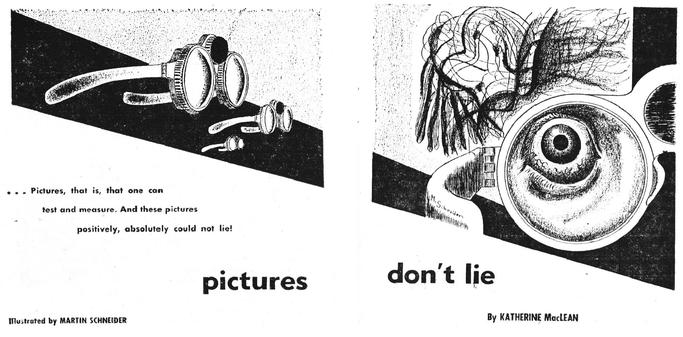
Innen-Illustration von Martin Schneider für
"Pictures Don't Lie" von Katherine MacLean
aus Galaxy, August 1951
#sciencefiction #GalaxyMag #KatherineMacLean #MartinSchneider

Magazine Review: Galaxy Science Fiction, ed. H. L. Gold (October 1950) (Simak, Sturgeon, MacLean, Matheson, Leiber, Brown, Asimov)
Preliminary Note: I plan on reading all 116 issues of the influential, and iconic, SF magazine Galaxy under H. L. Gold’s editorship (October 1950-October 1961) in chronological order. How long this project will take or how seriously/systematically I will take it are complete unknowns. I am a reader of whim. I will choose whether to reread certain stories that I’ve previously covered. Serialized novels will only be reviewed after I complete the entire work and posted as separate reviews. Why Galaxy, you might ask?
First, I can’t escape the pull of 1950s science fiction focused on social commentary and soft science. Second, I am obsessed with 50s American politics during a time of affluence, the rise of TV and mass culture, and the looming terror of the Cold War. Third, there are a legion of well-known 50s authors I’ve yet to address in any substantial manner on the site who appeared behinds its illustrious covers. Fourth, H. L. Gold was interested in all different types of stories.
As SF Encyclopedia explains, Galaxy was an “immediate success” in part because “Astounding was at this time following John W Campbell Jr’s new-found obsession with Dianetics and was otherwise more oriented towards technology.” Gold’s interests, on the other hand, “were comparatively free-ranging: he was interested in psychology, sociology and satire and other humor, and the magazine reflected this.”
I hope you enjoy this series! Feel free to join.
Up Next: the November 1950 issue.
You can read the entire issue here.
Clifford D. Simak’s Time Quarry (variant title: Time and Again) (1950). Serialized over three issues. I will post an individual review after I complete the serialization.
Richard Matheson’s “Third From the Sun” (1950), 3.5/5 (Good): Previously reviewed a decade ago here. As I’ve enjoyed a lot of Matheson I’ve covered as of late, I decided to reread this one.
A brief distillation of dread, a “normal” American family (father, wife, children) and their neighbors plot radical action. Told with crisp lines of dialogue–“‘What time is it?’ she asked, ‘About five.’ ‘We’d better get ready.’ ‘Yes, we’d better.’ They made no move” (61)–Matheson embodies the existential anguish of looming annihilation. While the exact nature isn’t spelled out, it’s not hard to infer the following passage is a reference to nuclear war: “In a few years […] the whole planet would go up with a blinding flash. This was the only way out. Escaping, starting all over again” (62). As the family gets ready and interacts with their co-conspirators on the day of action, Matheson conveys the strangeness of it all by making everyday behaviors points of epistemological immensity. For example, as the family leaves their house and pauses on the porch for the final time, the husband asks “should we lock the door?” (64). She can only respond by smiling “helplessly” and running her hand through her hair, “Does it matter”?” (64).
Unfortunately, the twist is spelled out in the title. But unlike other twist stories, Matheson creates real import with the suggestions that this has all happened before. Despite its tantalizing allure and well-crafted moments, I’d still rank this among Matheson’s middling works. It’s no “Pattern for Survival” (1955) or “Dance of the Dead” (1955).
It’s the second best short fiction in the magazine. Recommended. But then again, I’m a complete sucker for nuclear dread short stories!
Theodore Sturgeon’s “The Stars Are the Styx” (1950), 4/5 (Good): A preliminary thought: was Frederik Pohl thinking of this story when he wrote Gateway (1975)? Pohl was a religious reader of SF and took over Galaxy after Gold’s tenure.
The premise: Humans created Curbstone, an artificial satellite around Earth, to facilitate the ultimate scientific achievement–near instantaneous transportation across the galaxy. How? Individual spaceships, with a solitary crew person or couple, will be hurled out from Curbstone at various points across the space time continuum. They will “appear” in 6000 years and connect to each other (and back to Earth) via a web of “force-beams in the form of a tremendous sphere” by which, like “the synaptic paths of a giant brain, “matter will be transmitted instantly” (74). There’s a catch. Only 54% of the crews will survive the voyage. Some will “appear” in conjunction with other pieces of matter and explode, others will be unable to connect force-beams, some crewmen might go insane before the process completes, etc.
The story revolves around the aging (and rotund) Senior Release Officer on Curbstone, who certifies, counsels, and guides the strange collection of humans who gather at the station willing to take such a risk. Like Charon guiding the boat across the River Styx taking the dead to the “Other Side” (72), he passes humans along the voyage–unable to take it himself. He’s caught in-between both worlds. Unable to return home. Unable to climb into the spacecraft and make the dash for greatness across the universe. He wants to make connections with those on the stations. But he knows that he might be sending them to their deaths. He watches young love, unable to participate, yearning for a touch. The story transpires within the interior thoughts of everyone involved: those taking the steps towards certification, others trying to make a final decision to head off or return to earth, or those who would make the decision if they found someone to make it with them. You could easily imagine this story shorn of its 50s descriptors and redrafted for the New Wave.
Often stories that touch on the longue durée suggest that a moment of far future technological triumph, think a generation ship story in which arrival is hundreds of years away, will trap society in stasis. Sturgeon follows this pattern: “And all Earth is in a state of arrested development because of Curbstone. Everything is held in check” (85). I don’t buy it. 6000 years is an inconceivable length of time! I imagine that humans will more likely ignore something that seems too distant to be relevant (I mean, we’re experiencing Global Warming now but….). Rather than a “realistic” imagining of future tech, “The Stars Are the Styx” operates best as a rumination on the drive to escape, to achieve, to control, to transcend death, and the struggling souls navigating those contingencies. And here Sturgeon triumphs.
This would be a masterpiece if Sturgeon tightened it up a bit. Recommended.
Fritz Leiber’s “Later Than You Think” (1950), 3/5 (Average): The Explorer, returning from a voyage to space, rushes to discuss a recent discovery on Earth with the Archeologist. But this is a very different Earth. Everything gleams with “radiation from some luminous material impregnating the walls and floors” (108). The Archaeologist discovered a time-capsule of artifacts from an earlier civilization that possibly destroyed itself with “atomic energy, out of control” (111). At the revelation, the Explorer’s excitement turns to anguish. He wanted to learn about a species that succeeded! One that successfully survived and strived and aspired and wasn’t prone to the misuse of technology that “outstripped their psychology” (112). Instead, both the present and the past seem obsessed with the idea that “others, greater than themselves, had prospered before them and then died, leaving them to rebuilt a civilization from ruins” (112). The past seems too similar to the present.
Like the Matheson and Asimov in the same issue, Leiber attempts to speculate on the “metaphoric aftershocks” of Hiroshima and Nagasaki on the global mind. The twist, silly perhaps, is designed to make us think about the impact of the Cold War decisions–that could be apocalyptic–we might make. But Leiber seems to suggest there’s a destructive heart beating within all highly sentient beings that we cannot escape. Devolution will occur. We will make a fatal error.
Minor Leiber. It’s not bad. It’s not good.
Katherine MacLean’s “Contagion” (1950), 3.5/5 (Good): I’ve read three of MacLean’s fictions– Missing Man (1975), “Echo” (1970), and “Interbalance” (1960)–and enjoyed elements of each. A bunch of her short stories–either ghost-written for her husband or under her own name–appeared in Galaxy under Gold’s stewardship. I look forward to this project as an excuse to finally read them!
“Contagion” (1950) is a contact with an alien planet tale that’s legitimately odd. A hunting party looking for specimens of alien life in order to dissect, sets off from the spaceship Explorer across an alien planet called Minos. Reasonably, the crew is obsessed with a minute medical analysis of flora and fauna. There’s good reason: “the cool wind might be death, for if the animals were like Earth animals, their diseases might be like Earth diseases, alike enough to be contagious, different enough to be impossible to treat” (116). The galaxy seems strewn with vanished colonies and the “corpses of ships” which had “touched on some plague planet” (116).
Unlike other contact stories, the MacLean focuses in extra-ordinary detail on the nature of the medical contraptions, medications and medication dispensaries, and decontamination systems that seem to fill-up all available space within the Explorer. The hunting party encounters a majestically shaped human who spins a crazy tale of adaptation and disease. He’s put through the gamut of medical analysis and invited to visit with the crew. The women, in particular, are obsessed with his physique and pioneer spirit. But there’s a catch, obviously.
If you’re writing about the male gaze re-imagined and critiqued by female authors, put this one on your list. If you’re interested in medical SF, put this one on your list. It’s almost surreal in the strange crisis that transfix the psyche and body–male and female–as the nature of the titular contagion becomes apparent.
Fredric Brown’s “The Last Martian” (1950), 2.75/5 (Below Average): Brown ranks among the authors I mentioned above that I have yet to address in a substantial manner. I’ve only read and reviewed The Light in the Sky Are Stars (1953), a slick 1950s vision of the fanatical men and women who take America by the scruff of the neck and yank it, without letting the law get in the way, towards space and the deep beyond.
A newspaperman learns about a potential story: There’s a guy down in a nearby bar “who claims to be from Mars” (145). He heads over to investigate! Maybe he’ll need to call the police. Over the course of far too many beers, the man reveals incredibly specific details about life on Mars and a catastrophe that ravished society. He simultaneously remembers the life of the man whose body he supposedly inhabits. Is he insane? Did he catch some fragment of Martian intelligence? There’s a twist of course.
“The Last Martian” is polished but doesn’t register as more than minor and forgettable magazine filler.
Isaac Asimov’s “Darwinian Pool Room” (1950), 2/5 (Bad): Mercifully the shortest story in the magazine, Asimov’s “Darwinian Pool Room” imagines a group of academics in Dr. Trotter’s laboratory ruminating on the nature of evolution. The state of a pool table after a game finishes–balls in pockets–and the challenges recreating the game from its ending state serves as the dominate metaphor around which the discusses revolves.
Asimov seems to want to say something about rapid evolutionary transformation/extinction as connected human discoveries in hydrogen weapons and computing. Instead, I couldn’t help but imagine the story as a clichéd manifestation of bored, mostly drunk, graduate students babbling about a vast range of topics all dolled up with pseudo-intellectual mumbo jumbo. I would know, I remember those conversations with a combination of cringe, intellectual jealousy, and growing nostalgia (how I want to be a graduate student early in my degree again!). Regardless, it fits Gold’s remit to focus on idea-heavy stories that don’t always defer to action.
For book reviews consult the INDEX
For cover art posts consult the INDEX
For TV and film reviews consult the INDEX
#1950s #avantGarde #bookReviews #books #CliffordDSimak #fantasy #fiction #fritzLeiber #IsaacAsimov #KatherineMacLean #sciFi #scienceFiction #TheodoreSturgeon #writing
Adventures in an Alternate New York City: Missing Man by Katherine MacLean
A dastardly plot unfolds in the future of 1999!
The post Adventures in an Alternate New York City: <i>Missing Man</i> by Katherine MacLean appeared first on Reactor.
https://reactormag.com/adventures-in-an-alternate-new-york-city-missing-man-by-katherine-maclean/
#Blog #classicsciencefiction #FrontLinesandFrontiers #KatherineMacLean #MissingMan #ScienceFiction
@indieauthors
Adventures in an Alternate New York City: Missing Man by Katherine MacLean
A dastardly plot unfolds in the future of 1999!
The post Adventures in an Alternate New York City: <i>Missing Man</i> by Katherine MacLean appeared first on Reactor.
https://reactormag.com/adventures-in-an-alternate-new-york-city-missing-man-by-katherine-maclean/
#Blog #classicsciencefiction #FrontLinesandFrontiers #KatherineMacLean #MissingMan #ScienceFiction
@indieauthors
What pre-1985 science fiction are you reading? + Update No. XIX
What pre-1985 science fiction are you reading or planning to read this month? Here’s the December installment of this column.
Lost texts, and the act of reconstructing the fragments, fascinates. The questions pile up. Would the contents reveal a pattern in an author’s work? Intriguing personal details? A startling modus operandi? At the 11th World Science Fiction Convention (Philcon 2), Philadelphia (September 1953), Philip José Farmer gave a speech titled “SF and the Kinsey Report.” Considering Farmer’s recent publication of “The Lovers” (1952), this is not surprising. Alfred Kinsey, the famous sexologist and founder of the Kinsey Institute for Research in Sex, Gender, and Reproduction on Indiana University’s campus, published his controversial Sexual Behavior in the Human Male in 1948. Sexual Behavior in the Human Female appeared in 1953. Like many of Farmer’s earliest speeches, he did not keep copies.
Deeply intrigued by what the speech might have contained, Sanstone and I (on Bluesky) managed to piece together a few general responses from fanzines and magazine con reports.
1) In the December 1953 issue of the fanzine Nite Cry, Earl Kemp wrote: “Then it came. Sex reared it’s [sic] wonderfully compatible head. SF AND THE KINSEY REPORT, a very interesting report on the works of the good Dr.’s Kinsey, Pomeroy, etc. delivered by Phillip Farmer [sic]. Very well handled tark, regardless of the absence of SF, by a very sincere individual. He was somewhat embarrassed, at the conclusion of his talk, as were most of the delegates, when some fan, after securing the floor mike, praised the speech a little too highly for comfort.”
2) In the November 1953 issue of the UK magazine Authentic Science Fiction, the editor H. J. Campbell briefly states: “among other first-rate and informative speakers was Philip Jose Farmer on ‘SF and the Kinsey Report,’ a serious and thoughtful study which was well appreciated by the audience.”
3) Robert A. Madle’s report in the March 1954 issue of Future Science Fiction wrote: “[Farmer’s] talk, ]SF and the Kinsey Report,] was quite unusual — to say the least! Farmer, in addition to indicating that he was one of Kinsey’s’ statistics, delved into a subject which isn’t the ordinary Sunday morning, pre-breakfast fare.” I’d love to know what Farmer meant by “he was one of Kinsey’s statistics.”
4) Milt Rothman’s Philcon II Reminiscence recalls: “Among scheduled talks were “The Future of Love,” by Irvin Heyne, and “SF and the Kinsey Report,” by Philip José Farmer, author of “The Lovers.” At that time heterosexuality was just coming out of the closet.” No other details are provided.
5) Dave Kyle’s article in Mimosa on Sex in Fandom describes the speech, along with many other tangents, as follows: “Maybe sf fans invented the 1960s in the 1950s. (Although I must say that, whatever the excesses, the only drug prevalent to a minor extent was alcohol.) By 1953, women were now a fixture in the sf firmament. Bea, Katherine MacLean, and the two Evelyns had a panel at Philcon II and there were talks on “The Future of Love” by Irvin Heyne and “SF and the Kinsey Report” by Philip José Farmer. Phil Farmer really broke the sex barrier in sf, and Kate MacLean was an unabashed advocate of “free love” and took explicit photos with Charlie Dye.”
If you know of more references, let me know if the comments.
And let me know what pre-1985 science fiction you’ve been reading!
The Photograph (with links to reviews and brief thoughts)
What am I writing about?
On January 1st, I posted a review of Future Power, ed. Jack Dann and Darner Dozois (1976) — it contained many of my best 20 short stories read in 2024. If you missed it, definitely check out my Best Reads of 2024 post. I also posted reviews of Philip K. Dick’s “Explorers We” (1959) and James Tiptree, Jr.’s “Painwise” (1972) recently for my series on subversive takes on “space agencies, astronauts, and the culture which produced them.”
As for future projects, I find I’m more likely to complete them if I keep the specifics under wraps. As always, I have grand plans and limited time due to my exhausting profession.
What am I reading?
As Barry N. Malzberg recently passed away, I thought I read a few of his novels that I’ve missed. I reviewed Malzberg last in 2021. Hopefully, more novel reviewed will be posted in 2025 than previous, often sparse, novel-reading years.
I also plan on reading De Witt Douglas Kilgore’s monograph above.
A Curated List of SF Birthdays from the Last Two Weeks
January 11th: Jerome Bixby (1923-1998)
January 11th: Terry Goodkind (1948-2020). As a teenager, I was obsessed with bloated fantasy sequences (Robert Jordan, Tad Williams, Stephen Donaldson, etc.). I thought Goodkind would be the perfect addition to my addiction. I tried at least three times to tackle Wizard’s First Rule (1994), the first book in the Sword of Truth Universe, but never got more than a 100 pages in.
January 12th: Jack London (1876-1916). I must confess, I’m utterly ignorant of his SF works like The Iron Heel (1907). My father read The Call of the Wild (1903) to me as a kid.
January 13th: Jody Scott (1923-2007). I should feature her in my first three published stories by female SF authors I should know about. Her noel Passing for Human (1977) judges me from the shelf.
January 13th: Ron Goulart (1933-2022). I have not been impressed with his brand of satire. See my review of After Things Fell Apart (1970).
January 14th: Kenneth Bulmer (1921-2005).
January 14th: Joseph Green (1931-). He must rank amongst the oldest SF authors still alive… I have not read any of his work.
January 15th: Robert Silverberg (1935-). An absolute favorite of mine! I’ve reviewed 46 of his short stories and twelve of his novels. I’ve also read but never reviewed A Time of Changes (1971), the stories in Capricorn Games (1976), and Tower of Glass (1970). The Man in the Maze (1969) and The Second Trip (serialized: 1971) might be his most underrated novels.
January 16th: Christine Brooke-Rose (1923-2012) is an author of experimental SF-adjacent works (and a YA SF volume or two). I acquired one of the latter Xorandor (1986), a few months ago. I’d love a copy of her early novel Out (1964)–SF Encyclopedia’s description: a SF novel “set after World War Three in a Post-Holocaust Afro-Eurasia where the colour barrier has been reversed, ostensibly for medical reasons, as only the ‘Colourless’ seem to be fatally afflicted by a form of radiation poisoning.”
January 17th: Paul O. Williams (1935-2009).
January 18th: Arno Schmidt (1914-1979). I tried to read The Egghead Republic: A Short Novel from the Horse Latitudes (1957, trans. 1979) at one point.
January 18th: Artist Eddie Jones (1935-1999). A British artist who contributed an immense number of covers for German SF presses.
January 18th: Clare Winger Harris (1891-1968). I acquired her collection (published after she had stopped writing), Away from Here and Now (1947), a while back. To the best of my knowledge it’s the first collection by a female SF author who appeared in genre magazines ever published.
January 19th: Margot Bennett (1912-1980). I finished Bennett’s The Long Way Back (1954) recently. Stay tuned for my thoughts.
January 19th: George MacBeth (1932-1992).
January 19th: Artist Victor Kalin (1919-1991).
January 20th: Author Nancy Kress (1948-). Another one of my favorites! “Talp Hunt” (1982) is a killer of a short story. I also reviewed her first three published short stories–“The Earth Dwellers” (1976), “A Delicate Shape of Kipney” (1978), and “And Whether Pigs Have Wings” (1979).
January 21st: Peter Phillips (1920-2012). I’ve promised myself I’d get to his fiction for years. I’m looking at you “Dreams Are Sacred” (1948)!
January 21st: Judith Merril (1923-1997). My most recent Merril review: Survival Ship and Other Stories (1974).
January 21st: Gina Berriault (1926-1999). Author of one intriguing SF novel of fallout shelters and paranoia–The Descent (1960).
January 21st: Charles Eric Maine (1921-1981).
January 22nd: Robert E. Howard (1906-1936).
January 22nd: Katherine MacLean (1925-2019). As mentioned above, her Nebula-nominated novel Missing Missing Man (1975) is one of the great unknown SF noels.
January 22nd: Artist Ray Feibush (1948-1998).
January 23rd: Helen M. Urban (1915-2003). Another author I should feature in my series on the first three published short stories by female authors I want to learn more about.
January 23rd: Walter M. Miller, Jr. (1923-1996). A favorite of mine! If you’re new to his non-A Canticle for Leibowitz stories, check out “Death of a Spaceman” (variant title: “Memento Homo”) (1954).
January 23rd: Artists Tim Hildebrandt (1939-2006) and Greg Hildebrandt (1939-2024).
January 24th: C. L. Moore (1911-1987). I recently enjoyed her collection of co-written stories (with her husband Henry Kuttner) Clash by Night and Other Stories (1980).
January 24th: Gary K. Wolf (1941-). Killerbowl (1979) is almost a 70s SF classic.
January 24th: David Gerrold (1944-). I thoroughly enjoyed Moonstar Odyssey (1977).
January 24th: Artist Douglas Chaffee (1936-2011).
January 24th: René Barjavel (1911-1985).
January 25th: Pauline Ashwell (1926-2015). Best known for her early short story Hugo-nominated “Unwillingly to School” (1958). I’ve reviewed Nebula-nominated “The Wings of a Bat” (1966).
For book reviews consult the INDEX
For cover art posts consult the INDEX
For TV and film reviews consult the INDEX
#1950s #1960s #1970s #39 #bookReview #bookReviews #books #fiction #JamesWhite #JohnShirley #KatherineMacLean #paperbacks #PhilipJoséFarmer #philipKDick #RobertSilverberg #RogerZelazny #sciFi #scienceFiction
 Science Fiction and Other Suspect Ruminations
 IndieAuthors.Social News
