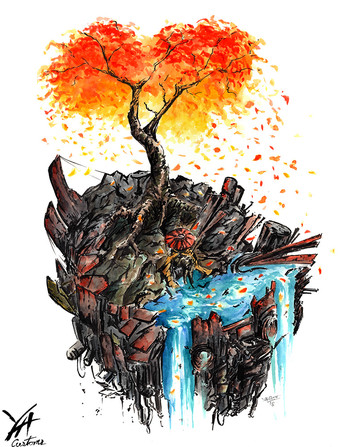
Have you heard of the Great Pacific Garbage Patch? Well, welcome to the Great Galactic Garbage Patch, also known as Salva.

Space is a big place, and a big place contains a lot of trash. A lot of this is in interstellar space: ejected waste, lost cargo, abandoned spacecraft, the losers of battles, spent fuel stages, and all manner of wayward junk.

Due to a quirk of galactic gravitational fields, a large swath of the galaxy has it's interstellar objects funneled into a singular location: a humble, nameless system, devoid of habitable planets and far remote from the nearest civilization. It's here that all this garbage began to accrete, swirling up into a sphere of a size somewhere between Mercury and Mars.

Salva is a planet shaped like a pile of garbage. Flat plains are scarce, with most of the surface being trash heaps and rough terrain with chasms that can run for miles below the surface. The planet's innards are much the same: space debris, crushed down by gravity into a semisolid metamorphic slurry, surrounding a core of solid metal.

The first inhabitants of Salva were refugees, crewmembers of ships left adrift by engine failure or loss of power. These ships were drawn to Salva and became part of the planet, serving as sites for the first cities.

Future generations of Salvans would operate much in the same way that their ancestors did: scouring the wastes for useful materials that could be repurposed to help them stay alive. Salvan Creole is a heterogeneous mix of dozens of languages, with particular dialects spoken by the descendants of different crews.

Cities were built wherever flat (preferably level) surfaces could be found: atop the hulls of freighters, or on areas artificially cleared of junk. The largest cities have populations sometimes reaching into the low five-digit range, although rural settlements generally consisted of only a few families.

The hallmark of a major city is its smooth, clean, shiny ground surface, full of ramps and elevators to emphasize their flat planes. The condition of your floor is a major signifier of status on Salva. While most material wealth is available in abundance for anyone with the will to retrieve it, a well-polished floor is available only to those with the manpower to maintain it.

For this reason, the larger Salvan cities contain disproportionately high volumes of people with mobility-related disabilities. A standard Earth wheelchair would work just fine (possibly even better, due to the abundance of ramps) in Salvan cities. In smaller towns or villages, however, the ground is rougher and more treacherous. In such cases, wheelchairs might be modified to use treads or hover technology, while in the roughest of cases, only walking exo-suits would suffice. For these reasons, a significant amount of rural disabled people flock to cities, establishing support networks and helping others make the trek.

Deep in the wastes, far from the cities and towns, a galaxy's worth of discarded technology, chemicals, biological samples, organic matter, and other nasty substances mix and foment together for years. Out of such sludge rises Salva's "wildlife"; a mess of techno-organic monsters struggling in their own way to find food or fuel. Such creatures span the full spectrum from "chemically enhanced animal" to "literally just a robot" and every weird combination in between. Sightings of such monsters near settlements is rare, but some think these creatures are more than they seem.
#worldbuilding #writing #scifi #Junkpunk #solarpunk

#junkpunk friends! Collect all your #textile scraps and embroider them into model virusus! Muahahahah!

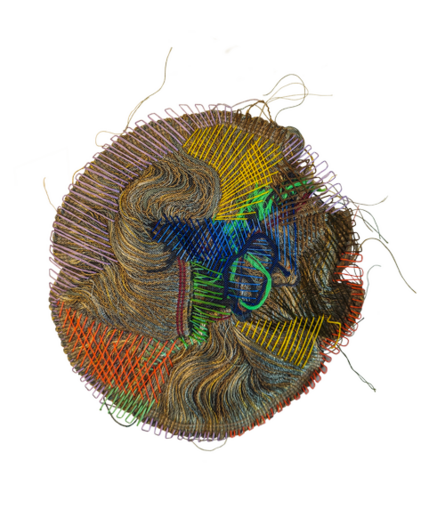
I been working on this project, Variant Phylogeny, all year. I hope to one day infect all of you with it.

#embroidery #covid #art

@havoc I love the term #Junkpunk!

God I fucking love #Junkpunk. I love the idea of taking trash and making something worthwhile out of it. In the end everything is made of parts, so if you have enough parts you can make anything.

I want to run an establishment that's halfway between a recycling center and a tool library. Bring in your old broken junk and I'll take it apart. Bring in something broken but fixable and I'll go find a replacement part in the library.

There's a feeling of #Junkpunk satisfaction in maintaining a #feedstock storage, even if it's not as sophisticated as I want it to be. Anytime I acquire new raw materials (litter I've picked up, broken stuff, unwanted things people give me), it immediately gets disassembled and sorted into cubbies and drawers. I've got all sorts of screws, wires, springs, pen/pencil parts, gears, both kinds of buttons, and a million other categories. It's gotten to the point where if someone needs a to repair something, they know I probably have the parts. And that's an incredibly good feeling.
If you can spare the space (my very large collection occupies as much as a small fridge) then I *absolutely* recommend starting a feedstock collection. Consider your consumption patterns. What sorts of things could you repair if only you had the spare parts? The fewer broken items we throw away, the more parts we have. The more parts we have, the fewer broken items we have.
#Solarpunk #recycle #sustainability
@geography Definitely. For your first response I definitely agree, finding methods of recycling that DON'T lower quality (recycling vs downcycling) is going to be so important.
And not to worry, #junkpunk advocates for the halting of current production methods in favor of just using the crap we've already made under such an overproductive system.
@havoc @hydroponictrash that said, I’m all for #JunkPunk and reusing existing waste, as long as it’s not used as a justification for keeping things as they are in terms of production and consumption
Thinking about circular economies and @hydroponictrash 's recent writing on modular repair and construction systems.
It'll be interesting to create a "reverse-LEGO" System, where System parts can be used to repair non-System products. Eventually, Ship-of-Theseus style, products would end up becoming entirely made of System parts as their old ones break and are replaced. To this end, you have to make sure the System is interoperable both with itself and with pre-existing products.
Further, it would be best if the System were not only easy to manufacture, but easy to acquire resources for. This is a big part of the #Junkpunk aesthetic, going out of your way to reuse pre-existing material. In the context of our System, this might involve anything from collecting screws of standard System size off non-System products, or searching for plastics to turn into stock for 3D printing. 3D printable printers and recyclable stock would be a HUGE jump towards making this a reality. #solarpunk

Daydreaming about a subset of #solarpunk that I call #Junkpunk. It's about repurposing and reusing the crap we already have in order to build our better future.

I like to imagine a future society where we feed on the remains of capitalist overproduction like ants on a picnic. Retrofitting military tanks into all terrain recovery vehicles, sending out scouting parties to look for caches of junk, bringing it back to the settlement for dismantling and upcycling.