#bibliocon26 "KI ist die Plage unserer Zeit" Gerrit Gragert
@EzellaGarnie @stabi_berlin Er meine nicht die kleinen Helferlein. Während seines Vortrags greifen geschätzt 5000 Bots auf die Stabi-Daten zu und stören die Nutzung der Berechtigten.
"Es braucht einen neuen Dataspace"
#Datenraum #Datensouveränitaet #data #opendata #openaccess #wissenschaft #science #research #forschung #infrastructure #informationinfrastructure #DataSpaces #GaiaX @ChrisMayLA6
Resonates: “the software is over-sold & not nearly as useful or reliable as presented” - as always with this general type of ‘service’ (seen it all before in different circumstances); good to see some pushback. Health-related data is complex, complicated, nuanced; requires sophisticated expert tools and actual experts to derive meaningful results… all things that US companies are not known for & some might say have zero to little experience with… and for sure not in a good way.
#oversoldSoftware #NHS #Palantir #InformationInfrastructure #dataMining #pushback #healthData #privacy
Today, our colleage Moritz Schubotz from @zbMATH was giving a presentation on "Decentralized Information Infrastructure for Mathematics and Beyond" at KIT computer science faculty.
@fiz_karlsruhe @KIT_Karlsruhe @KITInformatik #mathematics #maths #informationinfrastructure #AI @schubotz
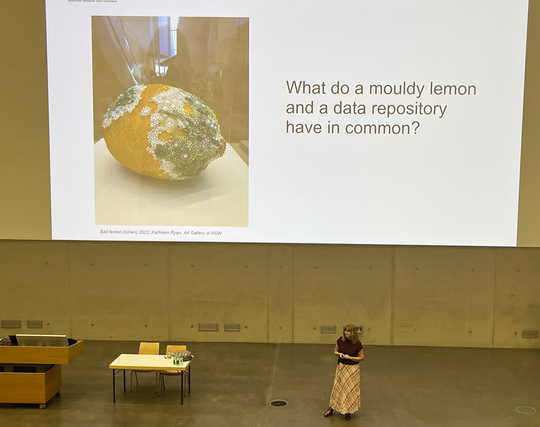
In her #CORDI2025 keynote, Rosie Hicks from the Australian Research Data Commons is introducing The Future of Digital Research Infrastructure in Australia, starting with an icebreaker question: What do a mouldy lemon and a data repository have in common...?
https://ardc.edu.au/
#australia #researchdatacommons #Aachen #informationinfrastructure
📄 New Manuscript published at ing.grid!
"How to Make Bespoke Experiments FAIR: Modular Dynamic Semantic Digital Twin and Open Source Information Infrastructure", by Manuel Rexer, Nils Preuß, Sebastian Neumeier, and Peter F. Pelz.
🔗 Read the full article: https://www.inggrid.org/article/id/4246/
#FAIR #linkeddata #modulartestenvironment #informationmodel #experimentaldata #informationinfrastructure

How to Make Bespoke Experiments FAIR: Modular Dynamic Semantic Digital Twin and Open Source Information Infrastructure
In this study, we apply the FAIR principles to enhance data management within a modular test environment. By focusing on experimental data collected with various measuring equipment, we develop and implement tailored information models of physical objectes used in the experiments. These models are based on the Resource Description Framework (RDF) and ontologies. Our objectives are to improve data searchability and usability, ensure data traceability, and facilitate comparisons across studies. The practical application of these models results in semantically enriched, detailed digital representations of physical objects, demonstrating significant advancements in data processing efficiency and metadata management reliability. By integrating persistent identifiers to link real-world and digital descriptions, along with standardized vocabularies, we address challenges related to data interoperability and reusability in scientific research. This paper highlights the benefits of adopting FAIR principles and RDF for linked data proposing potential expansions for broader experimental applications. Our approach aims to accelerate innovation and enhance the scientific community’s ability to manage complex datasets effectively.
English version available now:
https://zukunft-der-sub.de/for-a-library-with-a-futureMore than 550 signatures so far are a strong signal for the connection of
#research and
#infrastructure, the
#informationinfrastructure in Germany and beyond. Thanks to all supporters!
For a library with a future
Vera Münch on Twitter
“#bfscon18 #BFSCon Podium @konradfoerstner "Infrastructure needs cool tools. We have to make infrastructure more sexy again" #publishing #wisskom #scicom #Informationinfrastructure”
 Vera Münch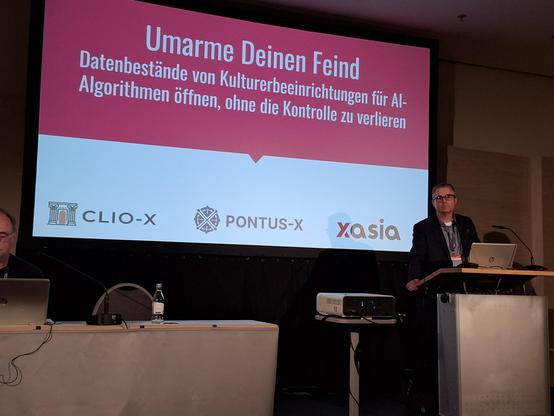
 Su_G
Su_G Harald Sack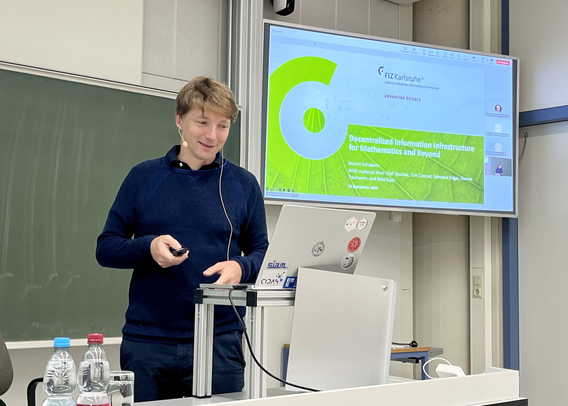
 ing.grid
 Andrea Rapp
 Gerrit Gragert