 Zeitgeisty Aphorisms
#Rosetta #Giotto #lander #Hipparcos is the shortest path from #exoplanets #astrobiology #Huygens #Cassini to 45.
A bit of #BepiColombo #Titan #asteroids #lunar leads away from #Rosetta #Giotto #lander #Hipparcos but a lot brings it closer.
 Dwight Williams (💉 x9)+😷🇨🇦
#StarTrek #StellarCartography question: when #StarCharts was first designed, was #Sheratan chosen as the host star of #Hanolan?
They seem close on the X-Y plane, and yet I suspect that I'm seeing another artifact of the designers working with #Hipparcos data...?
@jswhitten @galaxy_map @larrynemecek @thomasthecat Beginning to suspect that Cuellar = 23 Ursae Majoris, or that it was, based on the #Hipparcos database, before #GaiaDR3 came out. #starcharts #Stellarcartography
 Mikko Tuomi
An international team of astronomers using the #JWST have directly imaged an #exoplanet roughly 12 light-years from Earth.
This planet, Epsilon Indi Ab, is the nearest #Jupiter analog to the Sun, a giant gaseous #planet orbiting the star on a long-period orbit.
I especially like this result because my group discovered the planet in 2018 based on radial velocities and #Hipparcos and #Gaia proper motions.
#astronomy #exoplanets
https://www.esa.int/Science_Exploration/Space_Science/Webb/Webb_images_new_cold_exoplanet_12_light-years_away
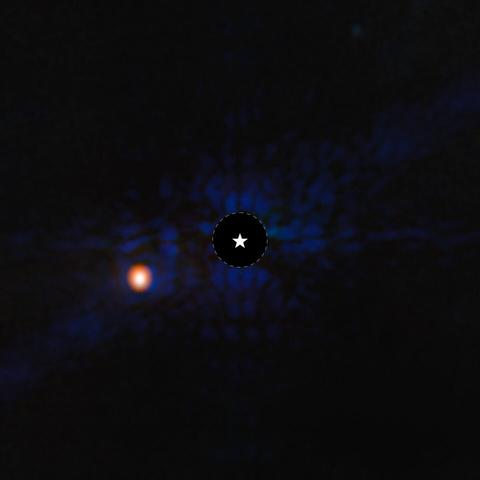

Webb images new, cold exoplanet 12 light-years away
An international team of astronomers using the NASA/ESA/CSA James Webb Space Telescope have directly imaged an exoplanet roughly 12 light-years from Earth. While there were hints that the planet existed, it had not been confirmed until Webb imaged it. The planet is one of the coldest exoplanets observed to date.
 Ronald Drimmel
It seems a fragment of the original star catalogue of #Hipparcos may have been discovered. Would be a great discovery, marking a milestone of the beginning of quantitative #Astronomy . Another #Palimpsest for the win!
https://greekreporter.com/2023/08/20/ancient-greek-map-sky-discover-monastery/

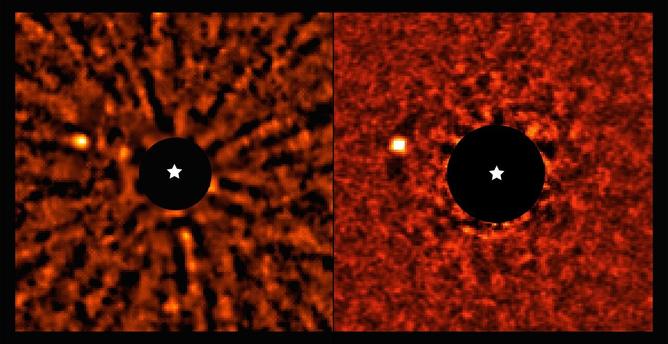
Two images of a #Jupiter-like #planet that orbits the star AF Leporis imaged with the #SPHERE instrument on #VLT in Chile.
Over the years, astronomers observed accelerating motion in the #star's movement in #Hipparcos and #Gaia observations
#Planets exert a gravitational tug on their host stars, explaining the acceleration, and as astronomers took a closer look at this star with the VLT, they managed to directly image the planet orbiting it.
#astronomy #exoplanets
https://www.eso.org/public/images/potw2308a/

Constraints for the orbital #inclination and the true mass of long-period single companions.
This work illustrates how #Gaia and #Hipparcos allow for the orbital properties and masses of long-period RV companions to be further constrained.
The first constraints for nearby long-period #planets from Gaia have started getting published.
#astronomy #exoplanets #radialvelocity #astrometry
https://arxiv.org/abs/2301.01263

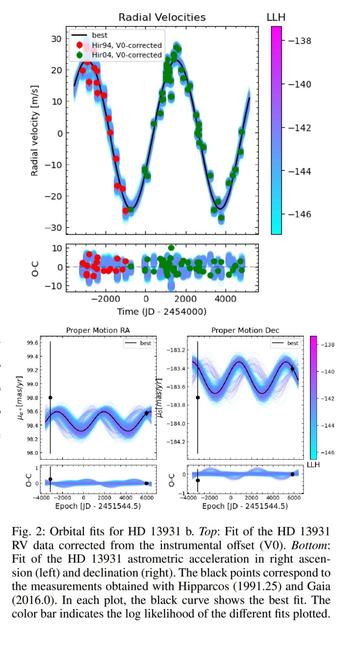
Updated characterization of long-period single companion by combining radial velocity, relative astrometry, and absolute astrometry
Context. Thanks to more than 20 years of monitoring, the radial velocity (RV) method has detected long-period companions (P > 10yr) around several dozens of stars. Yet, the true nature of these companions remains unclear because of the uncertainty as to the inclination of the companion orbital plane. Aims. We wish to constrain the orbital inclination and the true mass of long-period single companions. Methods. We used a Markov Chain Monte Carlo (MCMC) fitting algorithm to combine RV measurements with absolute astrometry and, when available, relative astrometry data. Results. We have lifted the sin(i) indetermination for 7 seven long-period companions. We find true masses in the planetary mass range for the candidate planets detected in the following systems: Epsilon Indi A, HD 13931, HD 115954, and HD 222155. The mass of HD 219077 b is close to the deuterium-burning limit and its nature is uncertain because of the imprecise mass of the host star. Using additional RV measurements, we refine the orbital parameters of HIP 70849 b and find a mass in the planetary range. By combining RV data with absolute and relative astrometry, we significantly improve the characterization of HD 211847 B and properly determine its mass, which appears to be in the low-mass star range. This work illustrates how Gaia and Hipparcos allow for the orbital properties and masses of long-period RV companions to be further constrained.
@cmdrDiscoCat They had everything up to #Hipparcos data to work with at that time. And now #GaiaMission is in the process of expanding further upon what we know of our Galaxy. The illustration I screencapped comes from a website created by @galaxy_map and he might be better able to address the coordinates aspect of things.
 Frédéric Véron
[#BotActu] « Les calendriers : calculs et unités de mesure » https://www.futura-sciences.com/sciences/dossiers/astronomie-calendriers-calculs-unites-mesure-11/#xtor%3DRSS-9 #calendriermésopotamien #calendrierbabylonien #genèsedescalendriers #calendrierégyptien #calendrierlunaire #calendriersolaire #calendrierhindou #calendrierromain #calendrierteuton #calendrierjuif #calendriergrec #détermination #annéetropique #Mésopotamie #Astronomie #Calendrier #Hipparcos #semaine #soleil #Saison #ÀlaUne
